
Decide Whether You Need a Letter or an Arrival
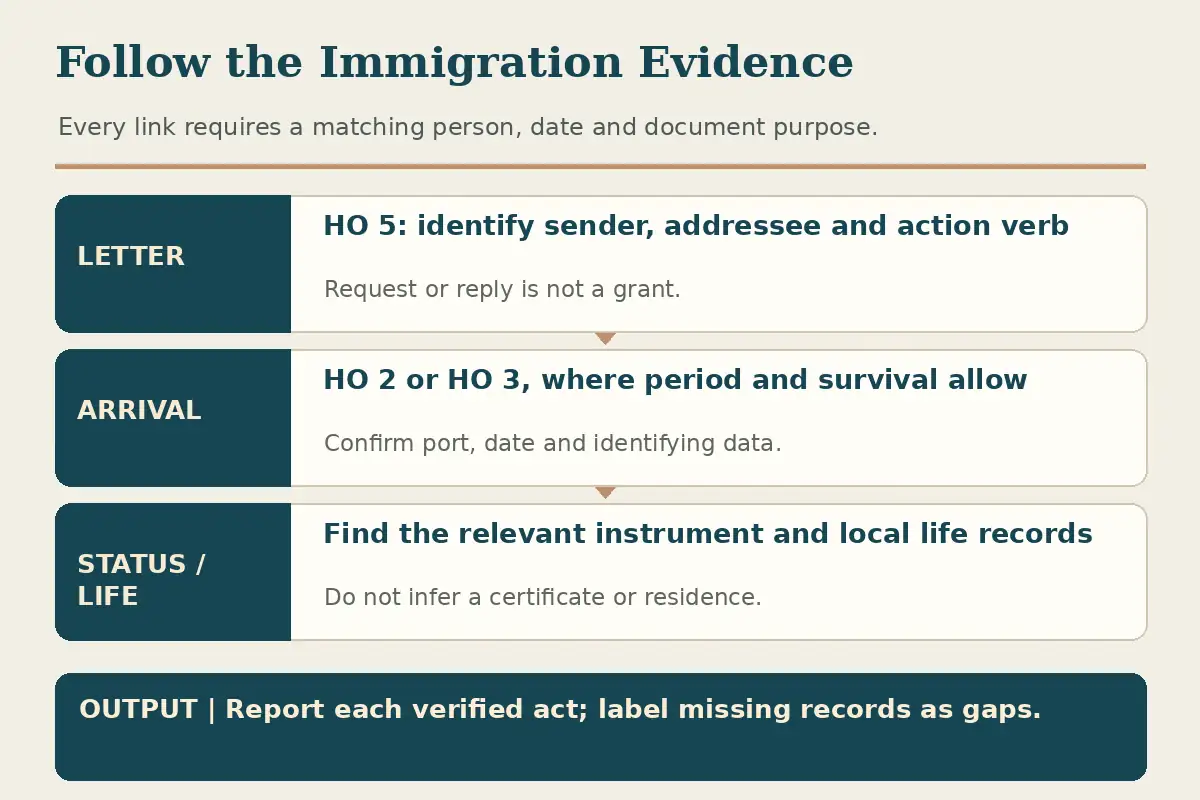
HO 5 is a series of aliens’ entry books associated with the Aliens Office and Home Office, covering 1794–1921. The books principally preserve outgoing official letters about aliens and naturalization; they are not an uninterrupted passenger list, and their presence does not by itself prove that a person entered Britain on a specific ship. Start by stating the question in one sentence: was the person arriving at a port, corresponding with officials, or receiving an actual change in legal status?
A government out-letter may be addressed to a constable, an applicant, an intermediary, or another official. Read the salutation and context to decide whose actions are actually recorded. A person’s name in a letter might identify a subject or an agent, not the traveler you intended to find. The National Archives HO 5 guide identifies digitized books available through Ancestry, a paid provider; online access depends on collection and subscription terms.
Historical administrative language such as “alien” denotes a legal category in its original context, not a label for present-day families. The meaning of British subjecthood and alienage changed with law and territory over time. Quote historical terminology where relevant, but do not assign modern nationality, ethnic identity, or immigration status from a single letter.
Use the Correct Date and Series Gate
The Archives’ immigration guide distinguishes HO 2 original certificates of alien arrival from HO 3 returns or papers and HO 5 out-letters. HO 3 shipmaster returns under the 1836 Act survive for July 1836–December 1869, with a gap from January 1861 through December 1866. Their content and survival are not interchangeable with the surviving HO 5 books.
HO 5/25–32 includes indexes to certificates of arrivals in HO 2. That makes it possible for an index to point toward a source that no longer survives for the relevant period. Record the exact index page and person named, but do not state that a certificate has been examined until you find it. The index can support a bounded claim about filing or indexing, even where the underlying paper is missing.
For a passenger arriving before the regular surviving material, the same official guide directs researchers to scattered sources, including FO 83/21–22 for 1810–1811 and CUST 102 accounts for selected London and Gravesend periods in the 1820s and 1830s. These are targeted alternatives, not proof of universal port coverage. If the date falls in a known gap, write down that gap rather than manufacturing a negative conclusion about immigration.

Identify the Correspondent and the Official Act
Transcribe the sender and recipient, date of the letter, reference if any, and the event it discusses. A message requesting information about naturalization is not the same as a certificate of naturalization; a letter reporting an application is not the grant. When the body says a request has been referred to another office, the only direct fact may be the referral. Assign a claim status such as REQUEST, ACTION, DECISION, or UNKNOWN.
A reliable name match needs more than a surname. Compare age or birth context when supplied, occupation, address, spouse, port, agent, and known dates, but mark each field “not stated” if the actual entry lacks it. An address for a constabulary office is not automatically the home of the person discussed. Administrative files may preserve several individuals with similar names and different legal situations.
For a genealogy worksheet, keep three columns separate: PERSON NAMED, OFFICIAL CORRESPONDENCE, and LEGAL RESULT. This prevents a chain of inferences from turning the name in a register into a claim of citizenship or a documented crossing. If you cannot find the decision instrument, say “correspondence about naturalization” rather than “naturalized.”

Test Port Arrival Against Independent Evidence
Where HO 5 discusses an arrival, compare it with the relevant HO 2 certificate or HO 3 return if one survives. Use the port, date, original name spelling, and last country visited rather than assuming that a surname search hit establishes the same person. Passenger lists in BT 26 concern different, later routes and dates, so they are not a direct substitute for an 1830s arrival certificate.
Not all immigration was documented or preserved. The National Archives explicitly warns that there is no comprehensive index to immigrants and that many individual records were destroyed. The absence of a match may mean a record was never created, is outside the collection’s scope, survives under another spelling, or was lost. Describe the precise search attempted before making any statement about likely arrival.
For an individual who remained in Britain, independent census entries, parish or non-parochial registers, naturalization instruments, and local records may establish residence or family relationships. None can simply be copied from a HO 5 name occurrence. A consistent pair of names across records is a lead; a proved connection requires dates, locations, and identifying details that do not conflict.
Document the Search and Explain Its Limits
Capture the HO 5 volume reference, page or folio, date, correspondent, quoted action verb, and image provider or archive access route. Label a third-party transcript as a transcription, and where possible consult the digitized original. Do not confuse digitized availability with all records in the series having been photographed or indexed at item level.
The finished output should be a traceable administrative timeline, not an invented immigration narrative. If the result is only an official letter and an index to a missing certificate, that is valuable evidence of a documented interaction. It does not prove a landing, ongoing residence, marriage, or legal status without a record that directly supports that particular claim.
More Records and Archives Guides
How We Research the Archival Evidence
Our method begins with the repository’s description of each series, its date limits and its known gaps. We compare record purpose with the question under investigation and distinguish direct statements in an original document from the cataloguer’s summary, a family tradition, and inference. The examples and record-class distinctions in this guide derive from the official sources listed below; they are guidance for finding and evaluating a document, not proof that any particular family member appears in it.
Official references checked on October 29, 2026: alien entry books. immigration. passengers. We recommend recording retrieval dates and consulting the original image or physical document when possible. See our affiliate disclosure for site-wide relationship information; no paid relationship is implied by these archive links.
No. Match the person across independently dated records using place, role, age when available, associates and documented relationships. A name hit is only a research lead.
A catalogue or printed calendar can locate a record and supply context, but summaries may omit wording and qualifications. Inspect the original before making a strong personal claim.
No. A series may have coverage limits, losses, poor indexing or alternative filing. Record the years, references and spellings actually searched before describing a gap.
Keep the complete archival series and piece, item or folio where available, document date, repository, image or physical access route and the exact claim supported.
Write a precise hypothesis and find an independent record of the relevant person, place or event. Keep unverified relationships and movements clearly labeled as unproven.