
HO 13 preserves Home Office correspondence and warrants from 1782–1871. Follow the order or decision, not just a prisoner petition or name-index hit. Start at the original repository’s guide and note its stated series coverage. See our affiliate disclosure before comparing paid record platforms.
Ask Whether You Need a Warrant or a Petition
A clemency application expresses a request; an entry documenting a Home Office decision has a different evidentiary role. The National Archives describes HO 13, Criminal Entry Books, as correspondence and warrants from 1782–1871. The books can record pardons, reprieves, remissions, instructions and movement between institutions. The person’s original trial may be found in court calendars or trial proceedings. A relative’s emotional appeal, by itself, does not show that the prison sentence was changed.
Write down the claimed outcome before searching: Was a death sentence stayed? Was a prison term reduced? Was a free pardon given, or did conditions continue to apply? Was the person transferred without any reduction of punishment? Search for the relevant name, approximate decision date and place of conviction. Enter HO 13 as the source of a possible order, not as a substitute for the court’s original verdict or for proof that a transport ship actually sailed.
Locate HO 13 by Time and the Type of Warrant
The criminal entry books are organized historically in bound volumes, and finding a relevant name can require attention to dates and the type of business recorded. Search Discovery for HO 13 and the approximate year; also consult indexed digital collections where a provider has transcribed names. Different searches may expose either a descriptive catalogue entry or images of a page. Retain the piece number, folio or page, date of the document and classification of the warrant rather than citing only the online collection name.
Read the heading and surrounding entries. A list may be grouped by kind of relief or addressed to a particular official; an isolated name can be misleading. Try alternative spellings, initials and the prisoner’s court or gaol. If the passage reports that a warrant was prepared or sent, quote that language accurately. Do not silently elevate a proposed order to the act being carried out. A visible index may omit spelling variants and will not guarantee that every surviving entry has been captured.
Read Pardons, Reprieves, Remissions and Transfers Differently
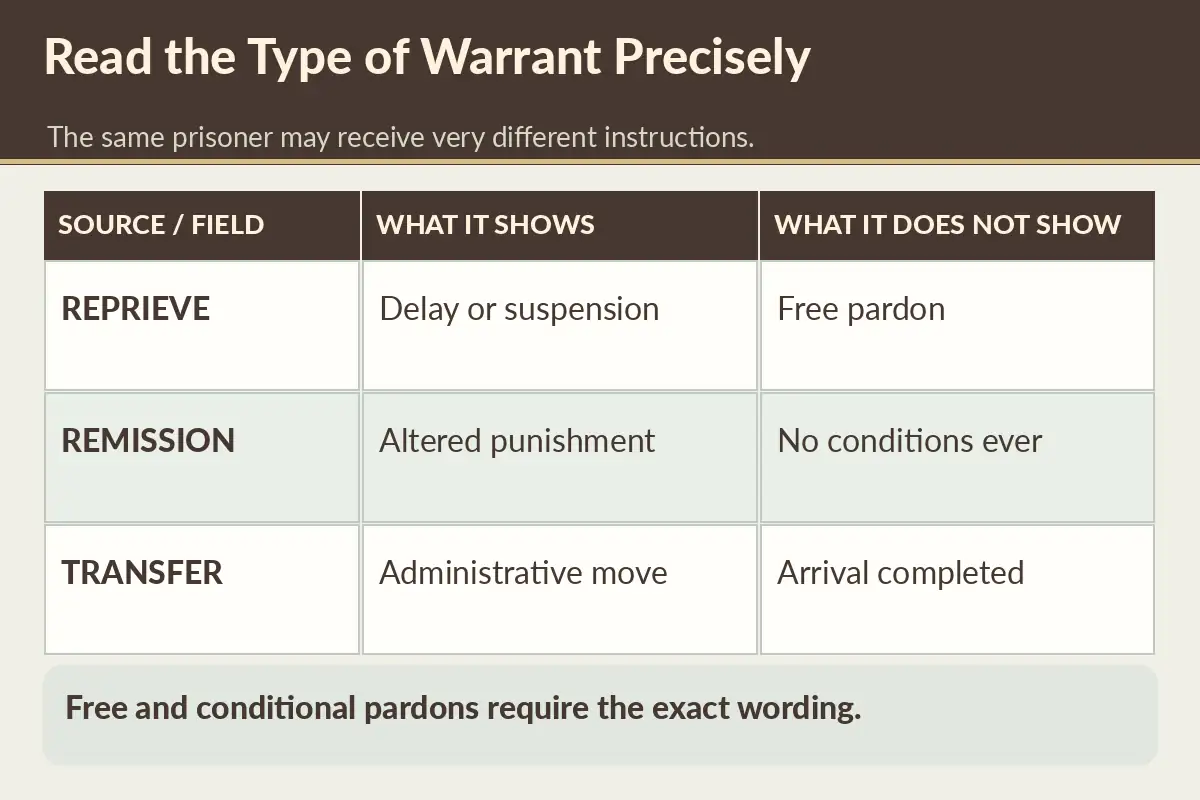
A reprieve is a delay or suspension, not necessarily a permanent pardon. A remission changes some part of punishment. A free pardon, conditional pardon and prison transfer have distinct administrative meanings. These labels are essential because a genealogy narrative that says a prisoner was “pardoned” can obscure the conditional terms or the fact that the prisoner remained in custody. HO 13 may help establish the order in the Home Office sequence, but the execution of its terms may need later records.
Create four columns: decision language as written, date, authority or addressee, and subsequent evidence required. For a conditional release, find the precise conditions before assuming unrestricted liberty. For a transfer to the army, navy or a different prison, verify a receiving institution or muster record. An order to transport a convict does not by itself establish arrival in a colony. Later events may be recorded in HO 11 transportation registers, prison records or receiving-colony documents, depending on the story.
Compare the Petition and the Judge’s Opinion Without Merging Them
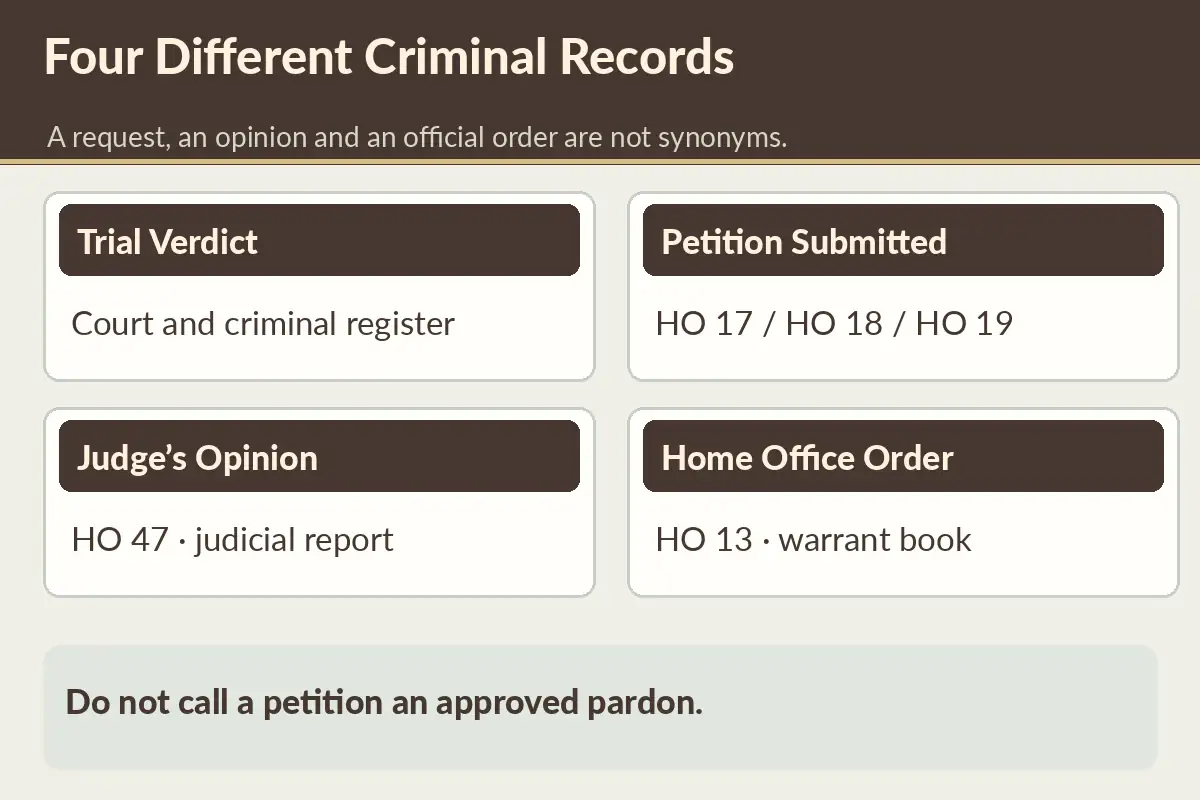
The Archives lists HO 17 and HO 18 as criminal clemency petitions, HO 19 as a receipt or register route and HO 47 as judges’ reports. A request can contain family circumstances and allegations supplied by relatives; a judge’s report can characterize the underlying conviction. HO 13 can instead record a Home Office instruction or warrant. These documents were written by different actors for different purposes and should not be treated as redundant copies of a single factual account.
Build a decision chain from the original sentence to petition, official review and the eventual warrant, but draw a branch wherever an expected document does not survive. A petition may be rejected, ignored or acted upon; the presence of a petition is not a positive outcome. Note changes of language between writers and whether a person is identified by the same court, offense, date and institution. A judge’s recollection of evidence is not itself the full trial transcript.
Use Transportation and Prison Records to Test Execution
Where HO 13 mentions transportation, check HO 11 by the convict ship and voyage: the National Archives says that transportation registers list people on particular ships along with conviction and sentence data. HO 10 provides separate lists for parts of Australia. But a transportation sentence did not guarantee actual departure; some convicts remained on hulks or in prisons. Never substitute the stated sentence for proof of embarkation, arrival or residence in a penal colony.
For a warrant to move a prisoner, seek an entry in a receiving gaol, hulk or institution. Record the date the original order was issued and the later independently documented event. If the two differ, retain that discrepancy. Be cautious with historical crime labels, especially when a family story concerns a living relative: reproduce the archival wording neutrally rather than amplifying unproved accusations. A contemporaneous criminal register may include individuals charged but not convicted, so identify the verdict separately.
Write a Narrow Conclusion When Records Are Missing
A successful HO 13 search may support the statement that a named prisoner was the subject of a dated Home Office warrant. Its precise legal effect depends on the text of the order, the named authority and any conditions. It cannot by itself supply the entire court file, details of confinement or conclusive evidence that a distant family descendant shares the prisoner’s identity. Distinguish namesakes with age, court, offense, gaol, relatives and repeated dates, not surname alone.
Use an outcome register with five lines: original verdict verified, request located, official opinion located, HO 13 order read and execution corroborated. Mark unexamined and missing material honestly. If no HO 13 result appears, search adjacent years or different administrative classifications and note which volumes you checked. Avoid declaring that an appeal failed merely because no index entry appears. The decisive contribution of this series is the government action stated in the record, not the completeness of any modern database.

How We Research This Archival Record Class
We first establish why an office created the record, the years and people actually covered, and its current custody and access status. A searchable catalogue description is not the original document, and a provider index may omit names or normalize dates. We record a positive finding exactly as written and distinguish it from inferences about identity, residence, family relationship or legal outcome. Every plausible namesake gets a separate comparison based on contemporary identifiers. Negative searches include what series, piece, years and spelling variants were really checked. A claim is accepted only when the evidence supports that narrow wording; gaps remain visible.
More Records and Archives Guides
Official Research Sources and Evidence Limits
The custodian’s collection guide confirms Identifies HO 13 criminal entry books 1782–1871 as correspondence and warrants, separate from HO 17/18 petitions and HO 47 judges’ reports.. Additional archive guidance confirms States that HO 13 includes instructions to gaol governors listing transportees and records of pardons, distinct from HO 11 transport registers.. These describe surviving series, not an individual ancestor’s case. Check the actual Discovery entry for piece-by-piece access and current closure information, and cite the original page where possible rather than copying a later index entry without inspection.
It may document a warrant or decision, but quote the actual instruction and check whether it was executed.
No. A reprieve, remission, conditional pardon and free pardon have different effects.
Look separately in HO 17, HO 18 and related HO 19 registers where appropriate.
No. Use transport and arrival records to test embarkation and arrival.
It establishes the verdict and sentence independently of later Home Office correspondence.