
MT 32 holds surgeons’ journals from convict voyages of 1858–1867. Search the ship first and distinguish sickness, conduct reports and voyage lists. Start at the original repository’s guide and note its stated series coverage. See our affiliate disclosure before comparing paid record platforms.
Identify the Convict Vessel Before the Patient
The National Archives describes MT 32 as a small collection of surgeon-superintendents’ journals from convict vessels, covering 1858–1867. It is not a general index of everyone transported to Australia. The ship and voyage are the primary organizing keys. Establish a credible vessel name, departure or arrival date and route from an independent convict record before expecting the journal to mention a person. A person who crossed an ocean may not have been a medical patient, and not every voyage has a surviving journal.
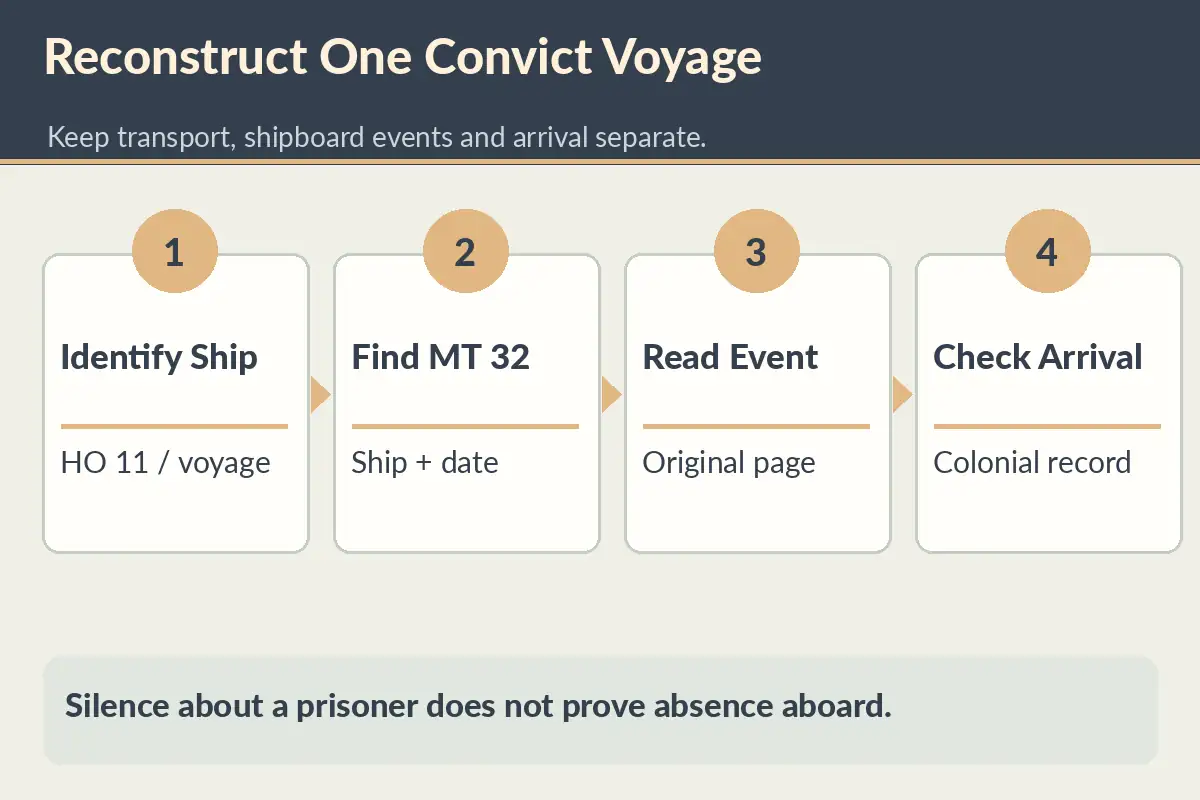
Start a ship worksheet with names and variants, captain if reported, year, ports, dates and the source of each detail. A vessel with a common name may have sailed several times: never mix observations from different voyages. If the only clue is a convict surname, first seek a ship in HO 11 transport registers or an Australian index; only then search MT 32 by vessel and period. A failure to find a named individual in a surgeons’ journal is not proof that the individual was not transported.
Separate MT 32 From the Earlier ADM 101 Journals
Many surgeons’ journals from Royal Navy and convict voyages occur in ADM 101, but the Archives identifies MT 32 as an additional, smaller series covering 1858–1867. The distinction is tied to archival custody and date, not to the presence of a special type of medical condition. The ships were transporting convicts in hired merchant vessels with surgeons appointed to supervise health. Do not assume a journal in one series must have a direct continuation in the other.
Search the correct series using the archival catalogue and the documented voyage. The State Library of Victoria’s ships research guide also distinguishes MT 32 from earlier ADM 101 materials and explains a route to digitized Australian Joint Copying Project copies. Mark whether a record is a contemporaneous manuscript, its digitized image or a provider’s name index. The fact that different websites offer images or transcriptions should not be mistaken for several independent medical observations.

Read the Sick List as a Medical Record, Not a Roster
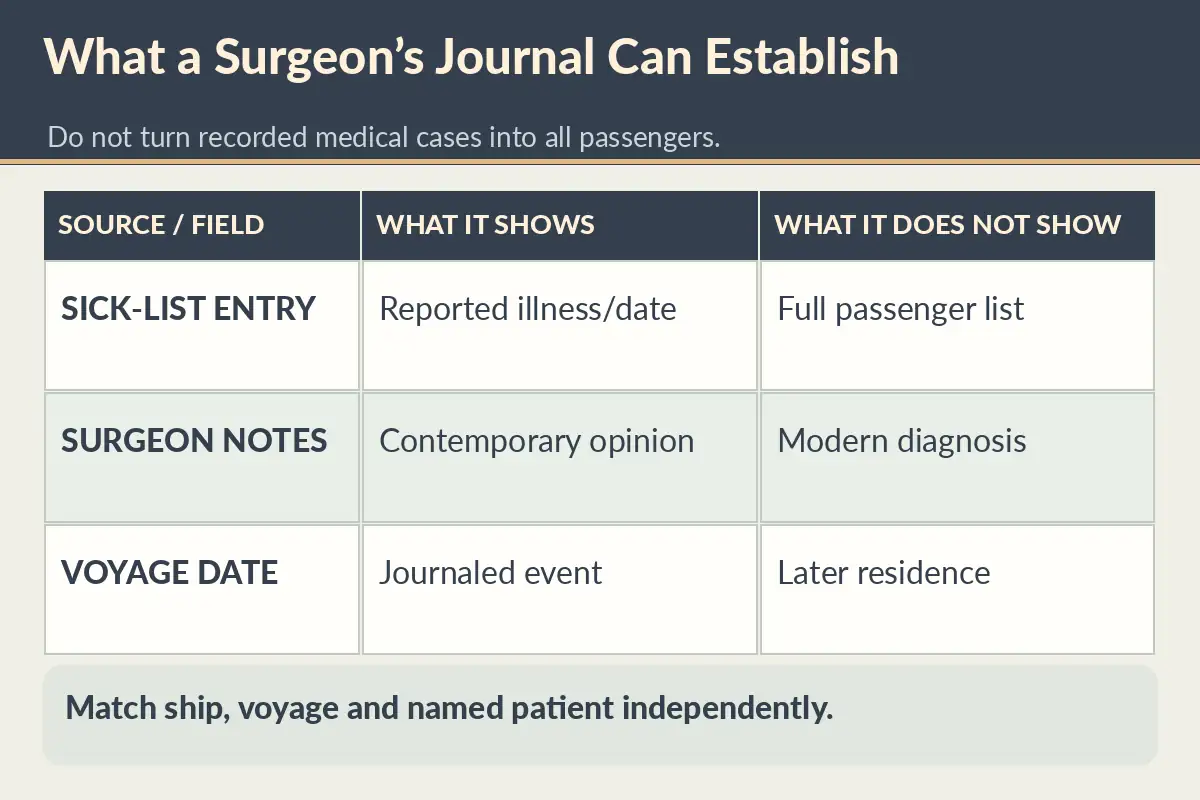
A journal may include dated illnesses, treatments, weather, food provisions and remarks on conduct or conditions aboard ship. The National Archives warns that convict surgeons’ records do not provide a complete name list: they most reliably identify people whose condition or treatment was worth recording. Even when a particular MT 32 volume includes other named events, that does not make it an accurate census of the ship’s population. The absence of a healthy prisoner is normally uninformative about that person’s presence.
For every named medical entry, transcribe the exact age if stated, spelling, date, original description of illness and outcome as reported. Do not translate nineteenth-century symptoms into a definitive modern diagnosis. Record whether the entry is contemporaneous or retrospective. The surgeon’s written interpretation is evidence of an observation by that writer, not a guarantee that the treatment worked or that later descendants share a condition. Medical descriptions are especially sensitive when shared with families.
Test Voyage Details Against Convict Transport Registers
HO 11 transportation registers are a different administrative source: they identify convicts on particular ships and often describe conviction, sentence and origin. Australian colonial records may document arrival, assignment, conduct or later permissions. The study works best when those materials are compared to MT 32, not merged into a single fictional story. A surgeon’s note about a shipboard death is not equivalent to a certified civil death entry, although it can be an important contemporary clue to the event.
Construct three source columns: transport order or ship listing, voyage medical journal and destination evidence. Record spelling differences, ages, dates and any change of status. If an MT 32 reference uses only a surname, do not attribute it to the first matching convict in HO 11 when there were several onboard. Look for an age, offence reference, bunk location or other identifier where a journal actually provides one. If none exists, keep the match tentative instead of creating artificial family certainty.
Preserve the Chronology of a Voyage and Its Omissions
The journal’s opening and closing dates may extend beyond the days at sea because the surgeon was accountable for preparation, embarkation or post-arrival reporting. A dated account of illness or weather establishes a report made about that stage, but it may not prove the person was in the same place for every day between entries. Copy the original voyage dates and compare them with departure and landing information. Do not assume that a date in a digitized catalogue is always the day of the event it describes.
A route map can show ports known from independent sources, while a journal timeline should mark only dated observations and openly show unexplained stretches. Journal notes may contain judgments about a convict’s conduct; attribute those assertions to the surgeon and avoid repeating moral classifications as uncontested fact. Survivorship and editorial selection affect what was recorded. No medical journal should be cited as evidence that every named person subsequently settled or married at the destination.
Cite Ship, Piece and Page Before Drawing Conclusions
When a useful entry appears, cite MT 32 with the ship, year, specific piece and page or image number. Keep an image of the original text and a careful transcription, labeling expansions or unclear words. An online provider’s collection title alone is not an adequate archival reference. Also note the independent transport or arrival document used for identity. If you consulted only an index, state that the manuscript page has not been checked and downgrade the claim appropriately.
The final family history should say that a shipboard medical journal reports a specific event on a particular date, not that the journal proves all details of a convict’s life. Describe what remains uncertain, including whether a person was healthy and therefore unmentioned. If there is no suitable MT 32 volume, test earlier ADM 101 holdings and colonial sources without presuming that a missing journal was destroyed for the same reason in every case. One accurately cited shipboard episode is a stronger contribution than a complete invented passenger biography.
How We Research This Archival Record Class
We first establish why an office created the record, the years and people actually covered, and its current custody and access status. A searchable catalogue description is not the original document, and a provider index may omit names or normalize dates. We record a positive finding exactly as written and distinguish it from inferences about identity, residence, family relationship or legal outcome. Every plausible namesake gets a separate comparison based on contemporary identifiers. Negative searches include what series, piece, years and spelling variants were really checked. A claim is accepted only when the evidence supports that narrow wording; gaps remain visible.
More Records and Archives Guides
Official Research Sources and Evidence Limits
The custodian’s collection guide confirms Confirms MT 32 is a smaller group of convict-voyage medical journals dated 1858–1867 indexed by ship/date, distinct from ADM 101 and HO 11.. Additional archive guidance confirms Identifies Admiralty medical journals and an additional MT 32 group of 1858–1867 searchable by ship name.. These describe surviving series, not an individual ancestor’s case. Check the actual Discovery entry for piece-by-piece access and current closure information, and cite the original page where possible rather than copying a later index entry without inspection.
No. Medical and other event entries vary and cannot substitute for a passenger or transport register.
The National Archives identifies the smaller collection as 1858–1867.
They are separate archival series; use the ship and voyage date to route the search.
No. Preserve the historical clinical wording and informant context.
HO 11 ship registers, voyage details and independent Australian arrival or conduct records.