
A Royal Navy ship’s position on a particular day is best researched by vessel name and date, not by an ancestor’s surname. The National Archives holds a substantial sequence of ships’ logs in ADM 53, describing movements, weather and notable events. However, its naval log-book guide cautions that these daily records seldom name ordinary crew. Before connecting a sailor to a voyage, establish his documented ship assignment independently.
Identify the Ship and the Right Time Window
Start with the exact ship designation recorded in a service register, medal paper, letter, photograph or contemporary news account. Naval vessels can be renamed and names reused, sometimes within the same century. Pair the name with vessel type, dates, station and any available commanding officer before accepting a catalogue match. A modern article referring to “HMS Victory” without specifying the period is not a sufficient source identification.
The catalogue search should include a date narrow enough to find a plausible log volume. The records are arranged by ship and time, not by every event mentioned in a modern biography. Record an approximate interval and why you selected it, then narrow after viewing the contents. If the source merely places a sailor in the navy without naming the ship, a ship log is not yet the appropriate first search.
Choose Between ADM 51, ADM 52, and ADM 53
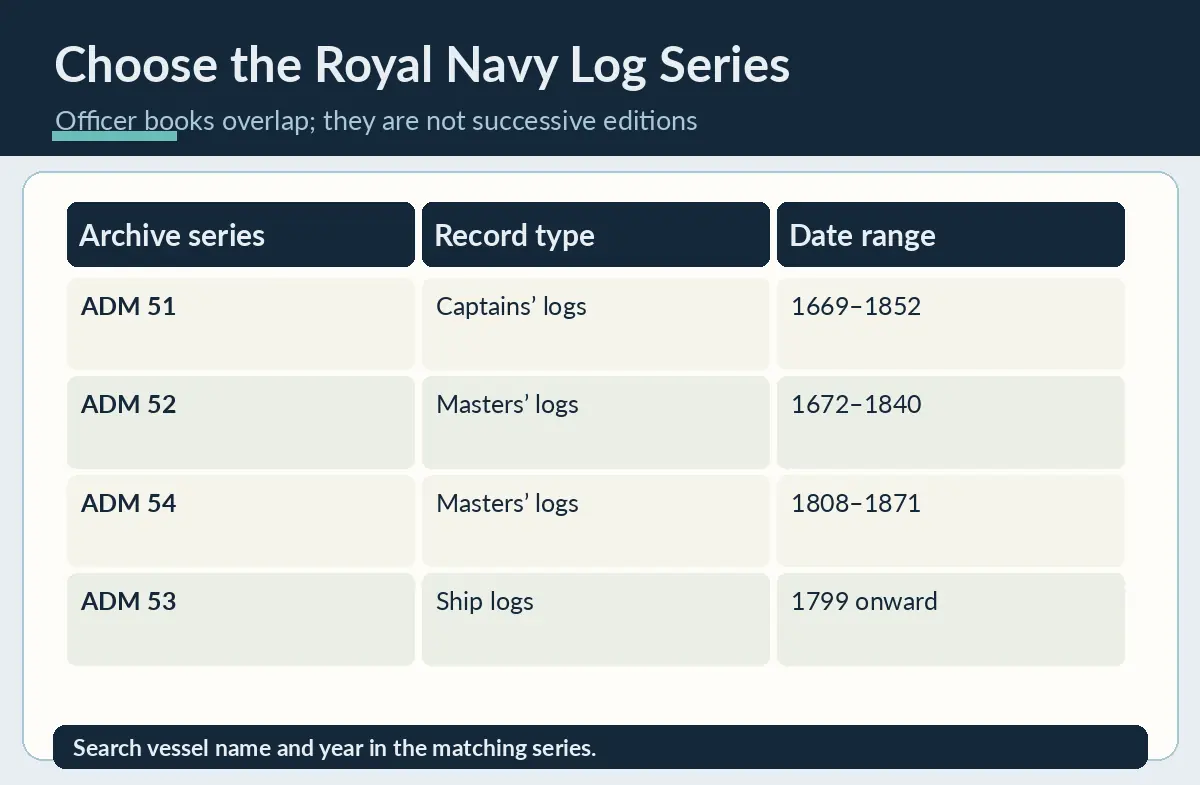
The Archives guide distinguishes officer-created logs before general ships’ logs became predominant. Captains’ logs in ADM 51 cover 1669–1852; masters’ logs occur in ADM 52 for 1672–1840 and ADM 54 for 1808–1871. These overlap because different officers maintained related but nonidentical records. A nineteenth-century voyage may therefore be documented in more than one series, and those accounts should not be silently fused.
ADM 53 records ships’ logs from 1799 onward and is often the key for later service. Search within ADM 53’s catalogue series by ship and year. Do not assume the beginning date means every Royal Navy vessel has complete coverage from 1799. Some ships were out of commission or in major refit, and archives hold what survived within specific record sequences.
Read Daily Entries as Ship-Level Evidence
Typical daily entries describe place, bearing, ship movement, weather, signals, duties and sometimes discipline, stores, visitors or deaths. Not every book has the same columns or reporting detail. The officer of the watch created a navigational record, not a family narrative. A surviving entry that locates the ship off Malta on a given day supports a claim about the vessel, but not by itself the presence or health of a named family member.
Transcribe the stated date, nautical position where legible, intended destination and actual entry. Be careful with abbreviations and older nautical vocabulary. If a coordinate is unclear, quote it as uncertain rather than plotting a precise modern point. Compare successive days to detect transcription mistakes: a sudden impossible movement often signals misread figures, a missing date or a different ship.
Map a Voyage Without Inventing Individual Travel
Arrange confirmed ports and dated observations in a voyage table. Note whether each event is a log entry, another ship’s sighting or a later recollection. A route line joining dated ports is an interpretation of ship movement, not an original line drawn in the archival record. Place uncertainties alongside the map rather than smoothing an unobserved leg into a confident itinerary.
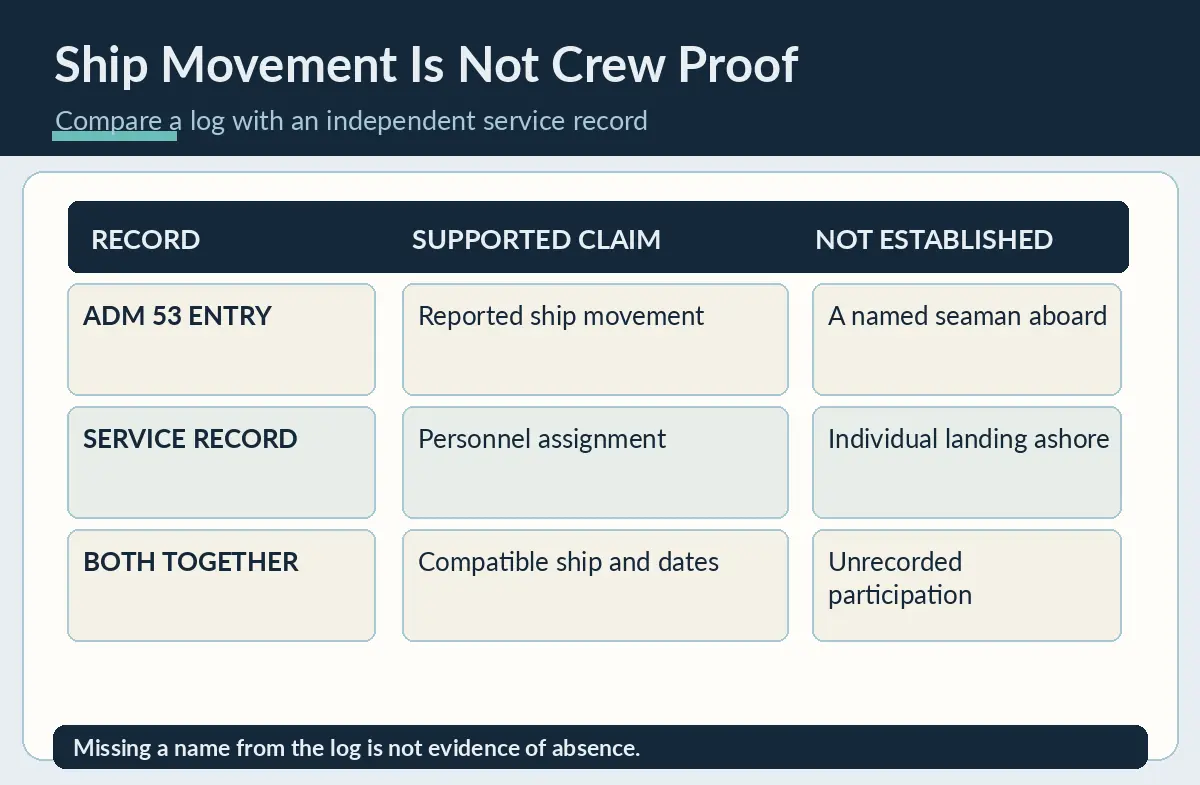
For a genealogical claim, maintain a separate service timeline. If a rating’s service record shows assignment from March to July and the log covers April, the evidence may fit. But a service notation could reflect administrative attachment, shore duty or a transfer, and more records may be necessary to establish presence on a particular watch or landing. Do not state that the sailor participated in an action merely because the ship was involved.

Know What a Log Can Say About a Person
Some logs include individual injuries, sickness, death or disciplinary matters, but names do not appear consistently. The repository guide points readers to medical officers’ journals where personal illness or treatment is the main research question. A naval muster or service record may be better for the basic question “was this person assigned to the ship?” A captain’s dispatch or court record may better document a particular incident.
A missing mention of a named sailor in ADM 53 is therefore unsurprising. It is not evidence that the man was absent. Conversely, a common surname appearing in an incident note is not enough to prove the sailor’s identity. Correlate rank, number where applicable, ship, time, and independent biographical details before adding the observation to an ancestor’s profile.
Example: Match an Officer’s Account to a Sailor’s Timeline
Imagine a hypothetical sailor, Robert Clarke, whose service paper lists a posting to a frigate between 1904 and 1906. An ADM 53 book documents that frigate leaving Portsmouth in 1905. You can safely say the ship sailed on the documented date. You may propose that Clarke was attached at the time, if his personnel record supports the period, but the log has not automatically placed him on that specific voyage or at every port.
Create three columns: log observation, service-record observation and conclusion permitted. If a conflicting transfer record shows Clarke detached before departure, the contradiction controls the claim until resolved. This prevents an attractive sea route from concealing a gap in the person’s chronology. Mark fictional examples as illustrative rather than presenting them as actual archival discoveries.
Plan Access and Produce an Auditable Citation
Some series descriptions can be read freely online while original log pages may require a visit to Kew or a copy request. Always follow the individual piece’s ordering status. Search for variant ship spellings if no result appears and check whether the same voyage belongs in ADM 51, 52 or 54. A blank name search is expected because the cataloguing unit is usually the ship or the volume, not an individual crew member.
Cite the archive, ADM 53, specific piece number, ship name, dates covered, page or folio and date of entry. Distinguish a scan, a transcription and a modern secondary timeline. If you publish a route map, explain which plotted points come directly from the journal and which are interpolation. Record uncertainties in the log so another researcher can retrace each movement.
More Records and Archives Guides
How We Research Royal Navy Log Evidence
We begin with The National Archives series guide and verify the vessel in the correct era. We search the ship-and-date catalogue, transcribe original journal observations and check a separately sourced service record before making any person-level statement. Our evidence ledger labels a statement as vessel movement, personnel assignment or conjectured personal participation. That distinction is the unique safeguard in this method, especially for names that appear nowhere in the log itself.
We also check whether a medical, officer’s or operational source is a better fit than the ship log, using the Archives’ operations guide for wartime context. For commercial tools or reproduction services mentioned in research, see our affiliate disclosure.
Usually not. ADM 53 logs are principally ship and navigation records, not crew lists.
Search the ship name and approximate date in The National Archives catalogue, then open the appropriate piece description.
Check the earlier officer log series such as ADM 51 or ADM 52, depending on the officer and dates.
No. First establish the person’s assignment from a separate service or muster record.
No. Availability varies by piece, and many documents require access at Kew or a copy request.