
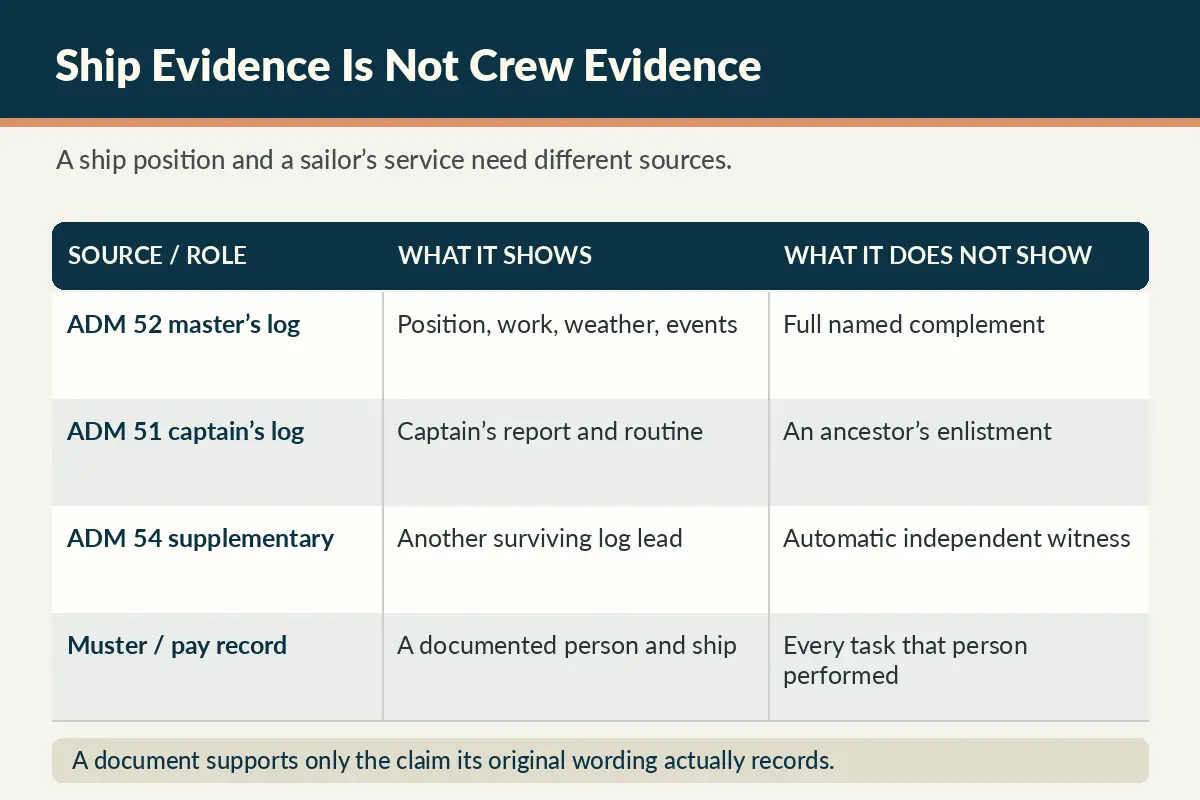
ADM 52 contains Royal Navy masters’ logs dating from 1672 to 1840. The master was principally responsible for navigation, and surviving logs can record position, course, weather, work and incidents aboard a ship. Begin with the vessel’s name and the period of a suspected voyage, not an assumed family member. A log describes what a ship did; unless it explicitly names someone, it does not prove that a particular ancestor sailed in her.
Identify the Ship and the Master’s Period
A Royal Navy vessel name may have been reused. The same ship may also have had several commissions, commanders or masters. Construct an identity card with the full vessel name, approximate dates, station, service period and any known commander or master. Do not treat a search result for a famous ship name as evidence for the right hull until the chronology and service context agree.
The National Archives’ official guide identifies ADM 52 as masters’ logs for 1672–1840 and recommends searching officers’ logs by ship name and date. Masters’ records can also be approached through the name of the officer who kept the log. Write down the exact ADM 52 piece reference and the dates it purports to cover before interpreting any entry.
A missing master’s log might reflect incomplete survival or an administrative route rather than an absence of a voyage. Compare the ship’s period with known gaps and alternative series. If a ship was operating in 1815, an ADM 54 supplementary log may be relevant; if the period is later, ADM 53 may be more productive. These are alternative holdings, not a prescribed chain of events.

Choose the Correct Kind of Naval Log
ADM 51 consists of captains’ logs, commonly compiled from masters’ observations with additional material thought necessary by the captain. ADM 52 reflects the navigating officer’s daily practice. ADM 54 holds supplementary masters’ logs for 1808–1871, while ADM 53 contains ships’ logs from 1799 onward. ADM 55 is a much smaller group of exploration journals. Always label which creator and record type produced the claim.
An admiral’s journal in ADM 50 may illuminate a squadron rather than a single vessel, while a master’s daily entry may be more useful for an individual ship’s track. The overlap in dates among series is an opportunity to compare evidence but not a guarantee that several logs survive for the same date. Record search results separately for each reference.
When two logs disagree about a position or event, check the day, hour, ship time, transcription and the role of the author before resolving the conflict. A copy of one officer’s report in another volume may not be independent confirmation. Preserve both readings and note whether a navigational estimate was revised later.
Read Navigation Entries as Dated Observations
A master’s log may list latitude, longitude, course steered, wind, weather, soundings, duties and punishments. The National Archives specifically cautions that content varies. Transcribe the words and marks rather than standardizing uncertain abbreviations. When a position is estimated or a bearing is unclear, mark that uncertainty instead of plotting a precise modern point.
The date of an entry, the ship’s observed position and the moment an event occurred may not be identical. Some logs contain multiple observations within one day and may use shipboard dating conventions unfamiliar to a modern reader. Record the exact entry, page and adjacent days before translating a note into a claim that the vessel reached a harbor on a particular date.
Storms, shortages and punishments can be valuable narrative context, but they are not an exhaustive record of everyone aboard. If the log states that “hands were employed” or that a boat was sent ashore, the unnamed hands remain unnamed. Do not insert family members into those events simply because an unrelated record says they served in the navy.
Connect the Vessel’s History to a Person
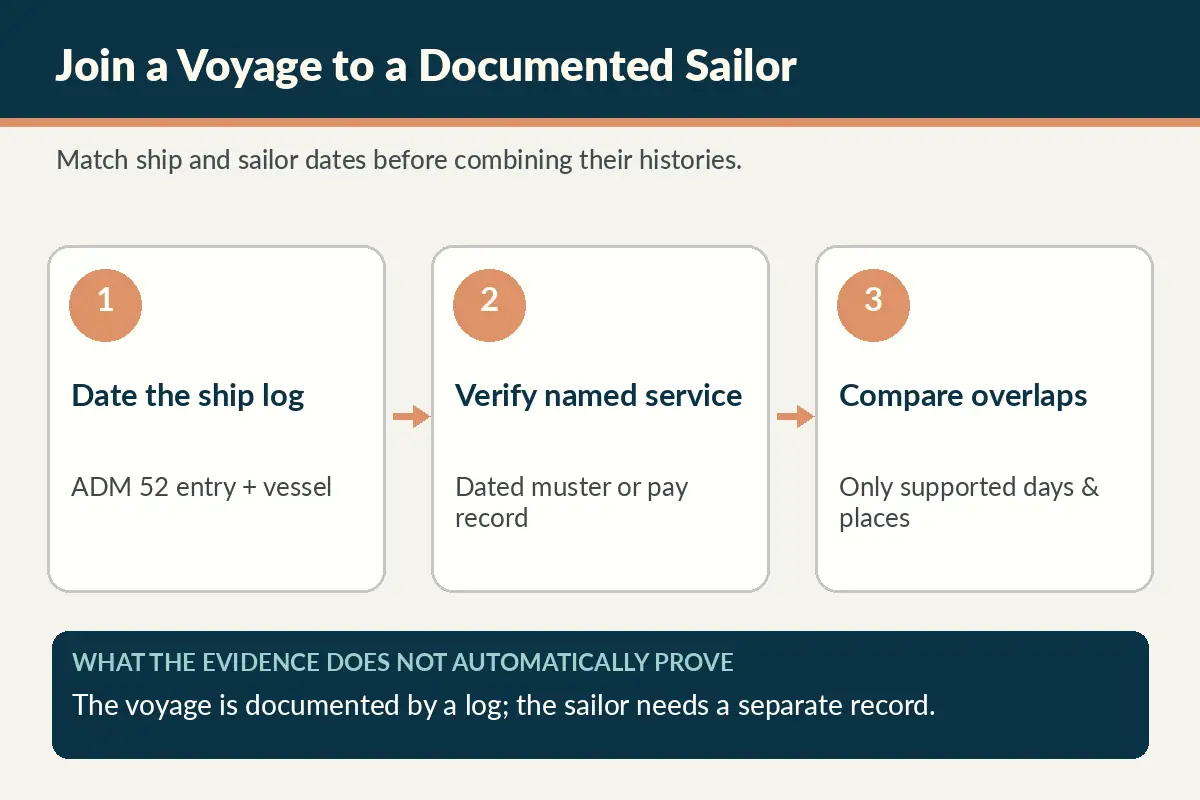
For a named sailor, look for a muster, pay record or individual service source appropriate to the date. The National Archives’ Royal Navy research guides distinguish operational logs from personnel records. A muster can place an identified man on a particular ship at a particular time, while the log may show the ship’s movements during that period. Only then can you frame the relationship cautiously.
A joined timeline should display the muster’s date range alongside the log’s daily entries. Service or payroll documents may contain transfers, discharge or dates absent from the log. If the confirmed service period starts after a dramatic incident, that incident should not be attributed to the sailor. Dates which merely touch at an uncertain boundary should be described as provisional.
Namesakes create an additional problem. Confirm rank or rating, age or birthplace if provided, earlier and later postings and any distinguishing number. A name in a secondary list may not correspond to the man on the muster. If independent identity evidence is missing, the defensible statement is about the documented ship, not the family member.
Test a Wreck, Battle or Passage Claim
When researching a wreck, remember that the log may have been lost with the vessel. The National Archives’ ships-wrecked guide advises checking logs of ships sailing in company when appropriate. This can reveal a reported location or observation, but it will still represent a particular observer’s account, not necessarily a surveyed site.
Separate an order to sail, an intended destination, a daily position, and arrival or landing. These are different assertions. A ship’s stated destination may change en route, and an entry about being off a coast is not proof that every person went ashore. To test a passage, compare the ship’s entries over several days and seek port, admiralty or independent correspondence where relevant.
A simple source grid can preserve these limits: ADM 52 logs report navigation; a contemporary ADM 51 log might offer a second official perspective; a muster identifies service; a later family story makes a claim to test. State exactly what each record contributes and which details remain unsupported rather than writing a seamless invented voyage.
More Records and Archives Guides
How We Research Naval Logbooks
We use The National Archives’ guides to Royal Navy logbooks and ships wrecked or sunk. Their series distinctions and date ranges determine which material should be searched. For any individual claim we require separately sourced, dated personnel evidence. An ADM 52 observation is not transformed into a crew list merely because a genealogist wants it to answer a personal question.
Cite the ship, log keeper if known, ADM 52 piece, dated entry and page or folio. For a route reconstruction keep uncertain positions and transcription choices visible. For an ancestor place the independent service citation beside the operational one. This lets another researcher distinguish the original evidence from the interpretation without repeating every search.
Authoritative repository guidance used for this article: The National Archives: Royal Navy Ships Voyages Log Books. The National Archives: Ships Wrecked Sunk. Confirm current piece-level access restrictions and ordering routes in Discovery before making a research visit or requesting a copy. The original record—not a search hit or a printed summary—must support every contested detail.
For our editorial and affiliate-policy statement, see the affiliate disclosure. This research plan does not require paid services; archive and document-copy costs depend on the repository and the material requested.
No. They are mainly navigation and operational records; musters or other personnel sources are needed to identify individuals.
The National Archives dates masters’ logs in ADM 52 from 1672 to 1840.
It depends on date and record type. ADM 53 holds later ships’ logs, while ADM 54 may supply supplementary masters’ logs.
The ship’s own log may have been lost. Check other ships’ logs or independent incident records when relevant.
No. Match a person to the vessel and the relevant date through independent muster, pay or service evidence.