
The Royal Navy submarine logs in ADM 173 are operational books for tracing a boat by name and date from 1914 onward. They can record wheel and telegraph orders, depth-keeping actions, battery charging, torpedo-related entries and navigation details. A page that locates a submarine does not by itself prove that a particular relative served aboard on that day. Start with the boat’s historical identifier and the relevant interval, then seek named crew evidence separately.
The National Archives’ log-book guide treats submarine logs as a distinct series because the entries were often made by crew simultaneously engaged in steering or depth keeping. It warns that many abbreviations occur and that naval logs rarely identify particular officers or ratings. The Archives’ Second World War naval operations guide advises searching ADM 173 by submarine name, sometimes without the prefix “HMS,” using date filters.
Start with the correct submarine designation
A submarine’s identity is not always captured by a familiar modern name. Some Royal Navy submarines were identified by letter-and-number designations, and names can appear in variant forms in archival descriptions. The National Archives advises looking by submarine name in ADM 173 and, for some catalogue queries, omitting the prefix “HMS.” Record both the period designation and the exact search string so another researcher can repeat the search.
Place the boat’s identification within a dated timeline rather than treating every similarly named vessel as the same hull. A name or number may be reused at another time, while a diary covering a long period can contain gaps. Use the piece-level date range to select candidates, then confirm the details in the inspected log. Do not manufacture missing patrols from consecutive catalogue volumes.

Decode wheel, telegraph and depth-keeping entries
Submarine logs include technical and navigational shorthand that can look like unexplained numbers when copied out of context. A wheel order may concern a change of course; a telegraph order concerns propulsion instructions; depth-keeping entries describe how the boat was operated. These are not necessarily personal statements by the sailor whose handwriting appears. Keep the physical field, unit and time column attached to the transcription.
Start with a small sample of entries and assemble a glossary from the original page headings and any contemporary reference material. Avoid substituting modern naval terminology without checking historical usage. If an abbreviation has more than one possible meaning, mark it unresolved rather than choosing the dramatic interpretation. Use adjacent entries to establish sequence and operational setting.
Put battery and torpedo information in context
Battery-charge entries can help explain an operational routine without proving the location of every crew member. A torpedo-related order may record preparation, firing or another operational stage; it does not automatically prove a hit, sinking or fatality. Distinguish what the book literally records from the outcome claimed in a later narrative, particularly when a family story attaches a named sailor to an action.
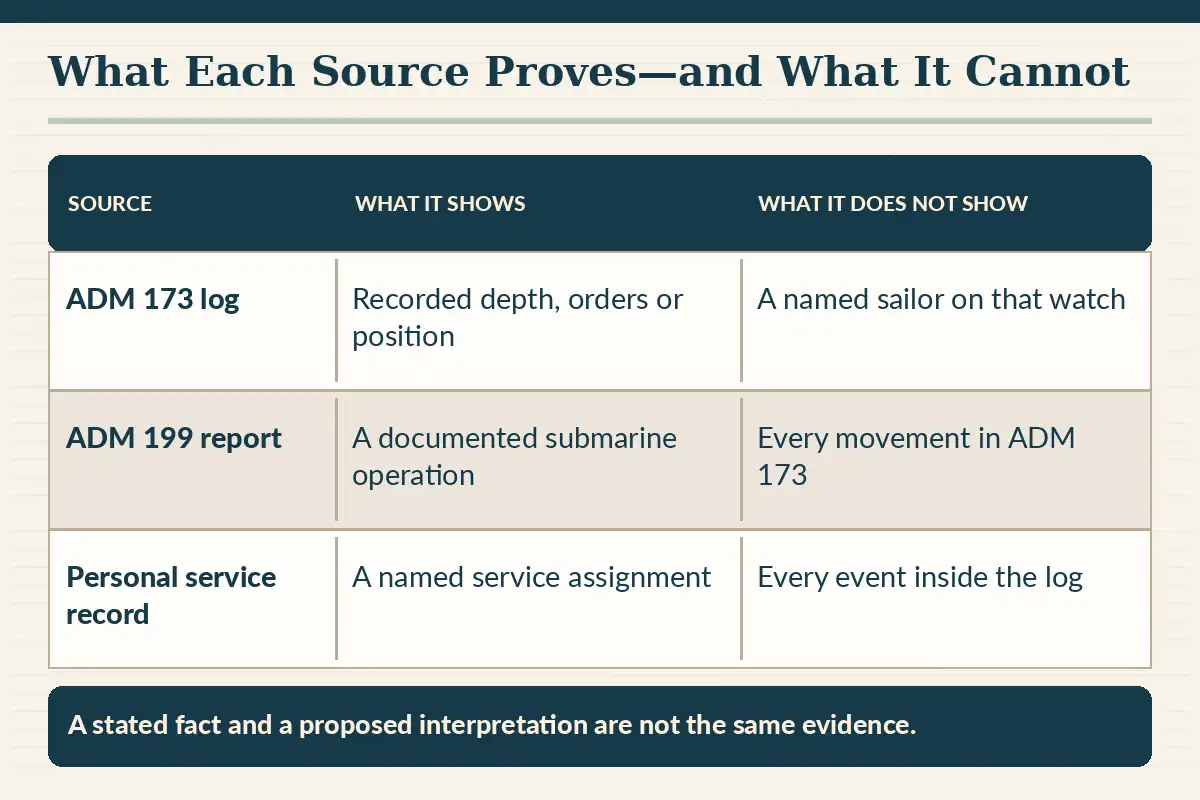
Where the question concerns an operation rather than day-to-day ship handling, use a separate wartime patrol report or operational summary if one survives. The National Archives points to ADM 199 and some Mediterranean supplementary reports in ADM 236. These are alternatives and corroborating accounts, not a mandatory chain for every boat. Differences in language and date may reflect their distinct purposes.
Respect the gap between boat movement and crew identity
Most Royal Navy log books describe the ship or submarine and provide little individual personal information. A surname remembered within a family cannot be located in a particular dive merely because the boat was active that day. To establish service, use the relevant sailor’s service record, a dated personnel list or another independent document that actually names the person and boat together.
A transfer, illness, leave or temporary attachment can complicate assumptions based on long-term ship association. If a service entry shows assignment for a broad interval, confirm whether it establishes continuous presence on the particular date being studied. A statement such as “served in the submarine during this period” is different from “took part in the incident recorded at 14:20.”
Handle changing dates and time conventions cautiously
Technical logs may use time formats and daily routines unfamiliar to modern readers. Preserve the log’s original date and time notation, and note when a later historian has converted it. A position, heading or depth may be an observation at one time rather than a continuous state of the vessel. Do not convert a set of isolated positions into a detailed route without appropriate assumptions and supporting records.
When mapping a patrol, use only coordinates or locations actually recorded and independently check the geographic reference system where necessary. A position may be approximate, transcribed incorrectly or subject to wartime secrecy. If the log is inaccessible and only the catalogue is available, describe the range of records rather than claiming a reconstructed course.

Create a source trail another researcher can follow
Record the full ADM 173 reference, boat designation, folio or page, date, time, original abbreviation and proposed interpretation. Separate transcription from paraphrase. Retain a photograph of the page only when permitted by the archive’s terms, and note if the text was consulted through a copy. A reliable source note makes clear whether you inspected the image or only the catalogue description.
Finish with two conclusions: what the log establishes about the boat and what a distinct personnel source establishes about an individual. If the evidence permits only a contextual link, state that. The most useful next action is usually a dated independent service reference, not another speculative reading of the submarine’s technical shorthand.
Build a traceable evidence worksheet
Start a claim-specific ledger with the full archive reference, repository, record level, historical creator, date, geographic scope, exact name and role, and whether you saw the original or a description. For each relevant field copy the literal evidence and add a separate inference column. Choose a boat and narrow date first; ADM 173 is an operational log, not a comprehensive crew or passenger register. If an index is incomplete, the right conclusion is that the search is incomplete, not that an event could not have occurred. Save every no-result search with its terms and coverage.
Compare with a record created independently of the first whenever possible. A logged torpedo command does not by itself establish an enemy vessel was hit or identify the crew member who acted. If two websites repeat one archival description, they are not two independent witnesses. Work with genuine conflicts rather than silently changing dates, spelling or personal identity until an ancestor fits. A good final sentence states what was directly documented, what remains an interpretation, and one specific record that could change the result.
More Records and Archives Guides
How We Research and Check These Records
We checked official archival guidance on 2026-11-03. The National Archives identifies ADM 173 as submarine logs from 1914, recording steering and depth orders, battery charges, torpedo activity and navigation. This verifies the described source route; it does not assert that a particular family member appears in the series.
We checked official archival guidance on 2026-11-03. The official Second World War operations guide describes searching ADM 173 by submarine name, with submarine patrol reports separately in ADM 199 and ADM 236. This verifies the described source route; it does not assert that a particular family member appears in the series.
We checked official archival guidance on 2026-11-03. The official Discovery search guide explains how record references and holding institutions should be checked before citing a source. This verifies the described source route; it does not assert that a particular family member appears in the series.
The images are original explanatory illustrations, not archival facsimiles. No paid endorsement or affiliate arrangement is implied. See our affiliate disclosure.
The National Archives identifies submarine logs from 1914 onward; check the dates of each surviving piece.
No. Its principal purpose is operational logging, not a named crew register.
They record aspects of operating the boat, subject to the meanings of contemporary abbreviations.
Not always. The Archives points to ADM 199 and supplementary ADM 236 reports for other operational accounts.
No. Verify the reported outcome in a distinct operational or incident source.