
To trace an early Royal Navy rating, identify a ship and an approximate service date, then find the vessel’s muster in ADM 36, ADM 37 or ADM 38. Read the original entry and cross-check age, birthplace and service dates with independent documents.
Search the Vessel Before You Search the Sailor
Early Royal Navy service evidence frequently survives as a ship’s muster or pay book rather than a modern, centrally indexed personnel file. Begin with a vessel name and approximate period from a letter, pension reference, contemporary newspaper or other known record. Search The National Archives’ Discovery catalogue for that vessel and the appropriate ADM series, then read the muster list itself.
The official ratings research guide identifies ships’ musters as the closest routine service evidence for many earlier sailors. A name coincidence alone is not enough to establish identity.
Choose ADM 36, ADM 37 and ADM 38 by Date
The National Archives describes ADM 36 ships’ muster books as covering 1688–1808, ADM 37 as covering 1757–1842, and ADM 38 as covering 1793–1878. Their dates overlap substantially because these are archival groupings, not a simple chronological sequence in which one series immediately replaces the last. Use vessel, period and the item description to select a book.
The Royal Naval dockyard research guide publishes the explicit range for these series and separately identifies ADM 33 pay books. Never assume an ADM piece includes your vessel solely because its date range fits.
Understand Why the Navy Created Muster Books
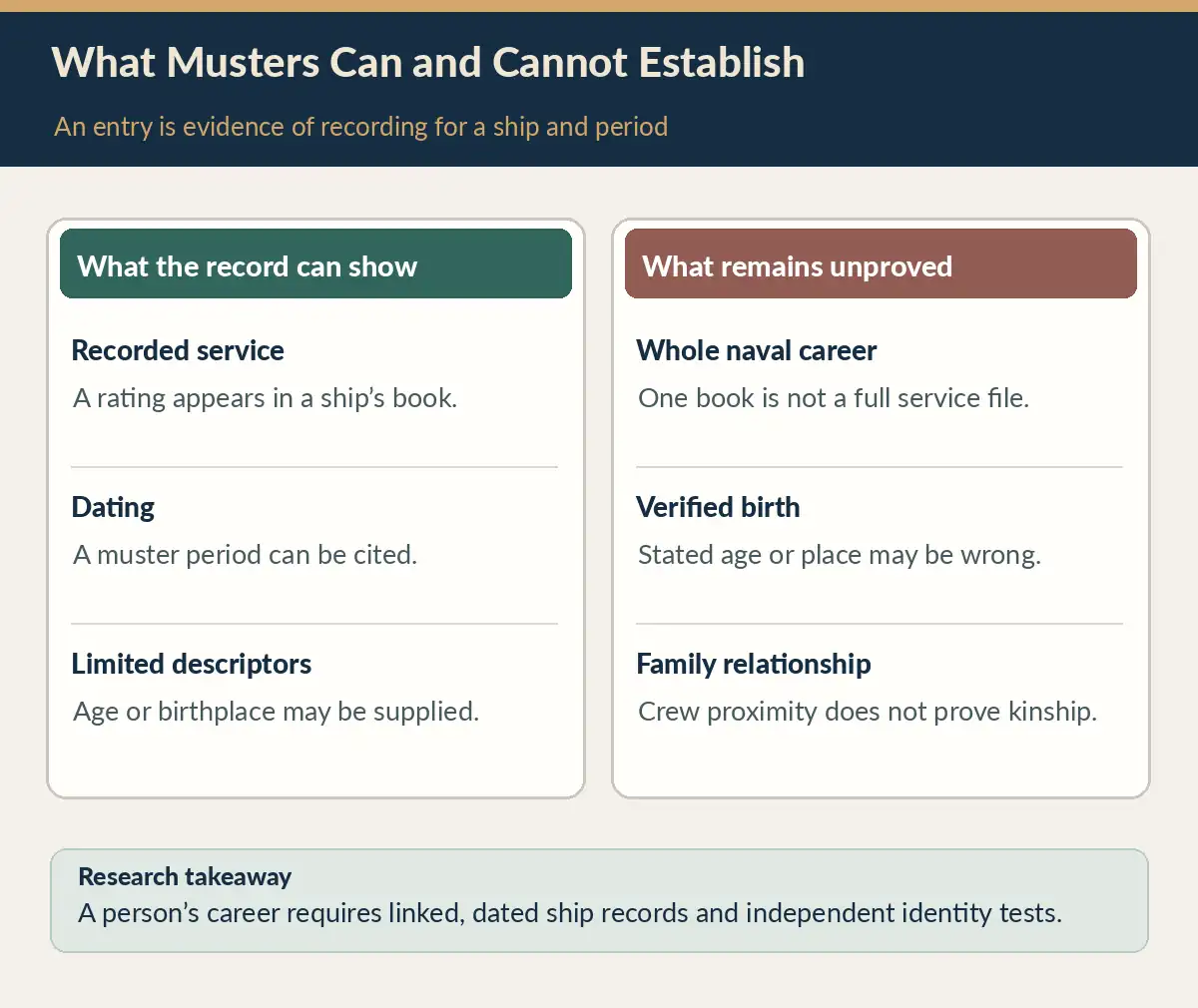
A muster list records ratings serving on a vessel for naval accounting and administration; examples were taken monthly or quarterly. The entries can establish a recorded name on a particular ship during a stated accounting period and may show role or status changes. It is not a passenger manifest, a baptismal register or an official family tree.
Transfer between vessels and gaps between periods have to be traced across multiple volumes. Some periods have incomplete preservation or difficult indexing. Cite the name of the ship, muster date, book and image or folio, and distinguish an actual contemporary entry from a later catalogue description.

Read the Age and Birthplace Fields With Caution
From 1764, Royal Navy muster records should include a man’s age and place of birth, but the National Archives warns that these details are not always present and can be vague or inaccurate. Do not convert a stated age into an exact birth date without an independent source.
A reported birthplace may refer to a broad town or county rather than a parish of baptism. If a ship lists two John Smiths, compare stated age, birthplace, rank and the sequence of muster appearances before choosing a candidate. An absent age does not make the entry useless; it simply reduces the specificity of the identity test.
Recognize Description Books in the Later Period
From the 1830s, description books, many included in ADM 38, may provide physical descriptions such as height, complexion, scars and tattoos. Such details can help distinguish same-name ratings, though they should be transcribed respectfully and are not infallible biometric identifiers. Do not assume every ADM 38 volume or every sailor has a detailed description.
Preserve the actual wording and the date of the descriptor, especially if handwriting is uncertain. Cross-reference descriptors only when an independent naval, pension or civil source offers a credible comparison; a similar physical mark alone cannot link all appearances of a common name.
Keep Musters and Pay Books Separate
Ship pay books exist in other ADM series; ADM 33 covers ships’ pay books from 1669–1778. A pay entry or settlement can corroborate service, rank, or a compensation-related detail but reflects its own accounting system and dates. It does not automatically prove that a rating remained aboard throughout a voyage, nor does the receipt of pay establish family identity.
When using a pay book to complement a muster, enter it as a second independent record with its own ADM piece and page. Distinguish wages paid, owed or otherwise accounted for instead of translating an ambiguous column into a full employment narrative.

Build a Ship-by-Ship Timeline Instead of a Single Hit
A research log should have columns for vessel, muster date, ADM series and piece, written name, recorded rank, birthplace, age and any annotated transfer. Arrange rows in the order their contemporary documents support, leaving gaps visible. Hypothetically, two entries for Thomas Jones on different vessels could be one sailor transferred, but they might be different men.
First see whether dates overlap impossibly, then compare identity fields and any explicit transfer notation. Do not silently stretch a one-month appearance into years of continuous service. A dated timeline makes it easier to test a later pension or family narrative.
Handle Negative Searches Without Erasing Service
A failure to find a name in an online index may mean the relevant muster has not been indexed by individual sailor at all. Search the ship and its possible variant spelling in Discovery, check a known commissioned period, and review descriptions of related volumes.
If the vessel name changes or the career crosses multiple ships, repeat the process rather than assuming a single master list exists. Remember that service records for commissioned officers may require different series from ratings. A documented search failure is not proof that someone never served, and the absence of a modern individual file is normal for many early periods.
How We Research Royal Navy Ship Musters
We work from vessel and date to the archive catalogue, then from the piece description into an actual muster entry. We compare ADM 36, ADM 37 and ADM 38 using their overlapping chronological ranges and consult pay or description books only where warranted. Each transcription includes the original date and source hierarchy.
We treat age and birthplace as reported details, not automatically verified facts, and seek separate civil or parish evidence before connecting a rating to a family. For transparency see the GenHis affiliate disclosure.
More Records and Archives Guides
Decide Which Next Record Can Resolve Identity
If a muster candidate remains ambiguous, choose the next source based on the particular disagreement: a separate ship entry for transfer continuity, a pay book for accounting identity, a parish record for birth locality or a later pension item where the date and career make sense.
Record what the first entry actually says and what the follow-up adds. If conflicting ages remain, preserve the conflict rather than selecting the number closest to a pedigree estimate. This approach produces a defensible record chain for the sailor and prevents the familiar error of giving a common-name seaman an invented complete naval career.
Not reliably. Earlier musters often require a ship-and-date search rather than one comprehensive personal index.
The overlapping ranges include ADM 36 and ADM 38; use the vessel and catalogue description to choose a volume.
Generally not. Ages and birthplaces may appear from 1764 but can be missing or inaccurate.
No. They serve related accounting purposes and require separate source citations.
No. It supports an appearance for its recorded period; other books are needed for a continuous chronology.