
Royal Navy Dockyard Pay Books ADM 42 can provide useful evidence only when the document type and its limits are understood. Begin with the official research guidance and distinguish what the repository holds from what a family story suggests. This guide gives a source-specific search sequence, the meaning of each relevant field, and a tested way to separate an original record from a mistaken name match.
Begin With a Dockyard, Not Just a Surname
The National Archives identifies ADM 42 as Royal Navy yard pay books dating from 1660 to 1857. Their arrangement usually follows a dockyard or vessel rather than an individual worker’s surname. Search by the probable workplace and date, then browse the relevant original book for the name. Famous naval installations include Portsmouth, Chatham, Deptford, Woolwich, Sheerness and Plymouth, later called Devonport. Coverage is uneven across places and periods.
A family story that somebody “served the Navy” does not tell you whether he was a sailor, shipwright, ropemaker, clerk or civilian yard laborer. Separate that occupational question at the start. Record a census occupation, address, parish and employer clue, but allow alternative yards and jobs. A royal dockyard worker’s presence at a port is not proof of a voyage, a military rank or participation in a particular naval battle.
Understand the Difference Between Ordinary and Extraordinary
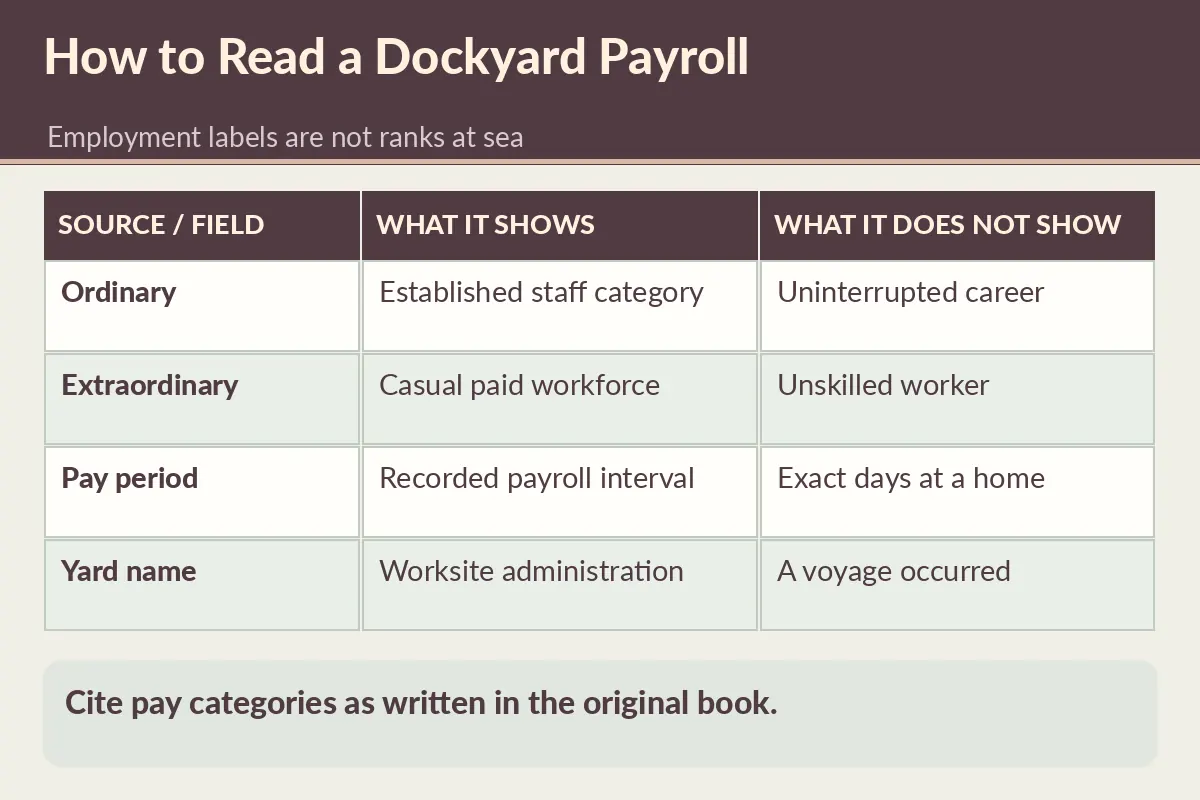
The archives describe two historical workforce categories. Ordinary workers belonged to a more permanent salaried establishment; extraordinary workers were unestablished or casual employees paid when needed. The labels belong to the wage system, not to a judgment about a worker’s skill or social status. Make a field-level transcription of the entry rather than substituting a modern job title.
Record the pay period, yard, name, work designation, rate or sum if present, and whether the original lists the person as ordinary or extraordinary. Do not infer that every pay period captures every day worked. Casual entries can have gaps and permanent employment can be affected by administrative changes. A name missing from one monthly or yearly page cannot, without coverage checks, demonstrate a move or a death.

Locate ADM 42 With the Yard and Historical Name
Most original payroll records are located through a yard-first catalogue search. Enter the dockyard name, narrow to ADM 42 and inspect the date range and piece description. The National Archives warns that names are often not searchable in its catalogue for these records. Browsing or ordering the specific volume may be unavoidable.
Port names and institutions can change. Plymouth became Devonport Dockyard in the nineteenth century, while different establishments in a single port could be administered separately. A pay book from a victualling yard is not automatically an ADM 42 dockyard payroll. Search alternative location names and verify the administrative department. A negative name search from a modern search box is not the same as a negative search of the original payroll.
Extract Evidence Without Creating an Imaginary Career
A payroll line identifies a work-related payment or account entry in a particular administrative context. It may help establish occupation and a plausible place at the pay date, but it does not guarantee full-time residence, continuous years of employment or a pension. Preserve all column headings and the full pay period; isolated handwritten numbers can be wages, totals or accounting adjustments.
Make a timeline with a separate source for each dated statement. Two entries a decade apart do not prove uninterrupted service in between. When two men share a name, compare trade, yard, salary category, neighborhood and other identifiable details. The more unusual the trade, the more helpful it is as a clue; it still requires corroboration through independent records. Mark every conclusion as directly reported, inferred or unresolved.
Follow Dockyard Careers Into Other Staff Records
The dockyard guide points to ADM 23, PMG 24 and PMG 25 for later salary or pension material, and to Navy Board correspondence in ADM 106 for some personnel matters. These are alternative record paths based on the question and date, not guaranteed next volumes for each name. Investigate whether the person remained employed after ADM 42’s main coverage.
A worker may also have spent time aboard a ship. Test that separate claim with ships’ muster or pay books and a match on the individual, not from the dockyard payroll alone. Conversely a sailor’s name appearing in a ship document does not prove he was permanently employed at its home dockyard. Administrative roles must be carried separately across the chronological evidence chart.
Match the Payroll to Independent Household Evidence
Search a plausible household near the working dockyard using parish, tax, probate, civil registration and census material where the years allow. Correlate occupation and age rather than relying solely on a surname. A Portsmouth payroll entry might belong to one of several workers whose family records were in surrounding parishes. If an address is absent from ADM 42, do not insert one from a later directory without identifying it as independent evidence.
Beware of job titles that changed meaning across centuries. “Artificer” may indicate a skilled employee, while a yard book may use a specialized abbreviation. Transcribe first, then explain the contemporary administrative terminology. If a payroll lists only an initial, seek a second unambiguous source before linking the entry to a family tree. Record competing candidates and the evidence that excludes or supports each one.

Write a Dockyard Employment Finding That Others Can Check
A defensible conclusion states that a pay book names a worker in a specified category at an identified yard for a dated period. Cite ADM 42, the piece, folio and full column context. It then adds only independently supported employment continuity, household identity or later pension status. Keep an explicit note where yard or year coverage is missing.
Finish with a testable next step. If the target is a dockyard craftsman, investigate another pay period or a related salary register; if the target is a sailor, move to ship service records. Do not turn a decorative illustration of a ship into source evidence about the worker. The value of the book is a precise employer-and-date clue with transparent uncertainty.
How We Research This Archive and Its Limits
Our research method starts with the National Archives record guide and a second official archival description. We establish why the document was created, what dates and places it covers, how its finding aids differ from original pages, and whether the item has restrictions or known survival gaps. An index hit only identifies a candidate. A signed statement reports a claim or legal act but may not independently establish the truth of its subject. The next source must be genuinely independent where possible. We record the catalogue piece, leaf or image, original column heading, transcription uncertainty, dates of observation and interpretation, and each same-name alternative. Before sharing a conclusion, we check whether changing jurisdictions, archival custody or missing years invalidate the assumption. The diagrams are original explanatory artwork, not facsimiles.
More Records and Archives Guides
Official Sources, Availability, and Disclosure
The first official guide supports the record series and its search route: ADM 42 yard pay books 1660–1857, yard-first arrangement, and ordinary versus extraordinary workforce terminology. The second archival guide adds this limitation: Crew-list fields distinguish actual seagoing employment from dockyard payroll work. Check the current catalogue entry for the specific piece, including view, copy and digitization availability; these vary even within a series. Images shown here are conceptual illustrations rather than source-document scans. Read our affiliate disclosure before using any commercial source links.
Usually not at catalogue level. Search by dockyard and period, then inspect the relevant volume.
They distinguished established or salaried staff from unestablished or casual employees in the historical payroll system.
No. Dockyard employment and shipboard service must be demonstrated independently.
The National Archives describes yard pay books covering 1660–1857, with gaps in individual yard coverage.
Use the archive’s yard staff guide to choose ADM 23 or PMG salary and pension records appropriate to the date.