
Merchant Navy Apprentices in BT 150–152 can provide useful evidence only when the document type and its limits are understood. Begin with the official research guidance and distinguish what the repository holds from what a family story suggests. This guide gives a source-specific search sequence, the meaning of each relevant field, and a tested way to separate an original record from a mistaken name match.
Start With an Apprentice Rather Than a Completed Career
The first question is whether the person is actually recorded as an apprentice, not whether a descendant remembers him as a master mariner. The National Archives identifies BT 150 as the index of merchant service apprentices, covering 1824 to 1953. It gives a route to an indenture, but an index entry is itself an administrative observation from the beginning of training. Note the name as written, approximate age, term of apprenticeship, date, master and ship details wherever the entry supplies them.
Build a candidate sheet for every similar name before selecting one. A young man may have worked on multiple vessels later, and another sailor can share his name, birthplace and occupation. Compare the entry with family documents created independently: census age, a baptism, or a civil marriage describing work at sea. Treat the index as an identifier-rich starting point, not a certificate that the apprentice completed years of service or survived a dangerous passage.
Search BT 150 by Its Actual Coverage and Access
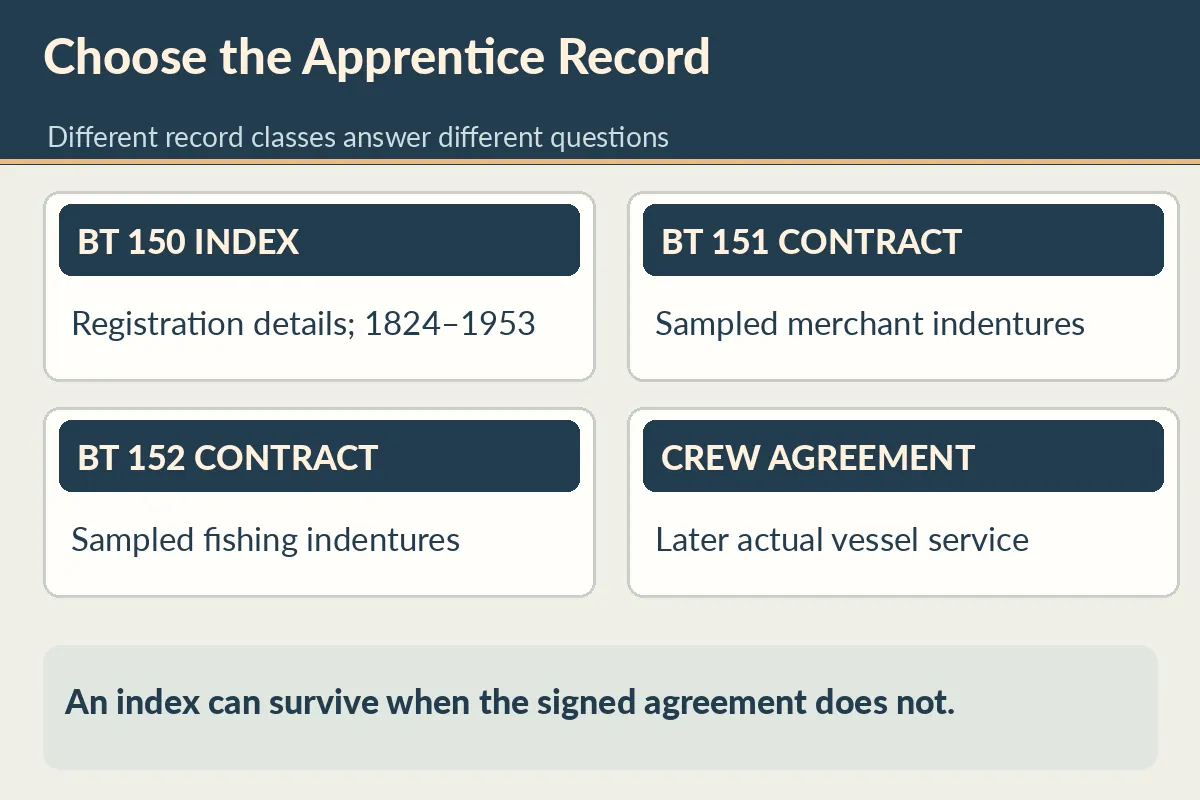
BT 150 contains original indexes of apprentices registered in merchant service; the 1824–1910 index portion is searchable through a commercial partner, and later indexes continue on microfilm to 1953. Different portions may be browsed rather than fully name searchable. The archive guide does not promise a comprehensive online surname search for all these decades. Record the volume, image or leaf and the method by which you obtained the result.
Older index entries can give age, indenture term, date, master and sometimes ship and registration port. Transcribe every explicit field and mark a blank as unrecorded, rather than filling it from a later biography. An index can contain clerical errors or abbreviations; a single digit on an age or year can change identity conclusions. Where an index cannot be viewed remotely, preserve the relevant BT 150 reference and investigate access at Kew before concluding that a trainee never registered.
Route a Register Entry to the Correct Contract Series
The corresponding indentures survive in BT 151 for merchant shipping and BT 152 for fishing apprenticeships. These are not comprehensive sets of completed contracts. The National Archives describes sample retention, including roughly two months every five years for much of the historical run. Therefore an apprentice can have a clear BT 150 entry while no indenture survives. A negative BT 151 result is not evidence that the index is fictitious.
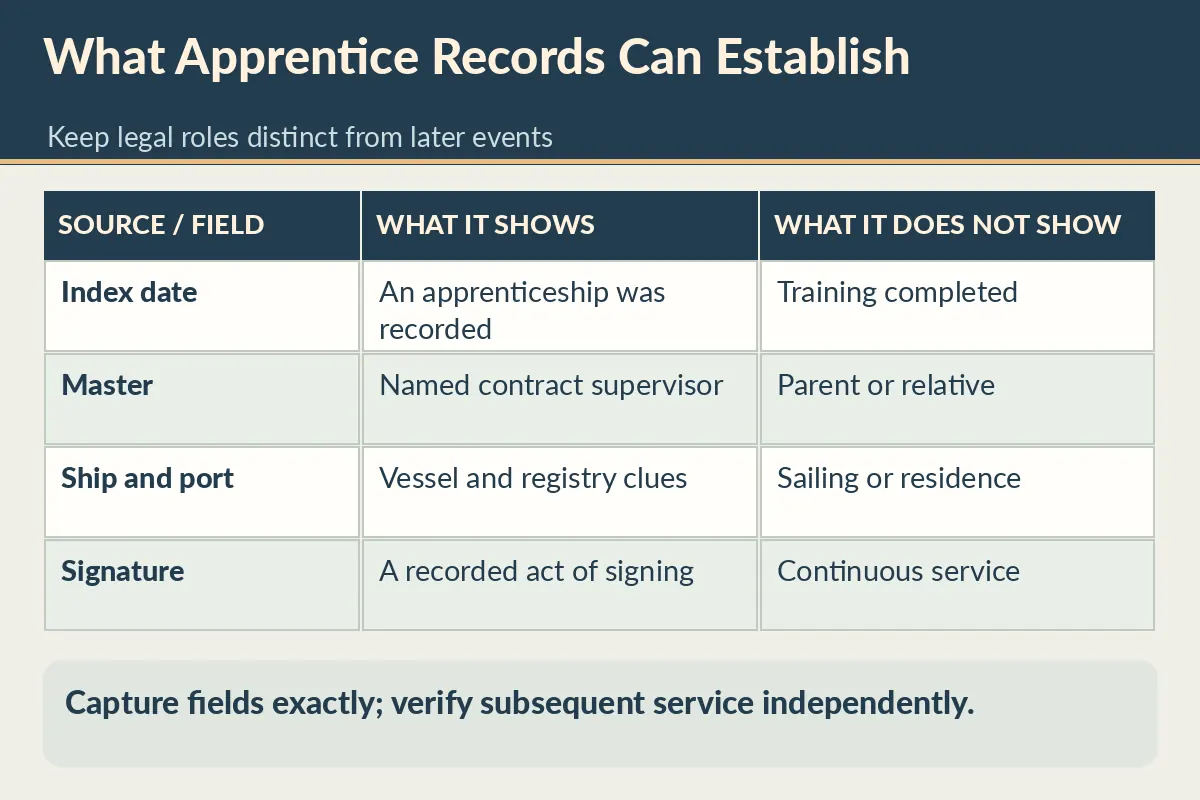
Search a surviving contract by the index date, port and appropriate series rather than by surname alone. Track the catalogue piece, which may represent several agreements. The signed indenture may include the signatures of apprentice and master; the national guide notes that it ordinarily adds little new information beyond the index. The contract creates evidence of an undertaking, not of how successfully the apprenticeship unfolded or a definite later rank.
Read the Master, Ship, and Term as Separate Clues
An apprentice contracted to a master is not necessarily that master’s relative. Record the legal role first: apprentice, master, ship owner or witness. The name of a vessel identifies a workplace at the signing date, while its port of registry may be different from the port where a child was born or the contract was made. A term of four or five years describes intended service, not a proven continuous itinerary.
Create two columns labeled “recorded at signing” and “later verified.” Place ship, master, apprenticeship period and the signing location in the first; put later crew entries, civil records and independent newspaper notices in the second. Where the name of a master resembles the family surname, actively test the possibility of no relationship. Do not infer that a vessel sailed on the day the apprentice signed; a crew list or dated log is required for that proposition.
Follow a Young Mariner Into Crew Records Carefully
Once a ship or official number is known, later crew lists and agreements may document actual joining and leaving dates, crew occupation and reported age. They are maintained for a different administrative purpose than indentures. First determine the ship’s name changes and official number, then choose the time-appropriate crew-list custodian; British merchant shipping records are divided among archives and were never preserved evenly.
A ship found in the correct port is not enough. Look for a matching master, plausible age and the chronology of service. If the apprentice disappears from the later crew list, possibilities include a different ship, a lost document, name variation or departure from maritime employment. Death or desertion should only be proposed if a relevant entry or independent record says so. Never transform a missing person in a partial digital database into a documented disappearance.
Use the Original Signature Without Overstating Its Meaning
A surviving signed indenture can link a name to a particular contract and distinguish one same-named candidate from another. Compare spelling, handwriting and date cautiously: a mark may have been made instead of a signature and clerks could write all names in a register. Ask whether the text explicitly identifies who signed. Do not apply modern expectations of identity documents to nineteenth-century apprenticeship administration.
If a parent or guardian appears in a related document, record the role that source actually assigns. The signature of a sponsor does not independently prove a biological parent-child tie. Independent baptism, guardianship, probate or household evidence can test that link. Save an image of the full page with archival reference and surrounding entries, not an isolated crop that conceals headings or a note of amendment.

Report What Was Found and What Still Needs Testing
The research report should begin with a narrow claim: a person of the recorded name and age entered an identified merchant apprenticeship under a named master on a documented date. Then list the evidence for linking that person with the ancestor in later records. If the contract is missing because of the archive’s sampling policy, say so explicitly; a comprehensive search of the surviving sample has limited evidentiary scope.
Keep index and contract citations separate. A disciplined conclusion might be “BT 150 identifies a candidate apprentice, but a matching crew agreement has not yet established continued service.” This is more useful than an invented naval career. The next task should be one obtainable independent record with a specific date, ship or port rather than a vague call to search additional maritime documents.
How We Research This Archive and Its Limits
Our research method starts with the National Archives record guide and a second official archival description. We establish why the document was created, what dates and places it covers, how its finding aids differ from original pages, and whether the item has restrictions or known survival gaps. An index hit only identifies a candidate. A signed statement reports a claim or legal act but may not independently establish the truth of its subject. The next source must be genuinely independent where possible. We record the catalogue piece, leaf or image, original column heading, transcription uncertainty, dates of observation and interpretation, and each same-name alternative. Before sharing a conclusion, we check whether changing jurisdictions, archival custody or missing years invalidate the assumption. The diagrams are original explanatory artwork, not facsimiles.
More Records and Archives Guides
Official Sources, Availability, and Disclosure
The first official guide supports the record series and its search route: BT 150 indexes through 1953, online portion to 1910, and two-month surviving indenture sample in BT 151/152. The second archival guide adds this limitation: BT 150 index and BT 151/152 indenture arrangement and evidence of sample-only survival. Check the current catalogue entry for the specific piece, including view, copy and digitization availability; these vary even within a series. Images shown here are conceptual illustrations rather than source-document scans. Read our affiliate disclosure before using any commercial source links.
No. It indexes an indenture or apprenticeship registration; subsequent completion must be tested through other sources.
The National Archives preserved samples rather than every original indenture, so absence is common.
BT 152 is specifically a source for fishing apprenticeships; check dates and catalogue descriptions.
No. The term master describes a contractual role and does not establish kinship.
Record the exact name, age, indenture date and term, master, ship, port, full reference and original image if available.