
BT 98 changes its filing logic across 1835–1860. Find the ship by port or official number, then examine the actual crew agreement instead of relying on a name index. Begin with the official archive research guidance. Review the GenHis affiliate disclosure before selecting any external access service.
Start With a Vessel and the Correct Filing Period
British merchant crew lists and agreements are documents created around a vessel and its voyages, not a modern surname-indexed national personnel file. The National Archives explains that BT 98 holds early merchant shipping muster material and the 1835–1860 agreements. The series is exceptionally useful when a seaman appears between entries in the central seamen registers, but it is arranged around ships. Begin with a suspected vessel, port and year, ideally supported by a family letter, seaman’s certificate, maritime newspaper notice or independent passenger-free shipping record.
Write down a proposed date interval and distinguish the port where a ship was registered from the port where an individual joined or left it. The same vessel may change master, voyage or registry, and ships often reused popular names. An assertion such as “John served on the Mary” is not sufficiently specific. Require a vessel identity, date, and at least one independent identifier before treating a person in BT 98 as your ancestor. A record concerning a ship is not automatically a record of its owner, passengers or every sailor who ever served aboard.
Use the 1835–1844 Port and Alphabetical-Range Route
For 1835–1844 the archive guide points researchers to BT 98/140–563, catalogued by ship registration port and alphabetical ranges of vessels. These early schedules are not comprehensively searchable by the crewman’s surname. Search Discovery for the port and relevant years inside BT 98 and examine the resulting box or piece description. Several boxes can cover one port and year, so a single negative result does not exclude the vessel. You may need to inspect internal alphabetical groupings and documents that are not individually described online.
When a candidate appears, record the complete reference, ship title exactly as written and the schedule type. A name written as an initial or phonetic spelling should not be silently expanded. Copy the entire line and adjacent headings; otherwise a discharge place might be mistaken for a place of birth. Cross-check a master’s name or tonnage when known to avoid conflating equally named vessels. If the original is not digitized, ask the custodian about a visit, paid copy or researcher consultation before claiming that the record is unavailable.

For 1845–1856 Search the Ship Rather Than a Sailor
From 1845 to 1856 the BT 98 entries are generally in BT 98/564–4758, grouped by port, year and alphabetical spans of ship names. The National Archives cautions that finding individual crew members directly is difficult; early central registers do not consistently name the ship up to 1854. Begin with a known vessel from a marriage occupation, contemporary news, port arrival notice or surviving correspondence, and move to the relevant alphabetical vessel range. A surname-only online search is not a reliable test of coverage.
The surviving paperwork may contain more than one schedule relating to a voyage. The archive describes Schedule A and C for foreign trade and Schedule B and D for home trade among documents used in this period. Read the printed heading rather than assuming the documents form a continuous chronological sequence. Record when the master filed the paperwork as well as the voyage or crew period stated on the form. A filing date can be later than the sailing or discharge, and a voyage on which a sailor was absent cannot be inferred from an adjacent agreement.
From 1857–1860 Use the Ship’s Official Number
For 1857–1860 BT 98 is arranged by official number rather than the earlier port-name route. Official numbers were introduced in the 1850s and retained by a vessel during its registration life. Use a contemporary Mercantile Navy List or Lloyd’s Register to identify the number for the ship and date. Then search the BT 98 catalogue for the appropriate numerical range. The official guide suggests a truncated numeric query—such as the leading digits with a wildcard—to retrieve the piece that covers the number.
Do not confuse an official ship number with a seaman’s registration or discharge-book number. These designate different entities and are not interchangeable lookup keys. If a ship changed name, follow its official number while documenting the change through vessel registers. If the number cannot be established confidently, return to place, name and period evidence instead of guessing a numeric range. After locating the agreement, compare vessel name, master and year before transcribing a crewman’s entry; an apparent name match without vessel confirmation remains weak.
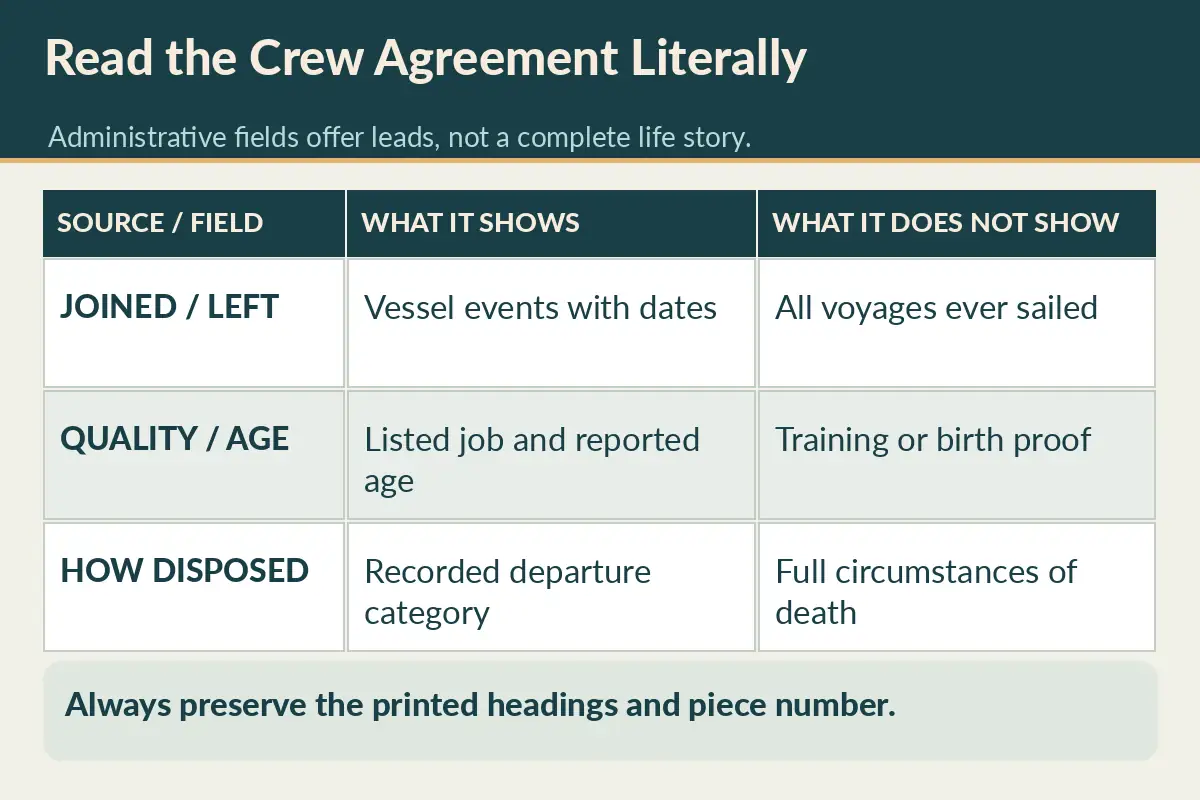
Read Joining and Leaving Entries With Legal Precision
A typical crew list can state a person’s age, birthplace, rank or quality, previous ship, place and date of joining, and how and where the person left the vessel. The phrase “how disposed of” may describe discharge, death, desertion or another administrative outcome. It does not on its own give a full account of circumstances. Examine amendments, marginal corrections and the printed schedule instructions. A listed birthplace is information reported to the clerk or master, not a substitute for a birth certificate or baptism register.
Create a crew-event ledger with separate columns for ship, official number if applicable, signing date, joining event, departure event, printed role, record citation and confidence. Compare multiple voyages before claiming a seaman remained on one ship for years. Two individuals with the same name can serve on different voyages, sometimes in the same port. Test age, place of birth, occupation, prior ship and a dated civilian record. A discharge from one vessel is not proof of exit from the Merchant Navy or emigration.
Follow Records After 1860 Without Inventing Coverage
From 1861 the National Archives’ BT 99 contains only a sample of merchant crew agreements for many years. Other surviving lists are distributed among the National Maritime Museum and the Maritime History Archive. The National Archives’ own guide provides the period-by-period survival and holder details; do not assume all later agreements will be in BT 98 or that a negative BT 99 result means the voyage never occurred. Some original logbooks were not retained, especially when no reportable birth or death was noted.
If no list emerges, assemble a documented search log of years, ports, ship-name variants, possible official numbers, searched ranges and archives contacted. Use maritime directories, newspapers and separately surviving employment or certificate documents only for questions they can answer. Finally distinguish direct findings—this person signed aboard on a given date—from inferences about voyages taken, destinations reached or family settlement. Preserve a reproducible full piece reference and image or copy-order details for every claim.

How We Research Bt 98 Crew Agreements
We first date the proposed service and determine whether BT 98 is organized by port and ship alphabet, or by the ship’s official number. We inspect actual schedules and their printed headings, then create a separate event line for each joining or departure. We verify ship identity and same-name sailors against at least one independent source and send post-1860 searches to the proper custodians without treating a sampled series as complete.
More Records and Archives Guides
Original Archive Sources and Proof Limits
For the specific archival series and its original arrangement, read the primary custodian guide (Documents BT 98 port and alphabetic filing in 1835–1856, official-number filing from 1857 and the contents of crew agreements.). For a separate official explanation of related records and coverage, use the supporting archive source (Confirms BT 98 pre-1861 crew agreement coverage and distinguishes later 10-percent BT 99 samples and separate seamen registers.). Keep a catalogue description, an index transcription and an examined original as distinct levels of evidence.
Usually not reliably; search the vessel, port or official-number range appropriate to its period.
BT 98 crew agreements began to be filed by ship official number rather than primarily by port and ship name.
No. Compare the exact crew period and departure entries with the ship’s movements and subsequent schedules.
No. It is mainly a contractual and administrative record, distinct from a surviving ship logbook.
Use BT 99 and the official guide to the National Maritime Museum and Maritime History Archive holdings.