
Some English deeds of bargain and sale were enrolled on Chancery Close Rolls. Locate the correct grantee or grantor index in C 275, then inspect C 54. Begin with the official archive research guidance. Review the GenHis affiliate disclosure before selecting any external access service.
An Enrolled Deed Is a Selected Legal Record
The Chancery Close Rolls in C 54 contain private deeds enrolled for legal or evidentiary reasons over centuries. The National Archives explains that the backs of these rolls were used for enrolled deeds from the thirteenth century, with records continuing to 1903 before the later enrolment-book system. From 1536 many conveyances by the method called bargain and sale had to be enrolled, but property could be conveyed by other legal mechanisms. Finding no entry therefore does not prove a transfer did not occur.
Begin by stating the research question precisely: identify the parties to one transfer, date ownership of a parcel, or trace a seller’s disappearance from a county. Gather an approximate date, historical parish or manor, and any buyer or seller name from tax rolls, probate records or private deeds. Avoid the expectation that C 54 is a complete indexed list of English landowners. Land descriptions may refer to multiple plots, tenures and conditions requiring legal interpretation; they should not be reduced automatically to a modern address.
Select the Correct C 275 Name Index
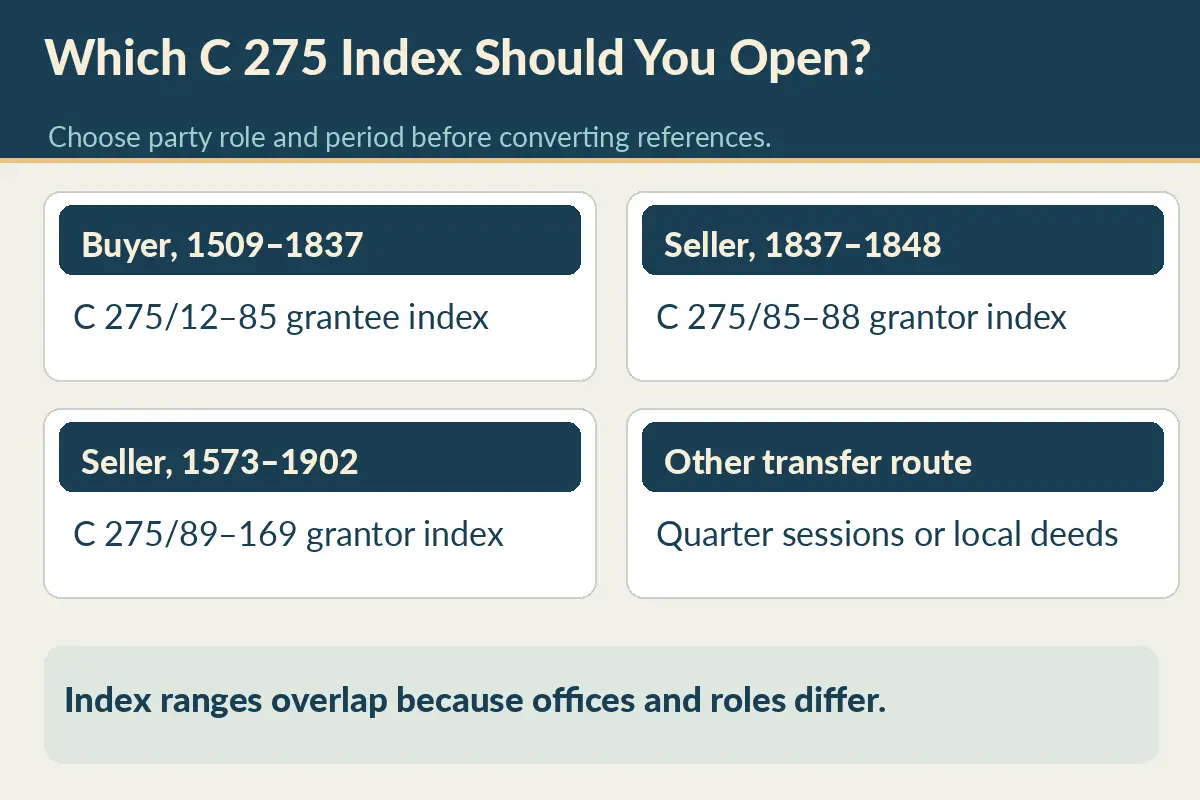
The index choice depends on period and which party you know. The archive’s guide identifies C 275/12–85 as chiefly grantee, or buyer, indexes for 1509–1837, while C 275/85–88 cover grantors, or sellers, for 1837–1848. A separate group, C 275/89–169, contains Enrolment Office grantor name indexes for 1573–1902. The dates overlap because these are not mutually exclusive eras of actual transfers; they are different index organizations and historical offices.
Indexes are usually alphabetical only by initial letter, rather than sorted surname-for-surname or searchable as modern databases. Be ready to scan multiple pages for the same initial, variable spellings, Latinized names and businesses. Record which index series, volume and page you checked. A negative result for one side does not settle the other side. The National Archives also lists special finding aids for 1559–1567 and enrolled deeds for safe custody in C 275/205; use them only for the relevant period and document type.
Turn the Index Entry Into a C 54 Roll Reference
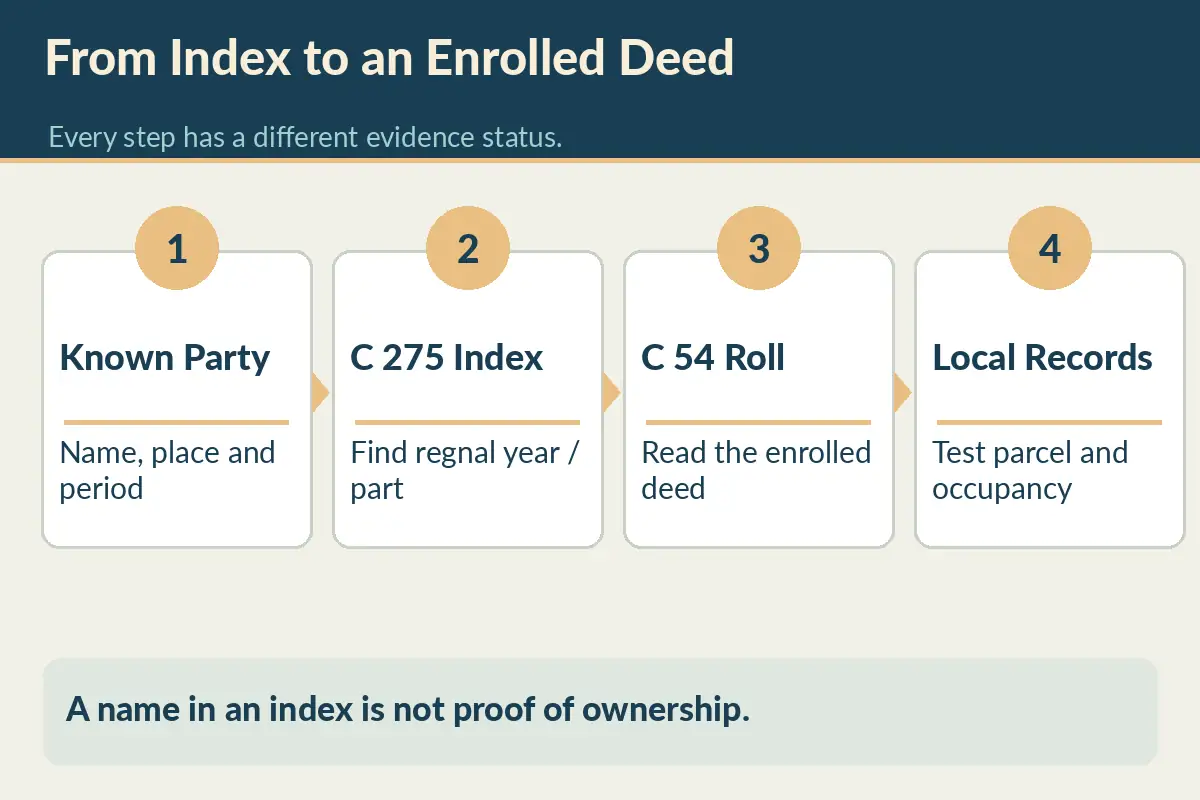
An index entry is a pointer, not the enrolled deed itself. It may supply an old part, regnal year, name and reference notation that must be translated into a modern piece reference in C 54. The National Archives recommends searching or browsing C 54 by regnal year, using the older indices and introductory notes available at Kew. Calendar dates can cross regnal years, and the legal year or administrative dating may not coincide with a modern January-through-December assumption.
Transcribe the complete old reference and its page before conversion. Record the actual C 54 piece and the part or membrane of the roll if identifiable. Ask the archive to confirm access requirements and copying arrangements for long or fragile parchment records. Do not describe a C 275 index line as the wording of the land conveyance. Once the original has been viewed, quote or paraphrase its clauses cautiously, preserving historical place spellings, property boundaries, financial consideration and named parties.
Read Buyer, Seller and Consideration With Caution
An enrolled deed may identify people on both sides, their roles, land location, type of property and consideration. Such wording gives valuable social and geographical evidence, but parties can include trustees, corporate bodies, heirs, attorneys and nominal purchasers. A listed sum may serve a legal purpose that differs from a modern property-market price. Do not assume the buyer personally occupied every parcel mentioned, or that a person sharing the surname of a trustee must be an ancestor’s relative.
Create a party-role ledger with exact recorded names, role, date, property description, amount, witnesses if stated and citation. Separate literal document claims from your interpretation. If land spans several manors or counties, consult period maps and local records to place it before assigning a modern coordinate. When a deed mentions a wife, child or heir, verify the precise legal relationship expressed in the instrument; witnesses, people of the same name and adjoining landholders may not be family members.
Search Other Courts and Local Archives for Missing Transfers
After the sixteenth-century legal reforms, some deeds could be enrolled at local quarter sessions, and other modes of conveyance did not require enrolment on C 54. The National Archives states that there is no single overall name or place index across the alternative court and deed series. County record offices may hold estate muniments, title bundles, leases or manorial records that answer a different part of a parcel’s history. Plan local searches rather than treating London’s Chancery series as exhaustive.
If your goal is a continuing ownership chain, compare each deed with later and earlier documents, probate records, parish rate books and maps. Separate initial acquisition, later lease, sale, inheritance and actual occupation. A deed by someone with the right surname but the wrong parish is a candidate, not a proven family connection. Record negative searches by index, period, location and alternative jurisdiction; simply writing “no C 54 record” is too broad to establish meaningful absence.
Build a Defensible Property Transfer Chain
Start a chronology with the earliest defensible dated transaction. For each entry provide the recording or execution date, seller and buyer as actually named, instrument type, property words, and archival reference. Mark missing links rather than inventing a continuous chain. Where a deed is Latin or uses unfamiliar common-law terminology, consult a specialist edition or qualified archival reading support instead of guessing the legal effect from a few recognizable names.
Use language proportional to the proof. “Party to an enrolled deed relating to land at X” is well grounded when verified in C 54; “owned and occupied the present-day house at X” generally requires much more. Do not convert land of the same village into the same parcel without boundaries or title continuity. Preserve index and original separately so that a subsequent reader can retrace the research path and correct an imperfect index interpretation.

How We Research C 54 Enrolled Deeds
We define the property question and approximate date, select the appropriate C 275 grantor or grantee index, then convert its old notation to an original C 54 reference. We inspect the deed, transcribe all party roles and place clauses, and test the parcel identity with local or probate records. We log other conveyance methods because an absent enrolment does not prove no transaction occurred.
More Records and Archives Guides
Original Archive Sources and Proof Limits
For the specific archival series and its original arrangement, read the primary custodian guide (Provides the precise buyer/seller C 275 index ranges and the C 54 record conversion method, dates and limitations.). For a separate official explanation of related records and coverage, use the supporting archive source (Explains that C 54 includes enrolled private deeds and that some conveyances were enrolled while other property transactions need separate sources.). Keep a catalogue description, an index transcription and an examined original as distinct levels of evidence.
No. Only transactions and other instruments enrolled by qualifying methods; many transfers were recorded elsewhere.
The party receiving the grant, often the buyer, rather than necessarily the person occupying the land.
No. It is a finding aid leading to the original Close Roll entry in C 54.
Different index offices and buyer/seller arrangements cover some of the same years.
Check the other relevant index side, period and local enrolment or private deed custody.