
Historical land records become much easier to use once you separate the first government grant from later deed transfers and from supporting case-file papers. In the United States, the right repository depends on the tract, its land system and the transaction you want to explain. A patent can establish a legal conveyance, but it cannot on its own identify an ancestor by surname or establish kinship between successive owners.
Identify the kind of conveyance before searching any name
Land research begins with a document question: are you looking for the first government transfer of a tract, a later resale, a map of boundaries, or the supporting application? These categories are not duplicates. A federal patent documents a transfer from the United States; a subsequent deed normally records a private or institutional transfer; a survey plat locates land; and a land-entry file may describe actions taken before a patent issued. Searching the wrong series can produce a misleading no-result.
Write a short target statement containing the person’s documented location, likely transaction interval, and all known property descriptors. Check whether that place lay in a public-land state or follows a different state or colonial land system. The Library of Congress distinguishes local deeds from original grants and directs researchers to state archives for certain state systems. Avoid assuming that a single national land database covers every U.S. jurisdiction or era.
Use BLM patents without treating them as full family histories
The Bureau of Land Management provides a General Land Office research portal for federal conveyance records. Its 2026 public update describes holdings that include patents, survey plats, field notes and tract books, with ongoing modernization. Search using available names and location terms; then record the document identifier, legal description, issue date and issuing office as displayed. Availability and search fields depend on the record, so inspect the result itself instead of extrapolating from a generic guide.
A patentee’s name on a federal document identifies a recipient in a legal transaction. It does not by itself prove the recipient is your similarly named ancestor. Compare the precise tract against a known residence, nearby people and the period in which that person could have acquired land. If a result matches only the surname and state, label it a candidate. Do not assign it to a family tree until multiple identifying details converge.

Find the federal application in an appropriate case-file series
Patents and case files can answer different questions. The National Archives describes millions of land-entry case files from the public-land states and distinguishes categories such as military bounty land warrants, earlier general land entries and post-1908 entries. Some may contain applications, correspondence or affidavits; others may offer little biographical information. Make the request using the land and entry information NARA specifies for that record group instead of guessing a uniform ordering process. For a related choice, see our guide to USCIS genealogy program records.
Document the connection between a patent search hit and any requested land-entry file. Write down entry type, tract, office and dates before looking for supporting records. A failed online image search is not proof that a federal case file was destroyed or never created. The catalog may describe holdings that are not fully digitized, and eligibility for copies depends on the actual series. Treat repository guidance as a route to verification, not a promise of survival. If that is your next decision, our guide “U.S. Homestead Land Entry Files” explains how to find proof beyond the patent.

Build a chain of title using county deed indexes
For a tract conveyed again after patent, identify the county that had recording jurisdiction at the time of each transaction. Use both grantor and grantee indexes when available: one follows a person selling or conveying property, the other follows a person receiving it. Record the book and page for every candidate and read the instrument image in full. An index may omit a spouse, witness, parcel qualifier or consideration that changes how the document should be interpreted. For a step-by-step method, see how to use historical property tax records in genealogy.
Follow the same physical parcel through changing hands rather than stringing together repeated surnames. Compare acreage, lot or survey numbers, adjoining owners and legal boundaries as written. When a county line changes, the next transaction may be recorded in a successor jurisdiction. A chain can have a gap even when the family stayed in the same home: recording practices, informal transfers and archival loss vary by location. Describe such gaps instead of inserting an unproven owner.
| Record | Where to begin | Core limit |
|---|---|---|
| Federal patent | BLM GLO database | Patent alone is not a full land-entry file |
| Land entry case file | NARA record and series guides | Contents vary by application and era |
| County deed | Recorder and grantor/grantee index | Recorded date may differ from execution |
| State grant | State land office or archives | Not covered by one nationwide federal portal |
Work through a hypothetical parcel without inventing relatives
Imagine that a federal patent names Alex Reed for a quarter-section, while an 1880 county deed transfers a parcel described by the same township, range and section. You suspect that the buyer was Reed’s adult child. The geographic match makes a promising lead, but the deed might represent a sale to an unrelated buyer. Extract the exact transaction language, signatures and dates; then seek a probate file or independent family event record before asserting kinship.
Now suppose the next deed lists “heirs of Alex Reed.” That phrase identifies a legal group, but the particular members and their relationships may require a probate order or inheritance law in force at the time. Do not count the deed as a birth record. Keep three columns: transaction proven, identity probable, relationship unresolved. A land map can make the ownership story vivid while preserving the limits of what the instruments say.
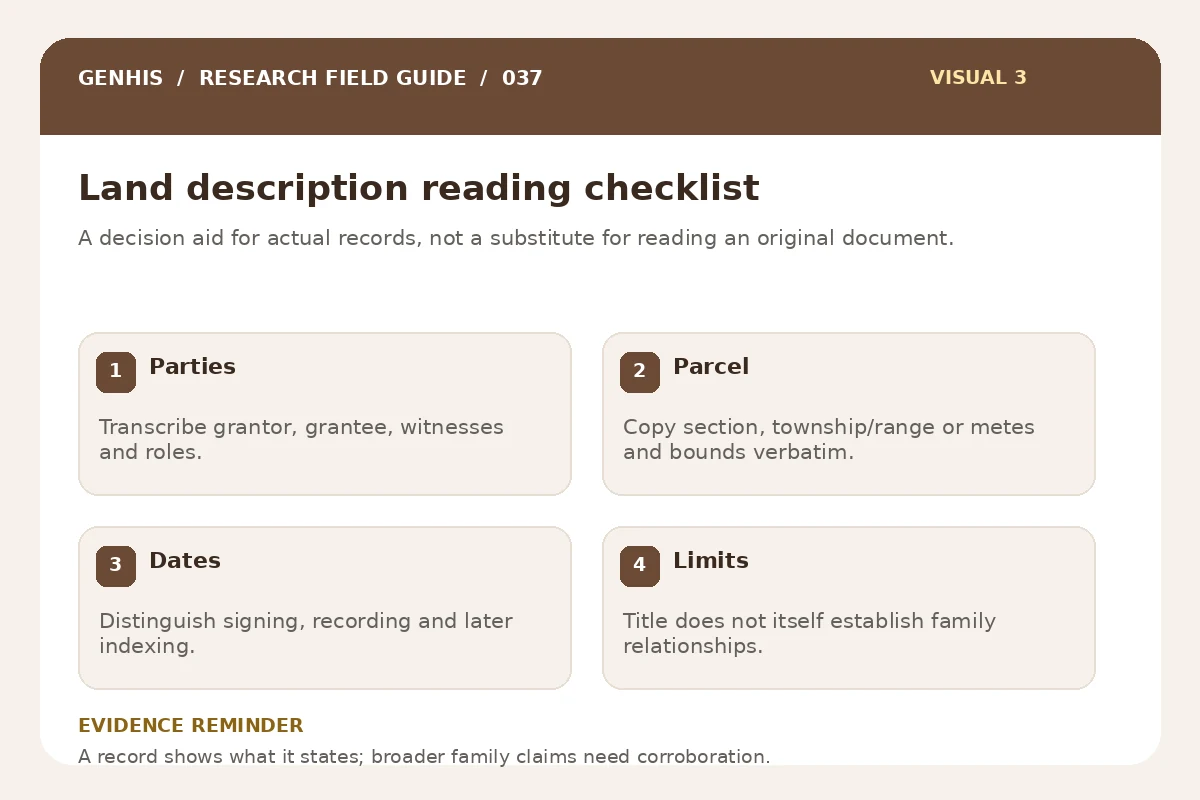
Cite maps, transactions and uncertainties together
A useful deed citation identifies the jurisdiction, office or series, deed-book volume, page or instrument number, parties, recording date, repository and consulted image. For a patent, capture the official database or record identifier and the legal tract. If a modern transcript expands abbreviations or silently modernizes a boundary, retain an image of the original wording. Clear citations are essential because a parcel can carry several different identifiers over time.
Finish by comparing the land timeline with probate, tax assessments, census residences and any local place-name changes. Tax records may establish an assessment against a named person, not necessarily residence or uncontested ownership. Census proximity may suggest a neighbor network, not a familial connection. The most useful outcome is a dated and sourced chain with visible weak links: every gap becomes a focused question for the next repository. Our guide “Historical Property Search” goes into more detail.
How We Research: jurisdiction, source provenance, and uncertainty
For land research, we compared the BLM explanation of federal conveyances with the National Archives instructions for land-entry case files and the Library of Congress account of county transfers. Those three record systems have different purposes, which is why a single surname result never settles a chain of title. The Reed illustration is fictional and only demonstrates how to test a parcel identity and a claimed family link. Local recording boundaries and actual document availability must be checked for the tract concerned.
Authoritative record sources and repository limitations
www.blm.gov — repository reference. BLM describes 2026 GLO modernization and federal land record types, including patents and plats. A search hit requires a legally described tract and a traceable transaction before it joins an ownership timeline.
glorecords.blm.gov — repository reference. BLM maintains its searchable General Land Office federal land record portal. A search hit requires a legally described tract and a traceable transaction before it joins an ownership timeline.
www.archives.gov — repository reference. NARA explains land entry case files and federal public-land-state coverage. A search hit requires a legally described tract and a traceable transaction before it joins an ownership timeline.
guides.loc.gov — repository reference. Library of Congress distinguishes county deeds, property transfers and federal versus state land research. A search hit requires a legally described tract and a traceable transaction before it joins an ownership timeline.
More Records and Archives Guides
Privacy, disclosure, and the limits of this guide
The instructions here are historical research tools, not a title opinion, property valuation, survey certification or guarantee that a parcel was conveyed. Patent images, local deeds and archival case files have distinct repositories and access conditions. None of the recommended resources is presented as an approved paid partner; see the GenHis affiliate disclosure. Keep modern owner contact information private and rely on qualified local guidance for present-day legal questions.
No. A patent is an initial federal conveyance. Deeds document later transactions between parties and are generally researched through local recording systems.
No. It focuses on federal land conveyances; state grants, colonial deeds, later private transfers and local tax lists require other repositories.
A formal description identifying the tract, potentially using township, range and section or metes and bounds. Copy it exactly before matching parcels.
No. A transfer can reflect sale, debt collection, inheritance or another legal process; examine the instrument and independent relationship evidence.
Find the associated land-entry case file if one survives, then search subsequent deeds, probate proceedings and county tax records.