
Identify a 1653–1654 Claim Before Tracing a Family
The National Archives identifies SP 63/288–302 as papers about Adventurers’ land claims in Ireland, including receipts for money subscribed under the Adventurers’ Act of 1642 and claims submitted in 1653 and 1654. These documents can document a subscriber’s stated financial interest, not automatically a legal title to a particular farm. Begin with the historical question: who paid, who petitioned, and what land interest was asserted at the claim date? Do not infer that a named claimant lived in Ireland or displaced a household personally.
The scheme arose within the conquest and large-scale confiscation of Irish land in the 1640s and 1650s. That setting is essential evidence context rather than picturesque background. A subscription to a parliamentary scheme, an administrative allocation, occupation on the ground, and ownership recognized later are distinct events. The same person may appear under different roles, and people whose land was taken may be absent from the surviving English administrative files. Record every statement as the record maker’s statement, not a neutral account of entitlement.
Use the National Archives guide to State Papers Ireland as the series map. It specifies SP 63/288–302 for these claims and explains why an item-level personal-name search is not always possible. Record the current catalogue description, piece number, any calendar locator and whether you examined a full image, a printed summary or merely a catalogue line. Those levels should never be cited as interchangeable evidence.
Choose the Correct Calendar and Piece Reference
The printed Calendar of State Papers Ireland covering 1647–1660 summarizes this group. A calendar can point toward an entry or identify a topic, but it is an editorial description, often shorter and more standardized than the original handwriting. Note the calendar volume, page and date alongside the modern SP 63 piece and folio where available. A marginal calendar number may identify an item within a volume, not an independent piece number. Confirm the matching document before quoting details.
An especially important date gate is the difference between a subscription made following the 1642 act and a claim submitted in 1653–1654. A receipt may preserve a payment statement that predates the administrative claim by years. Record RECEIPT DATE, CLAIM DATE and ANY LATER ENDORSEMENT separately. Do not treat a date on an attached copy or a modern database summary as the date an estate was granted. If the document lacks a precise day, preserve the original uncertainty.
The guide says SP 63 records are available through State Papers Online under relevant subscription terms, with free consultation at The National Archives in Kew. Digital coverage and catalogue searchability are different: a digitized document is not necessarily a fully indexed personal record. Browse the appropriate piece range and historical spellings if name search fails; check actual ordering before deciding that no claim survives.

Build a Receipt-to-Claim Evidence Ledger
Create one row per documentary assertion. Suggested columns are SP 63 REFERENCE, DOCUMENT DATE, CLAIMANT AS WRITTEN, CLAIMED BASIS, AMOUNT OR SHARE, PLACE WORDING, SIGNER OR AGENT, and EVIDENCE STATUS. If a sum is reported, copy the unit and whether it is subscribed, paid or alleged as owed. These are not synonyms. Do not interpret a share in a scheme as a measured parcel or a modern percentage of a specific townland.
A claim may be made by an agent or heir. A surname on a subscription receipt and a matching surname in the later claim do not prove that both identify the same individual. Test signatures where accessible, occupation, residence at the recorded date, business associates, inheritance language and identifiers found in independent papers. When a record says that someone asserted rights derived from another subscriber, mark the relationship as alleged until the actual instrument supports it.
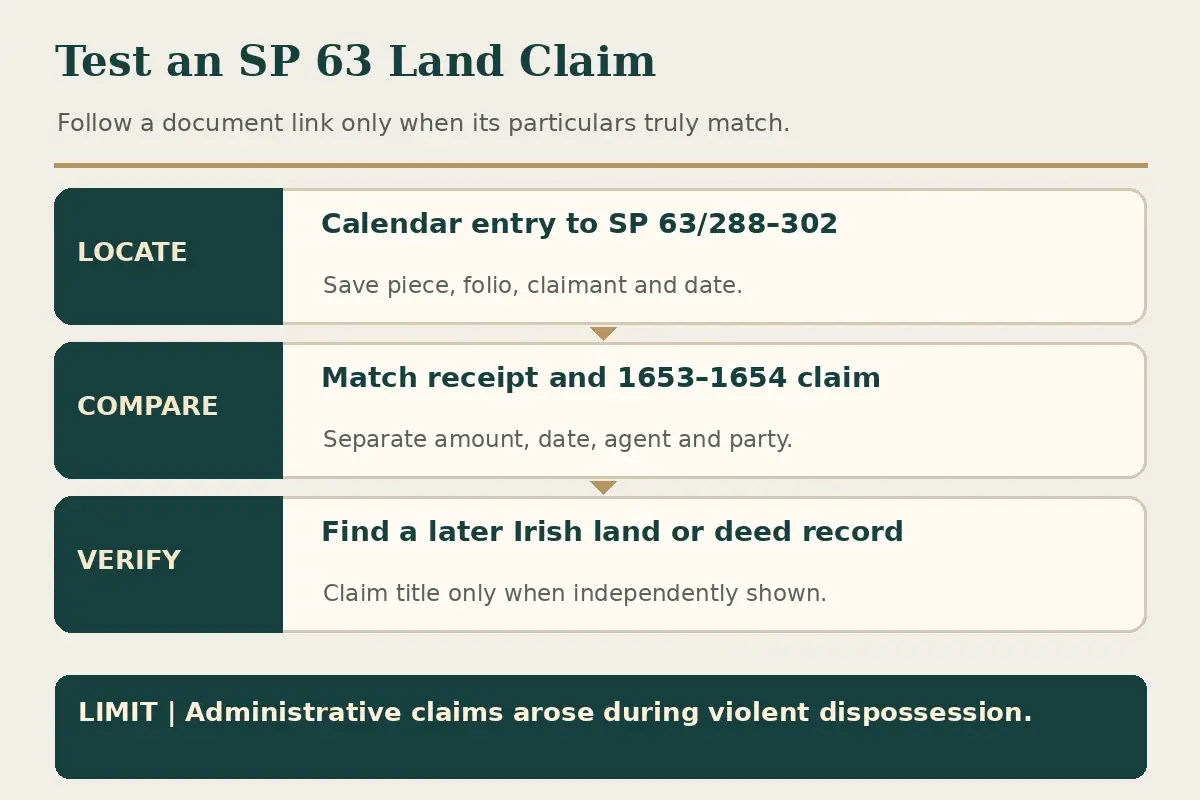
Use the table to grade each claim: directly copied from a manuscript, present only in a calendar, inferred by correlating records, or still unsupported. Distinguish the named beneficiary of a financial subscription from an inhabitant or tenant of the land. Even a map showing the same location can establish the site without establishing identity. The diagram below distinguishes receipt, administrative claim and eventual property evidence so that an enticing narrative cannot outrun the paper trail.

Test Land Location Against Independent Records
When an SP 63 item mentions a county or parcel, do not silently apply the spelling and boundaries of a modern administrative map. Record the original jurisdiction and variant place names, then seek separately dated Irish land surveys and later deeds or rental material. Surveys produced in different years may describe changed boundaries, occupiers and ownership classifications. A later printed survey is not necessarily a contemporaneous allocation under the Adventurers scheme.
The National Archives guide to crown, church and royalist lands documents different Interregnum mechanisms including E 317 surveys, orders and enrolled sales. Those are primarily English administrative records, not proof of an Irish SP 63 claimant’s title. They illustrate why a survey, sale agreement, enrollment and later occupation must be followed as separate evidence types. Choose sources relevant to the precise Irish jurisdiction rather than borrowing an English estate series as a shortcut.
For a family assertion, build a parallel person timeline from wills, religious registers, taxation and locally preserved deeds, where surviving and appropriate to the period. This is particularly necessary when a subscriber resided in England while others managed an Irish claim. An absence from a calendar may mean variant spelling, editorial omission or unexamined pieces. Report exactly what was searched; never conclude that the person did not participate solely because a name index returned nothing.
More Records and Archives Guides
How We Research Irish Adventurers’ Claims Responsibly
Our method starts with the 1642 subscription mechanism, moves to the 1653–1654 SP 63 claim, and only then looks for evidence that a stated interest was recognized or enforced. We write three independent sentences: what the receipt records, what the claimant asked or asserted, and what later title evidence actually establishes. Where the third link is missing, the conclusion stays limited. The teaching illustrations do not reproduce any specific claimant’s original documents.
A complete citation should identify the exact SP 63 piece and folio, calendar citation if used, document date, repository and image or reading-room access status. Disclose any ambiguous handwriting or unresolved similar names. Keep the record’s official language distinct from a fair historical description of dispossession, political violence and unequal access to land. These records document colonial power as well as individual transactions; avoid presenting official claims as morally or legally uncontested.
Check current Discovery descriptions and access conditions before ordering documents. Record the search range and the source that would change your conclusion. Our affiliate disclosure explains the site’s commercial transparency; none of these historical claims depends on an affiliate purchase. A substantiated family history preserves both the official paper trail and its limits rather than adding unverified ancestors to a land grant.
They are State Papers Ireland pieces containing Adventurers’ subscription receipts and subsequent land-claim papers summarized for 1647–1660.
No. A subscription or receipt records a financial statement; land allocation and later recognized title require separate proof.
The National Archives identifies claims presented then; the payments or underlying events may have earlier dates.
No. Use it to locate and identify the SP 63 original, then verify wording, endorsements and dates where possible.
No. Confirm domicile or occupation from independent dated records and treat place descriptions carefully.