
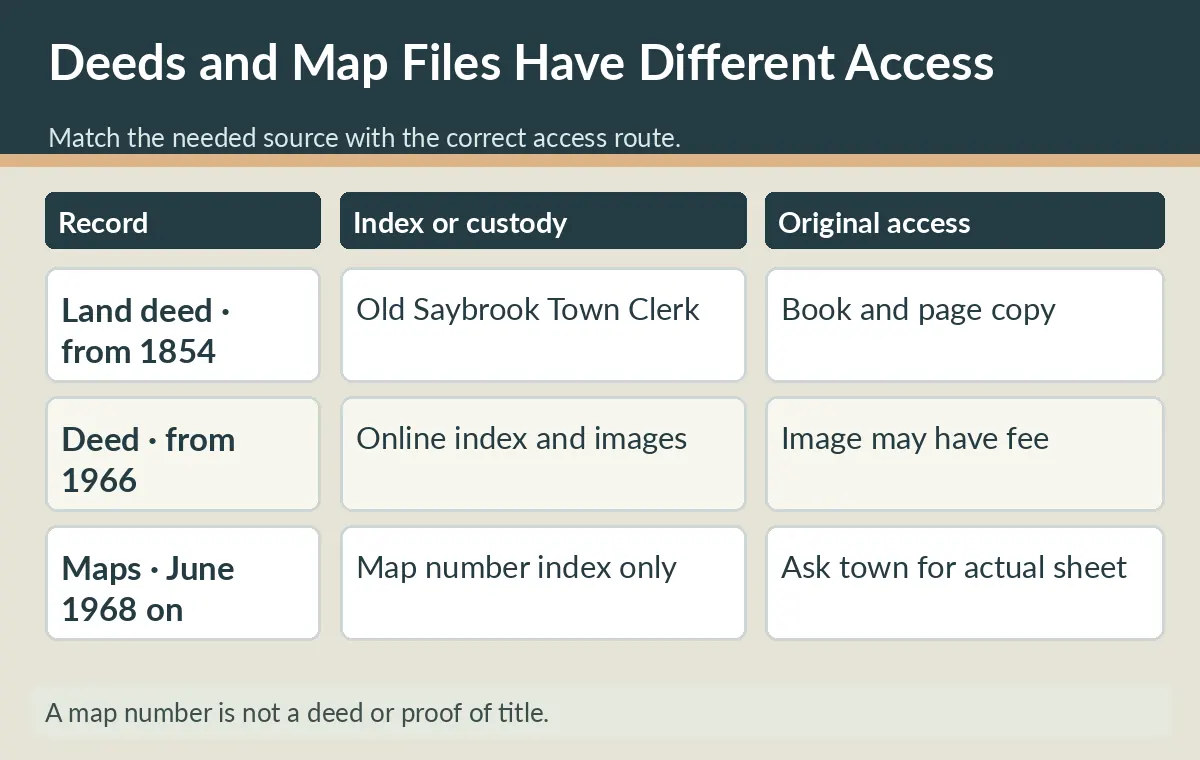
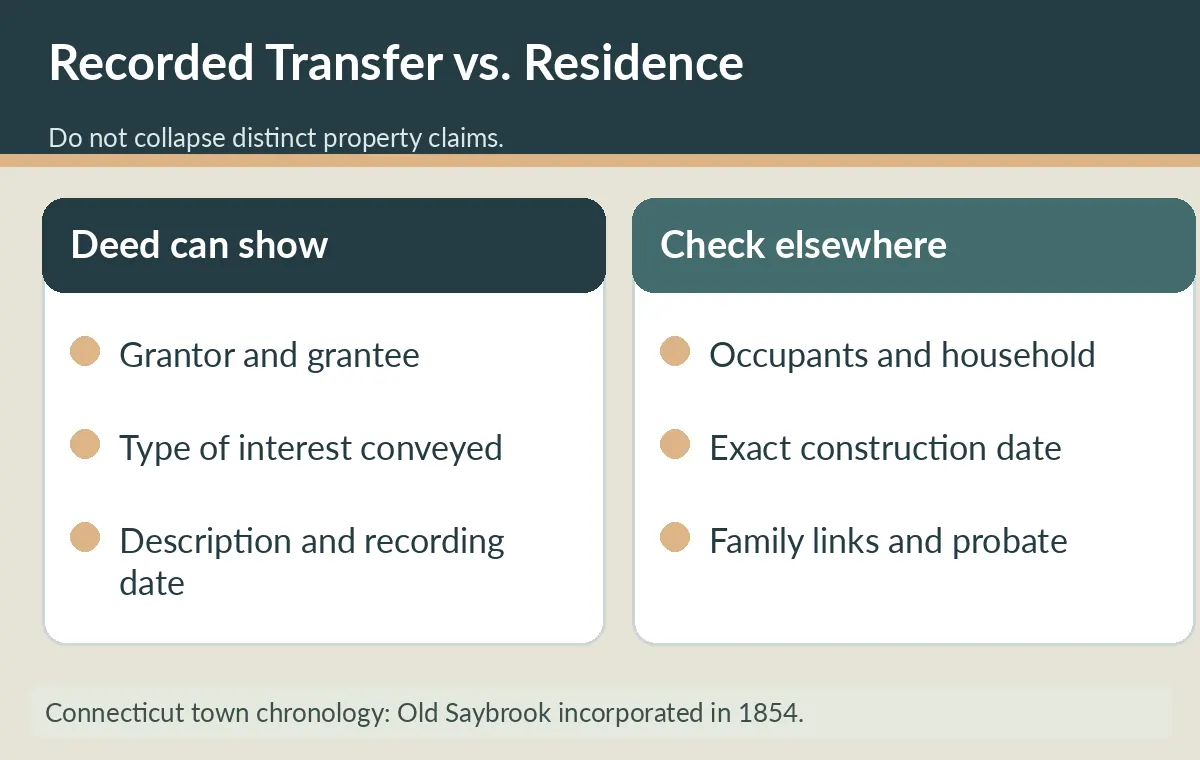
Old Saybrook land records are not one continuous online database back to the colonial era. The Town Clerk’s land-records instructions say the office has recorded land documents dating to 1854, while searchable modern land records begin in 1966; historic town maps have a different online limitation. Start with the property’s present location, identify the record year, then choose between the remote index, a town-office request and a predecessor town. A deed can support a transaction, not necessarily residence or the identity of every person with the same surname.
Choose the Old Saybrook Jurisdiction for the Deed Date
Begin with a named parcel, road or former owner and an approximate transfer date. Old Saybrook is in Middlesex County, but its modern town boundary should not automatically govern an eighteenth- or early-nineteenth-century document. Connecticut’s official town chronology identifies the 1854 incorporation of Old Saybrook out of Essex, while records of earlier Saybrook localities followed earlier municipal divisions. Make a two-column place note showing today’s street or neighborhood and the contemporary town name for the event under investigation. This prevents a fruitless search in the present-day clerk’s post-1854 land index for a deed recorded under a former town.
Do not confuse a municipal boundary change with a conveyance of land. A nineteenth-century family could remain on the same farm while the town name and record custody changed around it. The name on a tax record, the date of a deed and the place where a grantor lived may all need independent verification. Start before a proposed title transfer by comparing map clues, boundary descriptions and neighboring owners; search the historical town’s holdings when the proposed event predates the Old Saybrook series.

Use the Free Index Without Assuming Images Are Free
The Town Clerk explicitly distinguishes online viewing of land-record indexes from retrieval of the underlying document. It states that records from 1966 onward are searchable and viewable through the indexing system used in its office, with remote access also available. The index can be searched without charge, but there is a fee to view or print an actual instrument. Record document date, recording date, grantor, grantee, type, book or instrument locator and any parcel description; don’t treat the search-result label as a transcription of all covenants or the exact nature of the ownership interest.
When an index result identifies a matching deed, obtain the document image or paper copy. A common surname might appear as buyer, seller, witness, trustee or mortgage party, and these roles mean different things. Read the instrument and any attached schedules to establish who conveyed what interest, when it was signed, and whether the document describes a mortgage rather than a sale. A quitclaim deed, for example, is not the same assertion of title as a warranty deed. Keep the index reference and the full recorded deed as separate sources in your notes.
Find Early Deeds Before the Searchable Online Period
For documents recorded from 1854 to before the online searchable 1966 coverage, the town still reports custody of land records. Use the names and an approximate date to ask the clerk how the relevant grantor-grantee index and volume can be consulted. Request the exact book and page if another source supplies that locator. The office explains that land-record copies can be requested by mail and says a request should specify volume and pages. Verify current copy requirements with the clerk rather than assuming the historical record is accessible as an unindexed free scan.
Preserve the gap between the date of an instrument and the date it was recorded. A delayed recording may create the appearance of an owner remaining in the land chain after moving or dying; compare each adjacent deed in a chronological transfer worksheet. Where an inherited interest is alleged, look for separately filed probate or court records instead of inventing kinship from shared names. If the early deed is outside Old Saybrook’s custody, note that as a jurisdiction problem rather than a negative finding about the person or parcel.
Request Maps Separately From Recorded Instruments
The clerk says its map collection has been indexed back to June 1968, but the map files are not displayed as images in the digital system. The online entry is a route to a map number, not the map itself. Use a lot number, survey reference or plan title to request the correct sheet. The clerk’s instructions distinguish per-page land-record copies from a separate map copy fee for 11-by-17 reproductions. Confirm that the scale, north arrow, date, legend and adjoining parcels of the returned map actually correspond to your parcel.
A surveyed parcel outline does not establish who lived there on the survey date. If an owner name appears on a plan, classify it as a label placed by the map’s compiler. Link the map to a specific recorded deed by the described bounds or lot identifier before claiming a chain of legal title. Street names and lot numbering can change. When two maps disagree, keep both dates and the identity of the surveyor, then look for a subdivision, road realignment or later correction rather than erasing the conflict.
Resolve Two Same-Name Owners Without Inventing Kinship
An illustrative case involves two unrelated residents named John Clark appearing in separate Old Saybrook indexes. Put their deeds in a table with instrument date, grantee or grantor status, neighbors, road name, lot description and book-page reference. One Clark might have a property near the river while another occupies an inland district. Those distinct legal descriptions are stronger identity clues than spelling alone, but a match still needs independent evidence from a census, dated directory or vital entry. Never infer a father and son relationship simply because two Clarks convey adjacent lots.
If a deed names a spouse who relinquishes a right, quote the wording exactly and determine the law applicable at that date; it need not disclose a child-parent relationship. A surviving conveyance may name trustees or estate representatives. Make explicit what the record establishes: ‘a person of this name signed this document involving this property.’ Then state separately what remains unverified: household residence, heirs, duration of ownership and whether the signatory is your ancestor.
Cite Old Saybrook Record Volumes and Keep Search Limits Visible
A reproducible citation identifies the record-creating town, deed or map type, volume and page or map file number, parties, recording date, clerk’s custody, access mode and date checked. For an index-only hit, say so and add ‘underlying deed not yet examined.’ The Town Clerk office page confirms custody and supplies a route for correspondence. Avoid copying access prices into permanent citations because administrative fees can change independently of historical facts.
The GenHis affiliate disclosure explains the site’s editorial transparency; this guide does not imply an affiliation with Connecticut offices. A disciplined search log should record every name spelling, chosen year window, whether a map image was actually seen and the jurisdiction searched. Finish with a testable statement: ‘Recorded transfer located in volume X, occupancy not established.’ If you have only a free index entry, seek the original deed before assigning ownership or constructing a house history.
More Records and Archives Guides
How We Research This Collection
We compared Old Saybrook’s own land-record access instructions with its Town Clerk description and Connecticut’s official town chronology. We distinguished the 1854 municipal start, the 1966 online search period and the June 1968 map-index boundary, which belong to different record sets. We did not read a deed for any named family, and the fictional Clark illustration is not a report about a real parcel. Every family connection requires documentary corroboration.
No. The town says its land records date from 1854; investigate the appropriate predecessor town for older instruments.
The clerk states its map files are indexed but map images do not appear in the online system.
The clerk reports remote access to its index and images, with document viewing or printing subject to a fee.
No. A transfer of an interest is distinct from residence and requires independent corroboration.
Identify the contemporaneous town at the transaction date and search the earlier jurisdiction instead of assuming the current office holds everything.