
The Waipū Scottish Migration Museum is an archive of a particular migration community, not a public master family tree proving all Scottish ancestry. Its genealogy team holds family records for the people associated with the nineteenth-century route from Scotland to Nova Scotia, then through Australia to New Zealand. Start with a documented person, not only a clan surname. Ask what kind of source supports a proposed migration link—volunteered family chart, diary, letter, passenger list or civil entry—and obtain the museum’s permission before reproducing its privately contributed material.
Map Four Migration Stages Before Searching Names
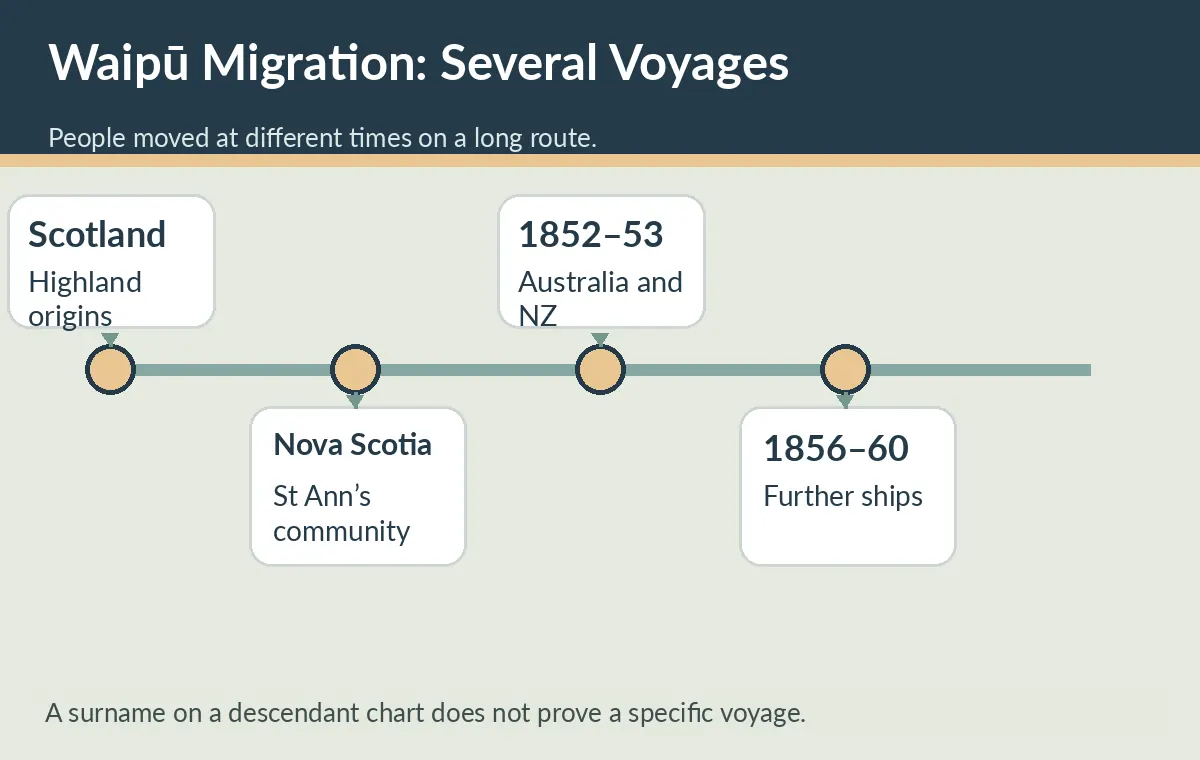
The historical story requires at least four different jurisdictions: the Scottish Highlands, settlements around St Ann’s in Nova Scotia, a period in Australia and arrival in New Zealand. Reverend Norman McLeod and his followers did not all leave on one ship or move in a single year. Te Ara’s biography describes the first group reaching Auckland in September 1853; the wider movement continued through later ships. Put each known person into a dated place column and mark every undocumented crossing as unknown instead of drawing an uninterrupted arrow because a family story sounds plausible.
Many families used similar Gaelic-derived surnames, given names and patronymic traditions. A McKenzie in Nova Scotia need not be the McKenzie appearing on a later Waipū chart. Search for occupation, age, spouse and children in an independently dated record at each stage. If a migration account names a ship but does not list passengers, treat the ship as context rather than proof that your specific ancestor traveled aboard it. Build individual timelines and allow two candidate identities to remain unresolved.
Request Museum Family Files Through the Genealogy Team
The museum explains that its genealogy database contains information collected about most families associated with the Waipū settlement. It says not every member of staff can search it and recommends arranging an appointment with the specialist researchers. Give the genealogy team the person’s full and alternative names, family links already documented, approximate birth and death dates, Nova Scotian locality, possible vessel and what specific information you want verified. Do not submit confidential details about living relatives unless permission and an appropriate research purpose have been established.
The service is not presented as universally free or instantly downloadable. The museum describes research and copying charges and an appointment system; confirm the current arrangements directly. Ask the researcher to separate an indexed name or privately submitted chart from a photograph of a contemporary document. Request archival identifiers, document dates, creators and citations, not just an attractive printed genealogy. Even a well-organized descendant file may contain older assumptions that were never tested against parish, shipping or civil records.
Read the Scottish Migration Collection as Different Source Types
UNESCO’s New Zealand Memory of the World register identifies the Waipū Scottish Migration Collection as containing diaries, personal correspondence, photographs, drawings, maps, publications and genealogies. Those formats are useful for different questions. A dated personal letter can directly place its writer in a location; a later published community history may preserve a tradition; a photograph might identify a gathering while leaving the names of many participants uncertain. Record authorship and the time an item was made, not merely the event it describes.
A diary mentions an observer’s experiences, but not necessarily a complete passenger list or every family living at a destination. A caption added many decades later is different evidence from an original inscription on the print. Transcribe uncertain handwriting with brackets in your personal notes, retain page order and avoid cropping out a signature, envelope or reverse side. Because the museum restricts reproductions of submitted charts and other material, obtain the correct permissions before circulating an image outside a private research file.

Compare the Ships and Dates Without Merging Voyages
Te Ara describes the Australian phase of the migration and later journeys to New Zealand, including Gertrude in 1856, Spray in 1857, Breadalbane in 1858 and Ellen Lewis in 1860. The initial group arrived earlier and took time to settle in Northland. Search a candidate ship and date separately in immigration correspondence, newspapers and surviving passenger records. Not every person mentioned in a later settlement narrative arrived on the same voyage, and a later arrival year need not indicate a person’s first New Zealand landing.
Keep a voyage worksheet with four columns: archival ship name and date, persons actually named, source type and unresolved alternatives. If a family record calls an ancestor a ‘Waipū settler,’ it may refer to the person or descendants rather than mean they belonged to Norman McLeod’s original group. Where a record was made after a death, mark it as retrospective. Only join the Atlantic and Pacific portions of a migration story after evidence bridges the same person, not simply a surname or a common religious affiliation.
Respect Māori Land History and the Limits of Settler Narratives
Waipū’s history did not begin with Scottish settlement. The arrival of migrant communities took place within a wider Māori landscape, with existing land interests, negotiations and colonial processes. A family’s recollection about taking up land is not itself a title deed, a complete account of those transactions or an authority to define whakapapa. Describe a museum chart as that chart’s account and seek appropriate independent archival and community evidence when reconstructing disputed land or relationships.
When presenting personal stories, distinguish a settler-era label from a modern identity or claim of belonging. Avoid publishing details of living descendants without consent. A cross-cultural connection may require respectful consultation with people who hold the knowledge, rather than a quick online assumption. If the research question is specifically about land tenure, find the relevant land records and understand their political and legal context. Genealogy files and community narratives do not replace those sources.

Document Every Generation and Ask the Next Question
Write down the archive’s collection name, item type, author, date, shelfmark or accession number, and whether you read an original or a later transcript. For museum-supplied information, note the date and scope of the enquiry and any reproduction terms. Include a separately cited birth, marriage, death, census or passenger entry supporting each parent-child transition. A reconstructed pedigree may be a guide to the next document, but should not enter your finished tree as verified simply because it came from a respected institution.
The GenHis affiliate disclosure is provided for transparency, not to imply a paid relationship with the museum. If a search turns up no file, record the spelling searched and the volunteer team’s scope; the collection is community-built rather than an exhaustive census of all people with Highland ancestry. End with a specific next task such as verifying a Nova Scotia marriage date or locating an independent passenger name list, and leave the transoceanic linkage unproved until it is supported.
More Place and Jurisdiction Guides
How We Research This Collection
We read the museum’s own research and permission instructions, the UNESCO description of its Scottish Migration Collection, and Te Ara’s chronology. We kept volunteered descendant charts, dated documents, voyage evidence and land histories distinct. We do not assert that all surname matches are migrants or that an individual unnamed in a source traveled on any ship; the research method requires a dated link at every crossing.
It describes a specialist-managed genealogy database; appointments and enquiries are recommended rather than assuming a complete public search.
The museum states that volunteered charts and materials require its written permission before reproduction.
No. The settlement began in the 1850s and additional groups arrived on later voyages.
No. Link individual people across documented times and places using independent records.
They can identify potential sources, but original civil or church records should test family relationships.