
For a British Women’s Land Army member during the Second World War, search the MAF 421 alphabetical index cards, then cross-check name, address, date of birth and any Land Army number. These cards are substitutes for largely lost individual service files, not miniature copies of complete personnel records. Record the card image and its source before you claim a county posting, wartime service period or family relationship.
Choose the Right Women’s Land Army Period
Britain organized the Women’s Land Army in January 1917 during the First World War, ended that wartime organization in 1919, and re-established it in June 1939 before the Second World War. The later organization survived until 1950. These dates matter because the accessible alphabetical cards do not cover every possible Land Girl from both wars.
A family photograph labeled “Land Girl” may have been taken in the 1917–1919 or 1939–1950 organization, and the same clothing theme does not identify the collection. First put the image, reported county, name and approximate birth year on a dated worksheet. Only then decide whether the MAF 421 search is appropriate.
Find the Alphabetical Cards in MAF 421
The National Archives describes microfiche copies of alphabetical Women’s Land Army index cards in MAF 421, principally covering 1939–1948; surviving original cards are held by the Imperial War Museum. Search the MAF 421 collection through the route in the official guide, which also identifies partner-site access and onsite fiche.
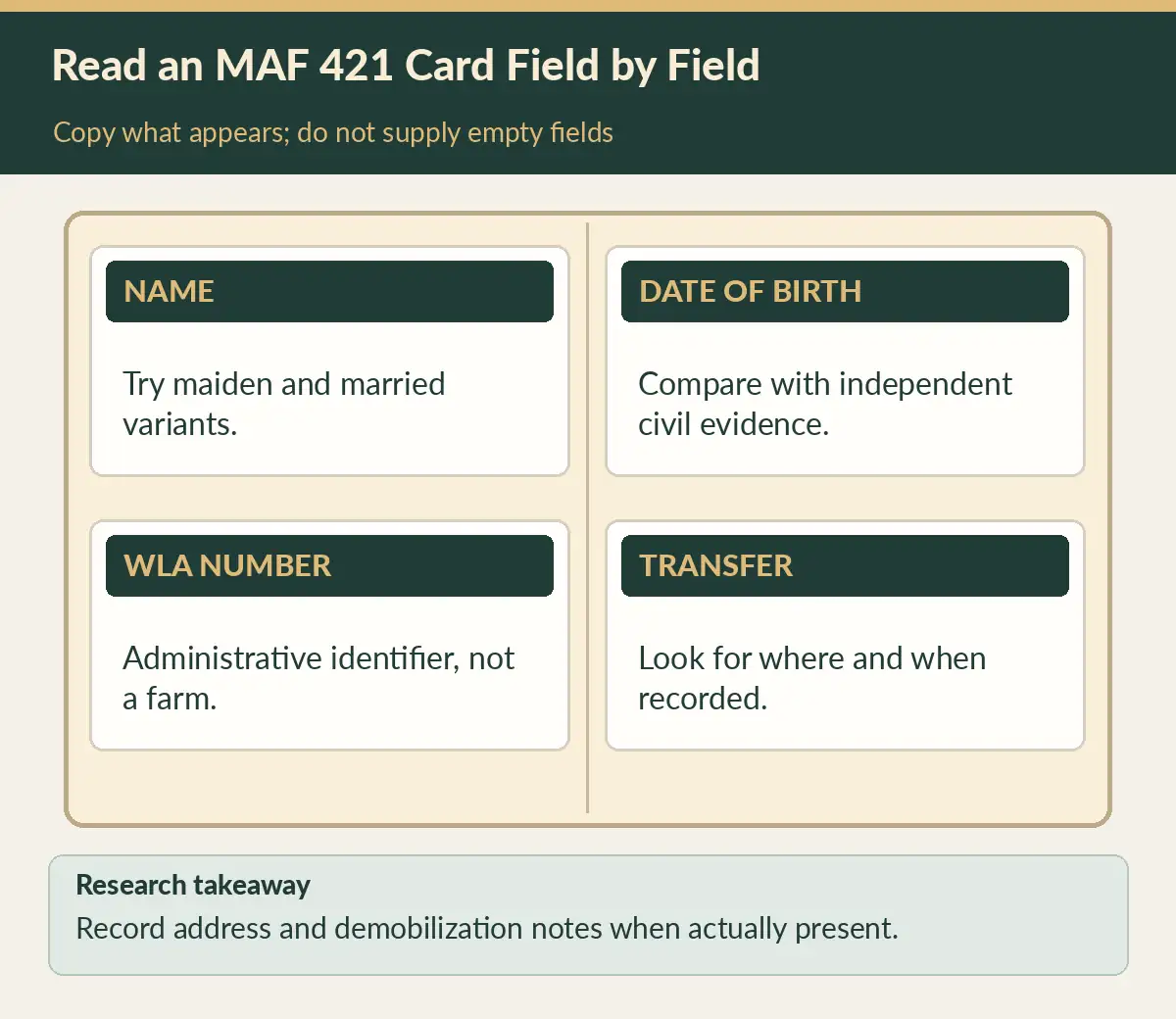
A card can include the woman’s name, address, birth date, service number, occupation, transfer destination and demobilization note. Actual fields vary. A result page containing just a name is an index entry; obtain the card image before treating any field as observed.

Account for Maiden Names and Married Names
Name change is an unusually important source of false negatives in Land Army work. The archive specifically recommends discovering a woman’s maiden name, because most members were unmarried during their service and later family documents often preserve only married names. Search each spelling independently, then compare date of birth and an address from the period.
A married surname in a 1970s obituary must not be retroactively added to a 1942 service card. In a two-candidate example, Ellen Brown born in 1920 and Ellen Brown born in 1923 cannot be joined solely because both appear in a rural county. Keep separate records until a contemporary document connects them.
Separate Online Access from Card Custody
The National Archives lists a partner search, free onsite microfiche access possibilities, and the physical card originals at the Imperial War Museum. The IWM guidance described by the archive says requests for a card copy should include full name, date of birth, wartime address and location of service when known; originals are not available for ordinary public handling.
The partner database does not display cards for women born less than 100 years before the current search. Do not attempt to bypass restrictions or infer absence from a missing online hit. Log what you actually searched, under which spelling and with which access conditions, and do not claim a negative result outside that scope.
Read Transfers and Demobilization Notes Narrowly
An entry saying “transferred” may reflect an administrative move or different placement rather than uninterrupted labor at a particular farm. A demobilization note is a recorded administrative event, not a full employment history or proof of a home address throughout the war. Extract every written term exactly, preserving abbreviations and uncertain letters.
If the card gives a county name, distinguish county committee, address of correspondence and site of agricultural work; these need not be one place. Make a three-column timeline: wording on card, cautious interpretation, and another document that would test it. This guards against turning sparse wartime records into an invented biographical narrative.
Use MAF 59 and Local Sources for Context
MAF 59 holds county committee material, photographs, recruiting posters and selected administrative files described by The National Archives. Those files explain how the wartime organization functioned, but they are not a substitute personal dossier for every Land Girl.
A local archive, newspaper, farm account book, parish magazine or oral-history collection might supply an independent picture of an individual placement. Do not infer that a person pictured in a MAF 59 photograph appears in the MAF 421 alphabetical cards. Compare dates, places, photographer caption and institutional custody, and identify which source names the woman rather than assuming identity from clothing or proximity.
Build a Card-to-Person Identity Matrix
Make one line for each name candidate: exact surname and variants, birth date, address on the card, Land Army number, county connection, transfer notation and source reference. Add comparison columns for a marriage entry, residence record or named period photograph.
Rank independent birth-date and address agreement above weak similarities such as surname alone. Where an age is rounded or an address appears later than the relevant period, report the conflict. A card marked with a service number supports an administrative registration; it does not by itself identify a particular farm, explain the worker’s wages or prove a relationship to another Land Girl in the district.
Distinguish Surviving Evidence from Missing Files
The National Archives is explicit that original personal service files have not survived in the way modern military personnel files often do. Researchers therefore work with surviving card copies, administrative records and independently preserved material.
A lack of a surviving card, a privacy-restricted card, a surname error and a person who never joined are four very different explanations for an empty search. Include these alternatives in the research log and avoid broad negative conclusions. If a 1948 card exists but a family account says the woman began in 1939, compare contemporary documents rather than invent a start date from the collection’s overall range.

How We Research a Land Girl’s Card and County Trail
We first verify the organization’s time period using the archive’s Women’s Land Army guide, then search name variants and record whether a full MAF 421 image was viewed. Next we inventory each field without supplying missing ones, distinguish county administration from farm placement, and consult MAF 59 examples for context. We compare the card with a separately sourced birth or marriage registration and preserve unresolved same-name candidates. Our affiliate disclosure explains site relationships; no commercial search partner is presumed necessary.
More Records and Archives Guides
Cite the Card, the Keeper and the Specific Claim
A reproducible citation identifies The National Archives, Women’s Land Army index cards, MAF 421, surname/card entry or relevant fiche reference, person, and the medium actually consulted. When a copy comes from a partner database, cite that container too; when consulting a separate IWM reproduction, name the IWM as the original-card custodian.
For context photographs cite MAF 59 and the individual piece, rather than the whole series alone. Include an access date, and annotate which birth date, transfer or number comes directly from the card. A precise citation allows another reader to separate observation from your inferred service chronology.
The National Archives says the original individual service records did not survive; MAF 421 is a collection of index-card copies.
The archive describes alphabetical copies mainly covering 1939–1948, not all service through 1950 or the First World War.
She may have served under her maiden surname. Search both names and compare the date of birth and address.
No. It documents a register entry; a dated transfer or local record is needed for farm-specific claims.
The archive warns that partner access excludes cards for women born less than 100 years ago; respect the stated access controls.