
The National Archives identifies a small but unusually specific Army photographic group: CG in Record Group 92, associated with flooding of the Rhine at Coblenz, Germany, and damage to U.S. Army motor vehicles around 1920. NARA’s record-group guide lists 168 images; its Still Picture Branch guide describes three albums used in investigations. These descriptions point researchers toward an identifiable group of pictures, not an exhaustive register of every flooded street, driver, or military unit in the city.
A useful first question is whether an image records a vehicle, a location, or an administrative investigation. The same photograph can help illustrate damage without saying who drove the truck, owned it, or was present when the water rose. Start with the RG 92 inventory and the still-picture description; preserve their distinct wording for date and function instead of treating both summaries as an item-level caption.
Find the Three Coblenz Albums Before Searching for a Driver
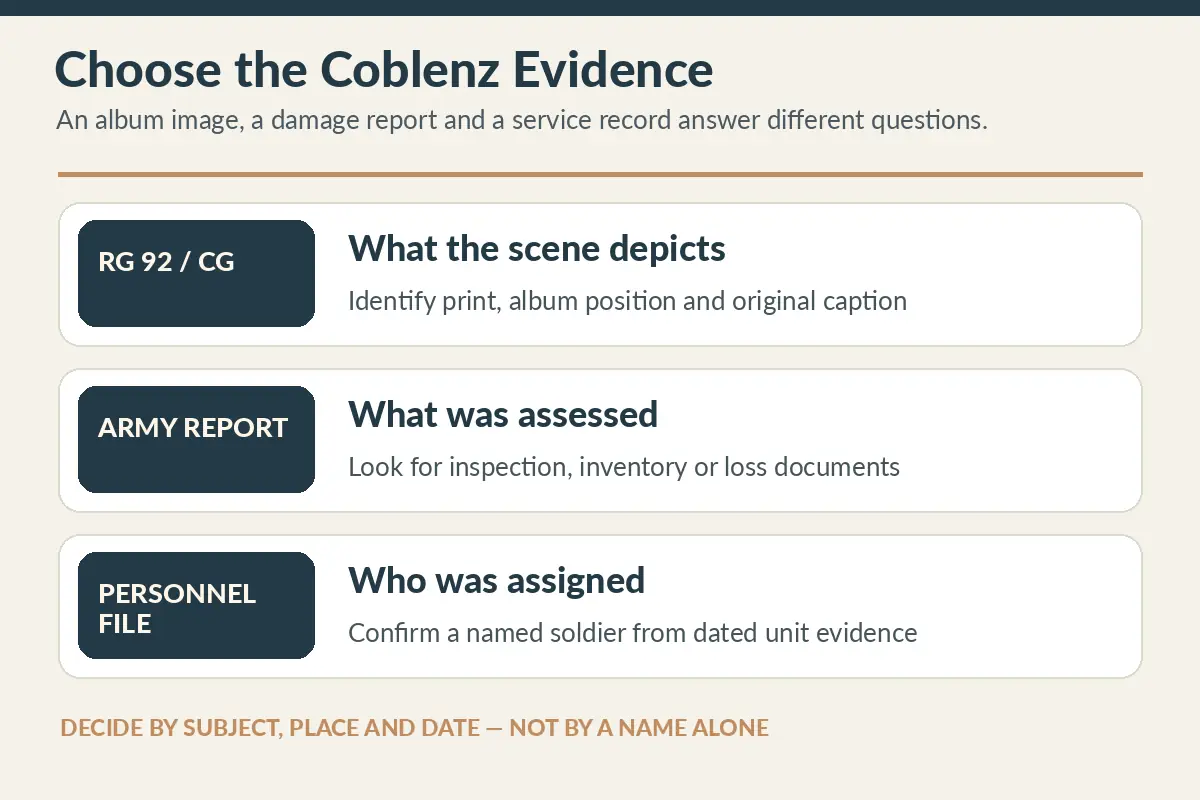
Search RG 92 with the CG designator and the place-name forms Coblenz and Koblenz. The period source uses the former spelling; a modern map may favor the latter. Ask for the three albums described by the archive rather than requesting all Quartermaster Corps photographs from Germany. Record each album identifier, image number, caption and any original ordering. Album order may reflect the course of an investigation rather than the order in which water or damage occurred.
If a catalog result shows only a series-level description, do not turn that into a claim about a particular truck photograph. Write down whether the catalog displays an actual image, a file unit, or an inventory paragraph. Describe surviving handwritten annotations as annotations, and distinguish a modern curator’s summary from text written on the album page. An archival reference is most useful when another researcher can locate the exact page or print again.
Date the Flood Separately From the Photograph and Album
The RG 92 guide gives the broader 1919–1920 date range for the CG material, while the Still Picture Branch guide identifies a Rhine flood at Coblenz in 1920. Neither wording establishes an exposure date for every print. A photo may have been taken during rising water, during cleanup, or after an investigator arranged damaged vehicles for inspection. Date evidence can include original captions, dated letters, numbered negatives and records contemporary with the event.
Do not borrow the date of an unrelated flood or a local newspaper headline to label the image unless the location and circumstance match. An inventory date can span record creation and subject content. Keep three fields in your research notebook: event date supported by independent evidence, photograph date supported by its own metadata, and album compilation date if ascertainable. Mark unknown values honestly; a guessed day creates apparent precision without adding knowledge.
Identify a Vehicle Without Imagining the Crew
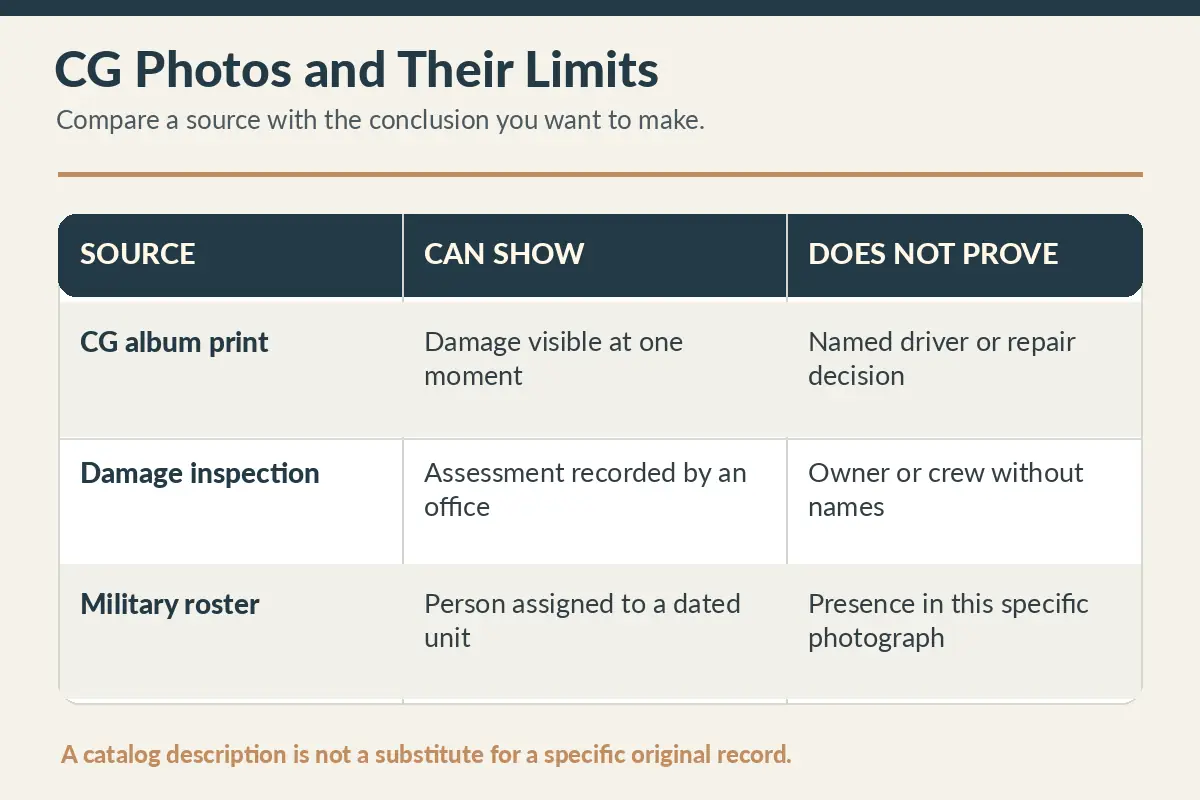
A number plate, painted unit marking, chassis outline or damaged equipment may provide a lead. Transcribe what can actually be seen, including partial markings, and preserve uncertainty where a character is obscured. A matching vehicle type is not a unique identity; multiple Army trucks may share the same manufacturer or body. The CG series exists because investigators were interested in equipment damage, not because a photographer was compiling named-service portraits.
To connect a named driver or mechanic to a specific vehicle, look for a separately dated motor-pool assignment, unit roster, transport report, maintenance record or individual service documentation. Search for the relevant Quartermaster organization and the precise Coblenz date, then compare the person’s confirmed assignment. A soldier’s presence in occupied Germany alone does not make him the man behind the wheel in one of the photographs.
Use Damage Evidence Carefully in a Family or Town History
The photographs can show that equipment stood in flood-affected conditions and may depict particular forms of damage. They cannot by themselves price the loss, document payment, assign legal responsibility or establish why a motor failed. A picture of a submerged axle is not a dated accounting entry. Look for contemporaneous inspection reports, claims, inventory adjustments or correspondence before stating that a particular vehicle was written off or repaired.
If a family story mentions a relative who helped with cleanup, a CG album may provide responsible contextual illustration. Caption it as a photograph from an investigation of Army vehicle flood damage rather than a portrait of the relative. To demonstrate the person’s work, pursue named unit orders, letters, diaries or period reports that connect the individual to a place and task. The most convincing narrative keeps context and biography visibly separate.
Make the Final Citation Reproducible

For a print-level citation, retain National Archives, RG 92, CG, album and item details, plus the exact caption and image access information. If the repository offers no digital scan, cite the collection description accurately and request the relevant album or item. Do not assert that all 168 images are online. A cropped image without its edge inscriptions may hide critical evidence, so preserve the source context when sharing a copy.
Write a restrained caption: “CG album photograph associated with investigation of U.S. Army motor vehicle damage during the 1920 Rhine flood at Coblenz,” then add the verified local scene or equipment description only if the original print supports it. Avoid claiming that the image depicts a particular regiment, driver, or exact street without corroboration. This is an effective family-history image precisely because it does not pretend to be a personnel record.
Worked Example: A Flooded Truck Said to Belong to a Relative
Suppose an inherited letter places an Army mechanic near Coblenz in 1920, and an online article shows a flood-damaged truck said to be his. First confirm the letter’s date and unit, then locate the photograph’s original CG album and caption. Look for a visible serial or unit marking and ask what the album itself actually records. If the only link is a matching city and year, the photograph remains contextual; it is not proof of that mechanic’s assignment to the truck.
An independent vehicle ledger or dated correspondence naming the mechanic might permit a stronger connection. Even then, check that the record identifies the same vehicle rather than a similar one. In the final story, quote the confirmed family letter and describe the CG image as a separate archival source. It is acceptable to say that no personal identification has yet been proven.
More Records and Archives Guides
How We Research and Document These Sources
We compared the two NARA descriptions and deliberately retained the difference between their general dates and the more specific 1920 event wording. We do not claim to have inspected each CG print or to know that scans are available. The archive’s item count is a holdings description, not evidence that every image is a unique flood incident.
For any personal connection we require two independent links: a precise item or album identification and a reliable source placing the named person with the relevant vehicle or task. Preserve original captions, alternative place-name spellings and uncertainty in transcribed markings. Our affiliate disclosure explains the site’s general relationship policy; this research path does not depend on a commercial partner.
No. CG consists of photographic albums used in investigations of flood damage to Army vehicles; names require separate evidence.
The RG 92 guide lists 168 images for the Coblenz flood-damage group. It does not say all are digitized.
Coblenz is a historical English and period spelling; Koblenz is the usual modern name. Preserve the spelling used in a source.
A marking may narrow a vehicle or unit, but a named driver needs an independent assignment or personnel source.
Cite the description as such and use its series and album information to inquire about the original item.