
In Record Group 92, the National Archives identifies an album of 34 photographic images documenting Mississippi River flood conditions in Tennessee and Kentucky in 1912. The collection is listed among the Office of the Quartermaster General’s still pictures and carries the archival code MRF. These photographs can help reconstruct a landscape, damaged building or flood response. They do not automatically name the people pictured, prove a particular family’s property damage or show that every image came from the same town.
The productive approach is to establish the photograph’s provenance, then its location, and only after that test a proposed family identification. An unlabeled person standing beside flooded houses may be a resident, visitor, worker or official; appearance alone cannot decide. Captions are valuable clues but must be treated as written assertions, especially if copied long after the original image. Create a photo log that keeps visible features, original captions and modern interpretations in separate fields.
Locate the Quartermaster Album and Its MRF Code
The NARA Guide to RG 92, section 92.17, describes “Mississippi River floods in Tennessee and Kentucky, in album, 1912” and identifies the MRF series. The Still Picture Branch guide independently mentions the same archival album. Use the title, year, record group and MRF code in an inquiry rather than searching only “1912 flood pictures.” A generic internet search often mixes different Mississippi River floods and images from other decades.
Ask for the current finding aid, series description and whether the 34 images have item-level records or digitized representations. NARA’s Guide gives a total image count, not a guaranteed caption transcription for each image. If access is possible, inspect the front and back of each print, album page order and any handwritten sequence numbers. A modern web filename is not automatically the original item number.
The album’s custodian was a federal military supply organization. That context can explain why the series survived, but it does not prove that every scene depicts troops or military relief personnel. Identify the particular print’s visual content and any accompanying annotation before assigning a role. Photographs often document surroundings as well as the work of the collecting office.

Date the Flood Scene Without Borrowing a Later Caption
The archival album is dated 1912. That is a secure collection-level reference, but a researcher still needs the print’s own caption or a corroborating record to supply a precise day. Compare the image with contemporary river conditions, town reports, period maps and documented damage descriptions. Do not label the photograph “April 5” solely because a local newspaper on that day reported flooding; news publication and camera exposure are separate events.
Examine what can actually be seen: the height of water against a doorway, the kind of road, the shape of a levee, signage or rooflines. Record the feature before naming it. Temporary wooden structures, boats and damaged fences can change quickly and may appear different in photographs taken a few days apart. A claimed date should survive comparison with nearby frames and with independent documentation.
If the original mount contains a place or date, quote it and attribute it: “Album caption reads …” rather than “The photograph definitively shows …” when the identification has not been checked. A miscaptioned print may still be genuine evidence of flooding. Maintaining that distinction avoids turning a collector’s note into an undisputed historical fact.
Use Maps to Distinguish Tennessee and Kentucky Locations
Search historical maps and town plans from the appropriate period for river bends, road approaches, embankments, docks and distinctive buildings. A broad resemblance between two waterfronts is weak; a group of independent landmarks is stronger. Record the map’s survey or publication date, scale and names because river channels and shorelines can shift. A present-day satellite map should be treated as an orientation aid, not the sole geographic authority for a 1912 scene.
The NARA album explicitly covers Tennessee and Kentucky but does not claim every community in those states was photographed. If a proposed scene belongs to another state, test that possibility against the item’s original caption and its place in the album before silently overriding the archive description. The goal is not to force the image into a favorite hometown but to let independent clues narrow its origin.
When a building appears in multiple frames, compare roofline, window count, nearby objects and the camera viewpoint. A sequence can help reconstruct adjacent streets or areas, yet album order does not necessarily equal exposure order. A compiler may have grouped pictures thematically. Cite each photograph separately if your argument depends on the relationship between images.
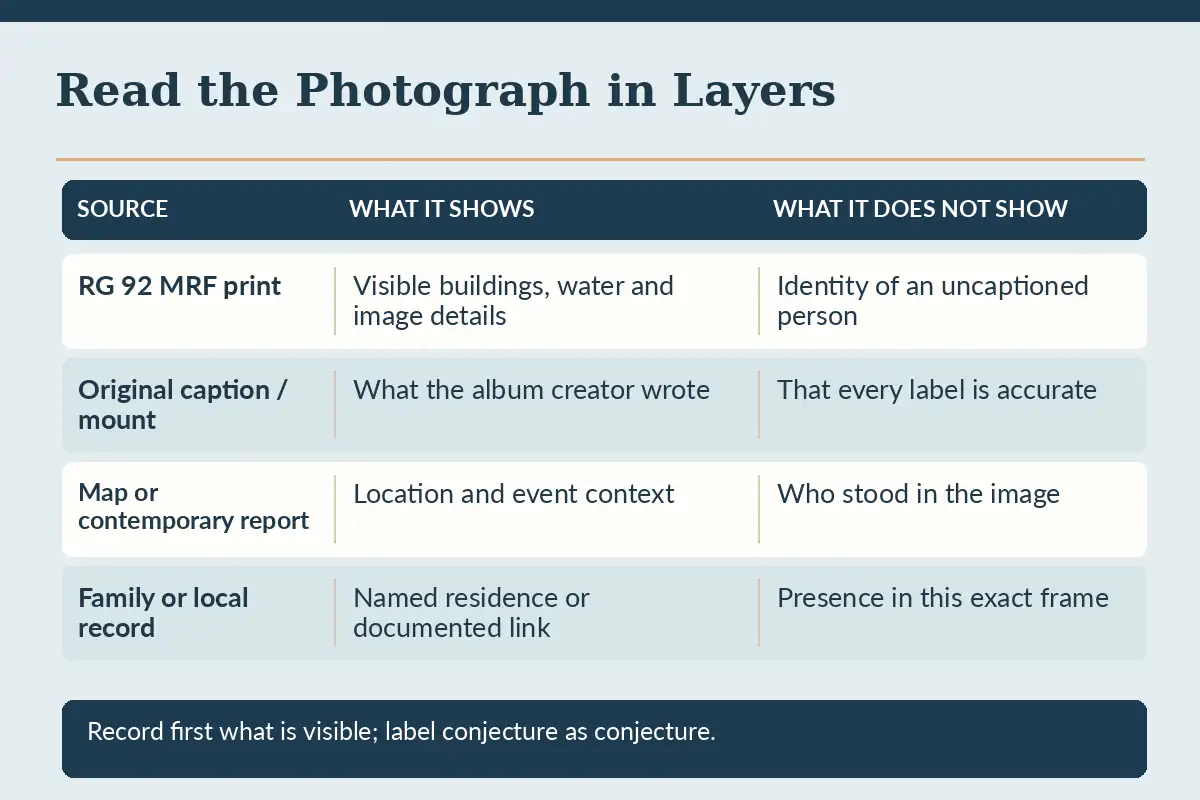
Distinguish Flood Residents From People in a Photograph
Even a well-identified street does not establish that the people pictured lived there. To connect a family, consult contemporary household records, city directories, deeds, local newspapers, relief applications if they survive, and personal letters with demonstrable provenance. A deed shows a property interest at a particular time, not automatic presence during the flood. A census household can establish residence on an enumeration date but not the individual’s position in an unknown photograph.
Family annotations may preserve valuable oral information. Record the identity of the person who labeled the image and when that label was added; compare the candidate’s age, clothing context and known circumstances. Do not make facial similarity to a later portrait the only test. Multiple independent records can support an identification, but when they remain circumstantial the caption should use “possibly” or “unidentified.”
An ethical caption does not need a personal name to be useful. “Flooded houses along an unidentified Tennessee or Kentucky riverbank, in a 1912 Quartermaster album” can be accurate if the precise location is not established. Add new detail only when its source is cited. This method protects the historical record against gradually accumulating confident but unsupported labels.

Preserve the Image and Its Evidence Trail
Keep the best permitted reproduction without cropping away the mount, reverse, edge writing or album number. Store the unedited version separately from contrast-adjusted copies used for comparison; a cropped detail may be helpful for recognizing an architectural feature but cannot stand alone as a full citation. Record who supplied the image and whether the file came directly from NARA or from an intermediary.
In the final family history, cite Record Group 92, the MRF album, the particular print identifier if available, date and location as documented, and any map or local record supporting the interpretation. State that the 34-image total is an archive description of the album, not evidence about the number of people or households affected. That prevents a compelling picture from carrying claims it was never able to prove.
More Family Story and Preservation Guides
How We Research This Historical Record Group
We checked NARA’s RG 92 still-picture description and its separate Still Picture Branch guide, both of which identify the MRF album, 1912, with Tennessee and Kentucky flood scenes. The guide’s 34-image count concerns photographic holdings; it does not identify people, precise exposure dates or all affected towns. We use NARA Catalog guidance for item-level follow-up.
The official sources are RG 92 photographic holdings, the Still Picture Branch guide, and the Catalog instructions. Our affiliate disclosure is included for transparency; there is no required commercial photo service.
NARA identifies an MRF album with 34 images of 1912 Mississippi River flood conditions in Tennessee and Kentucky.
The record-group description does not guarantee an individual location caption for each print.
Only when independent evidence reliably links the person to that specific photograph; otherwise mark the identity uncertain.
Not automatically. Check whether it is contemporary and corroborated by other dated material.
Retain the whole print, mount or reverse when possible, original caption, album code and precise archive reference.