
NARA identifies records of the West Point Hotel, dated 1839–1927, in Record Group 404 of the United States Military Academy. The listing appears in section 404.15, miscellaneous post and academy records, and it specifies West Point as the location. That is a concrete historical lead for hotel and local-history research. It is not proof that guest registers exist for every year, nor that a named traveler lodged there. The published finding aid describes “records” generically; the right first question is which document types are actually preserved and whether their original arrangement permits a person-level search.
A hotel has multiple documentary identities: a business serving visitors, a physical building within a military installation, a local employer and a setting in family stories. Different records could illuminate those roles, but no one role should be inferred from the others. Someone photographed near the hotel was not necessarily a paying guest. A worker named in an academy account may have been employed elsewhere. The task is to distinguish archival description, firsthand entry and independently corroborated stay, rather than building a narrative from a suggestive name alone.
Start With RG 404.15, Not a Guest List Assumption
Open the NARA Guide for RG 404 and locate section 404.15. Its West Point Hotel entry gives a date span of 1839–1927 without specifying room books, reservations, payrolls or account ledgers. Those forms must be confirmed from the current item or series description before being advertised as accessible. Ask the archival reference staff for the inventory, arrangement, extant containers and any known finding aid. In the request include the exact phrase “Records of the West Point Hotel,” the date span and RG 404. Generic web searches for hotel names may produce modern accommodations with the same words.
Check whether the record is held in West Point as the Guide indicates and what procedures apply to the current research location. The Catalog may describe a series without indexing names inside bound volumes. Requesting a digital name search of every page may therefore be unrealistic. A better starting query includes the year of a purported visit and the type of supporting document: travel diary, appointment notice, letter, invoice or dated photograph. If the hotel documents are not indexed by guest, an independent date gives staff and researchers a more practical way to narrow the search.

Separate a Hotel Business From an Individual Visit
A surviving hotel record could concern management, supplies, repairs, correspondence or money, and may not name guests at all. Do not infer a guest register merely because hotels commonly kept them. When the archive identifies an actual volume, read its title page and columns before transcribing names. A person signing a financial receipt might be a supplier rather than a visitor. An invoice for lodging can document a charge without proving that a particular individual personally occupied the room. Record the role assigned by the original text, not the role that would make a family story more interesting.
Likewise, an address in a letter such as “West Point Hotel” can mark where mail was sent or where a meeting took place, not necessarily a permanent residence. Compare an alleged stay with dated correspondence, city directories, travel schedules, newspaper notices or family diaries. Be alert to two people sharing a surname and to later recollections of a visit whose dates drift. If only a general institutional file survives, the defensible conclusion is that the hotel operated within the documented period, not that the ancestor stayed there.

Connect the Hotel to the Site and Its Workers
For building history, treat the hotel as a structure with a changing physical setting. An academy site plan may show a location, while a renovation account might date improvements. Neither document automatically names occupants. Check whether the identified plan uses a contemporary label and whether the building shown is actually the same one that existed during the alleged family visit. The date range 1839–1927 may cover multiple administrative stages, so avoid projecting a late photograph’s appearance onto an early nineteenth-century account.
For employees, use a different evidence path. Payrolls, service accounts, local directories, census employment descriptions and surviving personal papers can help identify workers if the relevant sources exist. But RG 404.15 does not promise a continuous hotel employee register. A surname on an academy payroll is not necessarily a hotel employee, and working at West Point does not establish lodging in the hotel. Use a date-and-role ledger to distinguish hotel operator, employee, contractor, visitor and member of the academy community.
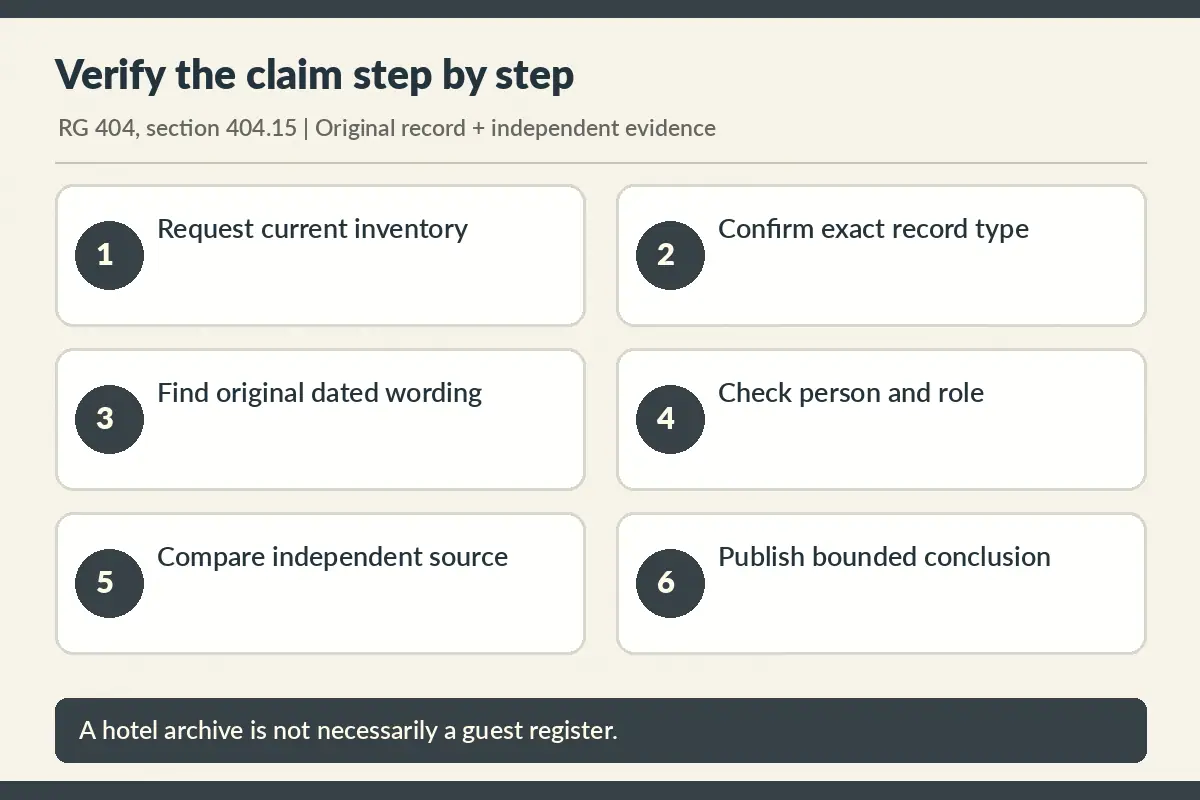
Before paying for a copy or planning a trip, ask whether the current inventory includes a name index and whether the volumes are accessible for the target years. The broad 1839–1927 span in the Guide does not guarantee continuous day-by-day survival. Note missing folders explicitly and avoid filling them with guessed names from tourist accounts. A well-scoped reference request saves effort and produces a stronger citation than a broad surname hunt.
Build a Verifiable Family or Building Narrative
Document every candidate with four fields: date, original document type, exact wording of the person’s role and independent corroboration. If an item is a later transcription or clipping, identify the underlying record if possible. Record the RG 404 reference, the West Point Hotel series designation, page or folder, and the present holder given by the archive. A screenshot of a Catalog result can establish that an archival series exists, but it does not replace a citation to the inspected guest or business entry. Avoid implying that documents were personally reviewed if they were not.
The most useful outcome may be narrower than a family tradition. You might confirm a hotel account from a year when an ancestor traveled near the academy without yet connecting the person to that account. Or independent correspondence might prove a visit while the hotel archive offers only contextual evidence about the building. Publishing each proposition separately preserves historical value and leaves clear questions for future research. Silence in a fragmentary hotel file is not proof that an individual never visited.
If a personal diary says “we stayed at West Point,” record those words exactly. The place name can describe an installation or a surrounding community rather than the hotel by name. A separate bill or letterhead mentioning the West Point Hotel would narrow the meaning, but it must be dated and connected to the same traveler. Language matters as much as geography when turning a travel memory into a record-based claim.
More House and Local History Guides
How We Research These Archival Claims
We verified that NARA section 404.15 describes West Point Hotel records for 1839–1927, but the public Guide does not identify their internal document types. We therefore do not call them guest registers, payrolls or reservations until an actual inventory or original volume supports the description. This distinction is the core research safeguard.
Start with NARA RG 404, use Catalog guidance to narrow a record group, and confirm access through NARA locations. Review the affiliate disclosure; no hotel booking or commercial archive is affiliated with this guide.
The NARA Guide lists records dated 1839–1927 under RG 404.15.
No. The public Guide calls them hotel records but does not specify guest books or continuous coverage.
Section 404.15 identifies the miscellaneous post and academy records as being in West Point; confirm current access.
Not alone. It might show correspondence or a meeting address. Seek person-level lodging evidence.
Only an original item that actually names the person and role could do so. Confirm the record type before drawing conclusions.