
Removed Graves RG 37 is best used as a specific archival lead, not as a complete family biography. Start with an exact reference, distinguish what a surviving record actually states from what you infer, and use at least one independently created source before naming a person or asserting an event. This guide follows the available archive descriptions and highlights common traps in historical dates, coverage and institutional terminology. The goal is a reproducible decision about which document to examine next, not a plausible story produced from a matching name alone.
Create a working note with the research question, likely place and period, identity clues and the kind of document that could actually answer it. Record gaps in survival and access without treating them as evidence that the event never occurred.
Identify the former burial ground first
RG 37 records in the custody of The National Archives relate to removal of graves and tombstones from disused or closed burial grounds. Deceased Online, which provides a searchable collection of these materials, describes scans of original transcriptions supplied by local authorities and Church Commissioners, with coverage from numerous sites in England and Wales. The documents are not a complete national index of everyone buried in a closed cemetery. They are better treated as a place-linked collection of surviving memorial words and associated records.
Begin with the most precise historical site name you can find: parish, cemetery, chapel, street, town and local authority. A modern district label may not match the jurisdiction used when the stone was recorded. Note alternative names for the same ground and any known closure or redevelopment date. Then search RG 37 holdings by place and by the candidate person’s surname. If the site is outside the described coverage, a name search elsewhere in the database cannot prove the memorial never existed.
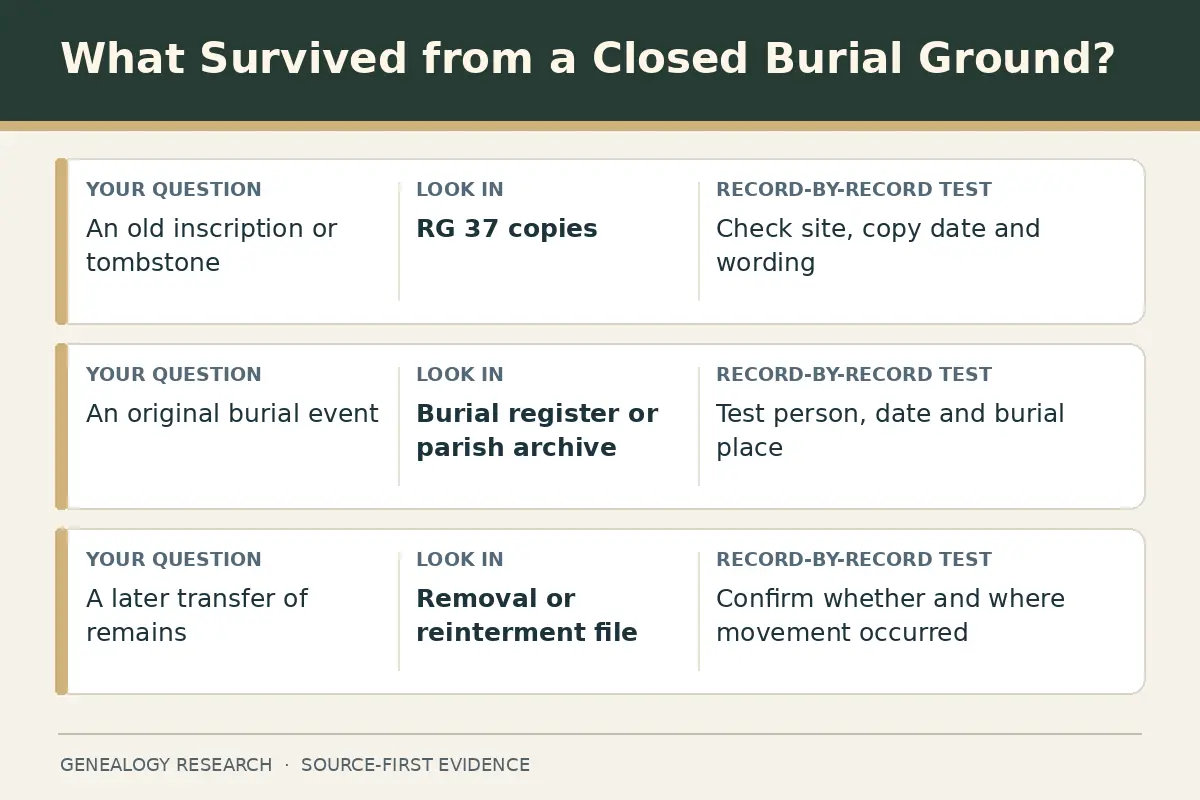
Keep inscription, transcription and burial separate
The physical gravestone, a later transcription of its lettering, a burial register and a cemetery plan are four different sources. A transcript may preserve words that no longer survive on a stone; it may also contain a reading error, omit damaged lines or represent multiple family members on one marker. The collection description notes that the inscriptions can be much older than the administrative transcriptions, which were created over the twentieth and early twenty-first centuries.
For each record write two dates when possible: the event or death date claimed by the inscription and the date the inscription was copied or deposited. Do not date an ancestor’s death from the copy date. Keep uncertain letters in a diplomatic transcription before offering a normalized reading in a separate note. An inscription may commemorate someone buried elsewhere or a relative with no surviving individual burial entry at this particular site.
Treat the coverage figures as descriptive, not complete
Deceased Online describes RG 37 as a substantial but selected collection, including transcriptions from more than two hundred burial grounds. The geographical extent and content vary from site to site. The years shown for a site are often the range of dates appearing on inscriptions rather than a continuous register of burials made during those years. A family name missing from a site record may reflect stone loss, transcription scope, damaged lettering or burial without a monument.
Make a negative-search log specifying the exact ground, variants, date window, online filters and any image pages inspected. If the site is present but the sought name absent, consult the corresponding burial register, grave plot books, newspaper notices and local parish records. Those may show a burial for someone who left no legible memorial. The absence of a tombstone transcription is not enough to negate a documented burial.

Do not confuse removal of stone with reinterment
The title “Removal of graves and tombstones” covers administrative situations that must be examined in their original documentary context. A stone can be moved or recorded before redevelopment without proving that every set of human remains was exhumed and placed in a particular new grave. Modern England and Wales guidance differentiates removal of remains from other cemetery activities; those modern procedures should not be applied mechanically to a historical case governed by different authorization.
To establish reburial, search for an explicit removal schedule, official authorization, contractor account, receiving cemetery entry, new plot number or local newspaper record. Compare names and dates between the older inscription and the later administrative document. Label a mere proposed transfer as “planned,” a documented execution as “carried out,” and an unknown destination as unknown. The original site’s disappearance cannot by itself locate a person’s current resting place.
Build an identity test for grouped family stones
Family memorials often list spouses, children and relatives in a compact inscription. The wording may suggest a kinship, but an entry such as “beloved mother” could refer to someone whose precise parentage remains unverified. Transcribe the memorial in its original sequence, noting which dates belong to which line. If a copied inscription is partially illegible, keep the doubt. Later surname matching from the census or probate calendar is useful only if the place and relationship evidence agree.
Test the proposed family against independent baptism, marriage, burial, census and estate sources appropriate to the era. Two people named Mary Smith may share a town and decade; age, spouse, occupation or specific address is needed for stronger identity. A shared gravestone can also be a memorial made after the person died somewhere else. The aim is not to build a family tree from an isolated carved name, but to use the inscription as one independently documented strand.

Prepare a citation and a careful conclusion
Cite the collection name, historic burial ground, record or image identifier, exact copied inscription and the repository or access provider. If the source is an image of a transcription rather than a photograph of the original monument, say so plainly. Include any transcriber’s notes and the uncertainty of the reading. For an online commercial viewer, distinguish what can be checked from the public description from what requires access to a particular image.
A defensible conclusion might be that a named memorial was transcribed from a specified ground before or during its clearance, without claiming that the individual’s remains were moved. The next research action would be an original burial entry, a site plan, or a recorded later transfer. This approach restores useful family evidence even when a cemetery has disappeared, while respecting the real difference between inscription, burial and reinterment.
More House and Local History Guides
How We Research and Verify These Archive Claims
We checked the relevant descriptions and searching instructions against the collection access provider and the collection access provider and The National Archives. These sources describe record categories, access and limitations; they do not identify any unnamed ancestor or certify a speculative biographical match.
For every claim we distinguish the wording of the inspected record, the archive or provider description, and our own proposed interpretation. Researchers should verify piece-level holdings and availability at the time of consultation. This is noncommercial guidance; see the affiliate disclosure for site policy.
No. The collection is selective and commonly preserves inscriptions or removal-related records rather than a complete burial register.
Not necessarily. Many RG 37 records are later administrative transcriptions, so the transcription date matters.
No. Look for explicit evidence of exhumation, transfer and a receiving grave before identifying a new burial site.
No. Correlate relationships and identities with independent parish, civil or family records.
Preserve the complete RG 37 citation, original site name, transcribed wording, uncertain letters, and any independently verified burial evidence.