
WWI Munitions Photographs MUN 5 is best used as a specific archival lead, not as a complete family biography. Start with an exact reference, distinguish what a surviving record actually states from what you infer, and use at least one independently created source before naming a person or asserting an event. This guide follows the available archive descriptions and highlights common traps in historical dates, coverage and institutional terminology. The goal is a reproducible decision about which document to examine next, not a plausible story produced from a matching name alone.
Create a working note with the research question, likely place and period, identity clues and the kind of document that could actually answer it. Record gaps in survival and access without treating them as evidence that the event never occurred.
Start with what MUN 5/75 actually identifies
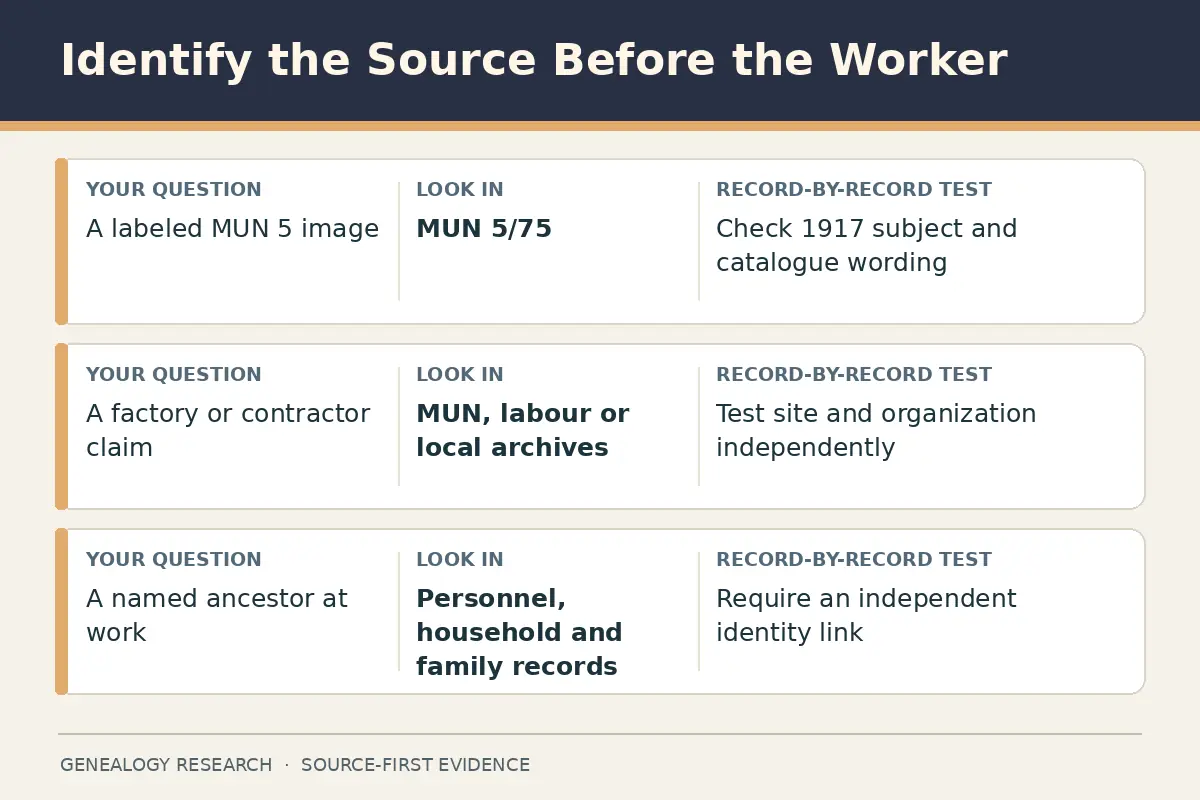
The National Archives illustrates women’s First World War engineering work with a 1917 photograph catalogued as MUN 5/75. Its published description identifies a fifteen-year-old girl turning ball ends for an aircraft engine. This is powerful historical evidence of a type of wartime work, but it is not an automatically searchable roster of everyone who worked in the workshop. When a family researcher finds an old photograph of a woman near machinery, identifying the activity and the person are separate questions.
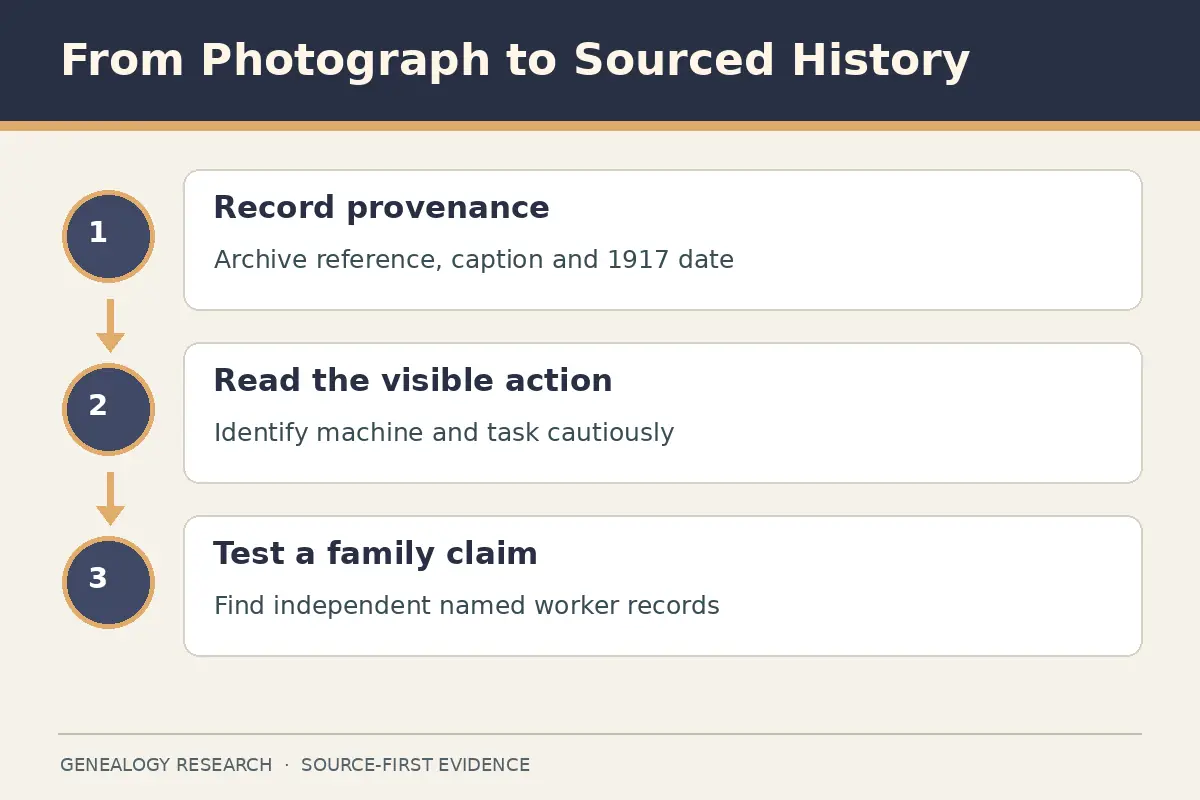
Begin an image record with the exact catalogue reference, attributed date, archive caption, subject description and the page or digital resource where the image was seen. Preserve what the archivist states separately from what you can observe in the picture. A caption that says an occupation or age may have a documentary basis, but unless an individual is named and independently identified, do not turn the scene into a portrait of a particular ancestor.
Place wartime engineering in administrative context
The Ministry of Munitions was established in 1915, and manufacturing work spread across government establishments and private contractors. The National Archives research guide describes relevant material distributed through the MUN department, other War Office and technical collections, and the records of contracting firms. A ministry photograph may document a government interest in production without itself identifying the employer of each person shown. Wartime publicity also shaped which tasks were photographed.
For a proposed family connection, identify the town, factory name, product, employer and most plausible years from independent letters, pay books, newspapers or local directories. Then check whether the archive caption actually places this photograph at that factory. Many engineering tasks looked similar across several worksites; a lathe or uniform alone will not locate the building. Keep geographical attribution provisional until a documentary label or comparison establishes it.
Describe the visible work without inventing names
Look for the machine, workpiece, guards, bench layout, lighting, clothing and how the worker interacts with equipment. Record a visual observation as such: “A figure is positioned beside a lathe,” rather than claiming a particular employment grade or years of service. The MUN 5/75 description offers an attributed specific engineering operation; that caption should not be expanded to every person in other photographs from the same archive. Technical interpretation needs source-specific context and, sometimes, comparison with period manuals.
Photographs can be posed, cropped or selected for official presentation. The National Archives also cautions that some wartime photographs in its broader women-at-work collection were likely staged. This does not make them worthless: they still demonstrate clothing, tools, production messages and the subjects that organizations wished to portray. It changes the question. Instead of “What was every working day like?” ask “What activity does this particular image show or represent?”

Use a provenance test before proposing identity
A named family photograph may include writing on the back, an album inscription or a photographer’s stamp. Treat each as a source requiring its own dating and authorship check. If the original image or caption names a person, compare age, hometown, workplace and date with independent census, civil, apprenticeship or employment records. A caption written decades later can preserve memory but may also combine two women with similar names or a story associated with a different factory.
An unlabeled official photograph should not be matched to an ancestor using perceived facial similarity alone. Lighting, resolution and the age of the print affect appearance, and family resemblance is not a reliable primary identification method. A strong claim needs a named record linked to the depicted workplace and time, ideally alongside a contemporary annotation or separately authenticated portrait. If that link cannot be made, publish the image as historical context rather than personal identification.
Find documents that answer the employment question
If the goal is to show that an ancestor was a munitions worker, look for personal correspondence, household records, surviving factory personnel files, union material, local newspapers or contemporary service records. The central ministry collection can supply production and organizational context, but its existence does not guarantee that a nominal employee register was preserved for the site. Search by company and place as well as broad subject terms; do not assume a department-level keyword index describes every individual in the underlying files.
Build an evidence grid with three separate claims: a particular factory operated at a date, a named person worked there, and the person appears in a specified image. Each can have different answers. Finding the first two does not automatically prove the third. If a woman’s employment ends abruptly in a later record, investigate local records before assigning a cause such as injury, marriage, transfer or the armistice. A historical trend is context, not an individual explanation.
Write captions that remain true at small scale
For publication, create a caption beginning with document type and source: “A 1917 Ministry of Munitions photograph, MUN 5/75, described by The National Archives as aircraft-engine work.” If the archive describes age or task, attribute that information explicitly rather than asserting that you personally determined it from the pixels. Separate any added diagram or artist’s illustration from the historical photograph, and never imply a newly drawn scene is an original archival print.
Preserve the chain of custody: original reference, online display or scan source, any transcription of the institutional caption, and the separate research notes. If no individual identity can be proved, say “unidentified worker” where appropriate. This still produces an informative historical account of skills and wartime industry without converting a compelling visual into a fabricated ancestor story. Accuracy about what is unseen is part of the value of an archival image.
More Family Story and Preservation Guides
How We Research and Verify These Archive Claims
We checked the relevant descriptions and searching instructions against The National Archives and The National Archives. These sources describe record categories, access and limitations; they do not identify any unnamed ancestor or certify a speculative biographical match.
For every claim we distinguish the wording of the inspected record, the archive or provider description, and our own proposed interpretation. Researchers should verify piece-level holdings and availability at the time of consultation. This is noncommercial guidance; see the affiliate disclosure for site policy.
No. The public description supports a dated subject and work activity, not a roster or independently verified identity for all figures.
Yes. The possibility of posing or official publicity must be considered when inferring routine working conditions.
Not by itself. A named, dated employment or comparable independent record is needed for the individual claim.
Nearby residence is a clue for further research, not proof that the person worked there or appears in the image.
Describe it as an illustration and keep its provenance distinct from original archival photographs or document scans.