
The Smithsonian’s educational radio series The World Is Yours began in 1936, but surviving materials are not a complete, single-format broadcast archive. NARA describes 300 RG 106 sound-recording items under the dates 1936–1941; Smithsonian sources describe the radio program itself as continuing into 1942. Those two date spans need not conflict: one characterizes a NARA record group’s holdings, while the other describes the program’s operating history.
To establish what a listener could have heard on a particular week, connect the episode title and broadcast date to an actual recording identifier, transcription or script, and any accompanying publication. The surviving sound might be split into parts. A printed synopsis can illustrate what producers intended but is not automatically an exact transcript of what NBC aired. Start with a documented episode rather than a guessed family listening memory.
Distinguish NARA Sound Items From the Full Broadcast Run

NARA RG 106, under sound recordings, lists 300 items associated with The World Is Yours, described as broadcast for the Smithsonian by the U.S. Office of Education between 1936 and 1941. Smithsonian’s audiovisual preservation project treats the wider series as 1936–1942. Do not divide 300 by the number of weeks to assert the total number of broadcasts, or claim that NARA owns every surviving episode. “Item” need not mean “complete unique episode.”
The Smithsonian identifies the program as an educational NBC series developed with the Office of Education and other New Deal support. Dramatization and curator-supported research were features of its format. That means a spoken historical character might be a scripted performance, not an interview with an original witness. Distinguish dramatized dialogue, actual recorded speech, music, narration, and institutional interpretation in any quotations or family history use.
Make a table for each requested episode: episode title, announced broadcast date, broadcaster and producing partners, NARA or Smithsonian collection, sound identifier, parts, accompanying script, and outstanding uncertainty. A date printed on supplementary material may mark its issue rather than the date a specific recorded segment was broadcast.
Use Two-Part Recording Identifiers as a Preservation Clue
The Smithsonian audiovisual exhibit supplies concrete examples: “The Romance of the Camera” is dated March 7, 1937, while “Saving the Forests” is dated March 27, 1938. Each example is represented by multiple sound identifiers. Treat those as item references for listening and citation, not as a count of independent broadcasts. A two-part recording may reflect preservation format or side/segment division; consult the catalog description before assuming an artistic break.
A digitized listening excerpt might not include the entire introduction, credits, commercials, or closing. Record its duration, any transfer information, and the source of the episode title. If parts are missing, do not silently reconstruct a continuous transcript. Compare the audible words to the official supplementary materials and mark discrepancies rather than substituting a printed summary for lost audio.
For people investigating a family connection to a 1930s school classroom or radio club, a dated episode establishes possible contemporary programming, not that an ancestor heard it. Actual listener participation requires evidence such as a letter, diary, school assignment, or contemporaneous newspaper notice tied to the individual or locality.
Crosswalk the Episode With Smithsonian Paper Records
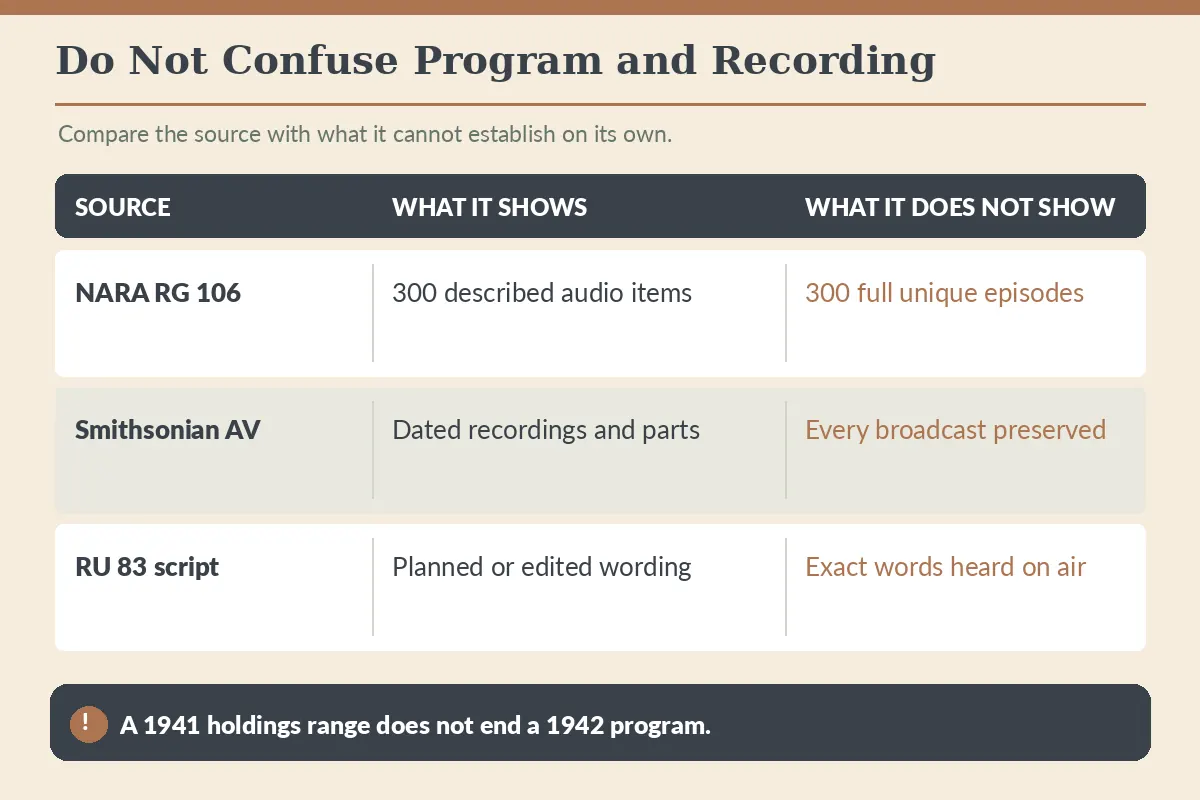
Smithsonian Record Unit 83 includes folders on program correspondence, The World Is Yours material from 1936 to 1942, supplementary literature, and broadcasts. Such paper files may answer why a topic was selected, how a script changed, or which institutional group was involved. But a script draft is not always the aired text, and a correspondence file is not proof that a proposed episode was broadcast on the planned date.
Use the program episode title as your bridge between the audio archive and paper material. Be alert to variant punctuation, renamed segments, and issues that bundle several subjects. Confirm the broadcast date in a trustworthy chronology or contemporary program schedule and separately note the creation and revision dates of scripts. If only a promotional pamphlet survives, call it a pamphlet; do not report having heard the program.
The program’s end in 1942 creates an important trap. A NARA holding range ending in 1941 is not evidence that no broadcasts followed that year. Smithsonian archival sources extend the program chronology and report later material. Conversely, a 1942 mention in a finding aid does not establish the survival of a 1942 audio recording. Keep program existence, paper documentation, and playable recording availability as three fields.
Cite the Sound and Protect the Original Context

In a citation, include the series and episode title, broadcast date if verified, archival repository, record group or unit number, item/part identifiers, and whether you consulted original media, a digital transfer, a transcript, or an excerpt. Do not label a modern edited clip “the full broadcast.” When discussing an actor’s fictionalized dialogue, attribute it to the program rather than asserting that a historic person personally spoke those words.
If a family letter says “we listened to the Smithsonian show,” you can test whether an episode aired in the relevant week and whether the local station carried the NBC program. But the letter should not be used to claim that the family heard an exact passage if only a script draft survives. Treat the radio schedule, station coverage, and private listening statement as independent records with different levels of certainty.
Keep a copy of any official rights and use notices along with the item citation. The existence of a Smithsonian online audio clip does not automatically settle rights for commercial republication. For a research article, a concise reference and a lawful link to the institution’s page are safer than assuming you can republish or edit the sound.
More Family Story and Preservation Guides
How We Research The World Is Yours Broadcasts
We begin with NARA’s RG 106 sound-recording description, then verify specific examples through the Smithsonian preservation exhibit. The Smithsonian Record Unit 83 inventory identifies paper records that should not be confused with recorded episodes.
These references substantiate the archival paths, not household listening behavior or complete episode survival. See our affiliate disclosure; archive links here are not paid placements.
No. NARA describes RG 106 sound items as 1936–1941, while Smithsonian sources describe the program continuing into 1942.
No. The number refers to cataloged sound items, not necessarily unique, complete episodes.
Not automatically. A draft or supplement may differ from the aired performance.
The Smithsonian audiovisual preservation exhibit lists episode dates and individual recording parts for selected broadcasts.
No. Look for independently dated diaries, letters, school records, or local broadcasting evidence.