
National Archives RG 12 section 12.2.1 lists Fight for Life, a 1940 drama produced and directed by Pare Lorentz, as eight reels about obstetric training and medical practice in a large-city slum setting. Researchers may encounter frames, film descriptions, or production stills that seem to portray actual patients. The key distinction is that a dramatized medical scene is evidence about the movie and its depiction of medicine, not an identifiable historical patient’s chart or proof of an individual birth. See the National Archives record-group description for the exact scope of this material.
Beyond the RG 12 film holding, NARA’s Still Picture Guide identifies production stills associated with the movie in RG 44 series LF; a NARA audiovisual blog also explains how separate 306-LSS stock footage was used in a Chicago street sequence. These collections are connected through production history but must not be silently merged. A reel of the completed drama, a still photograph and a stock-shot reel have different archival identities, creation contexts, and evidentiary limits.
Identify the 1940 Motion Picture Correctly
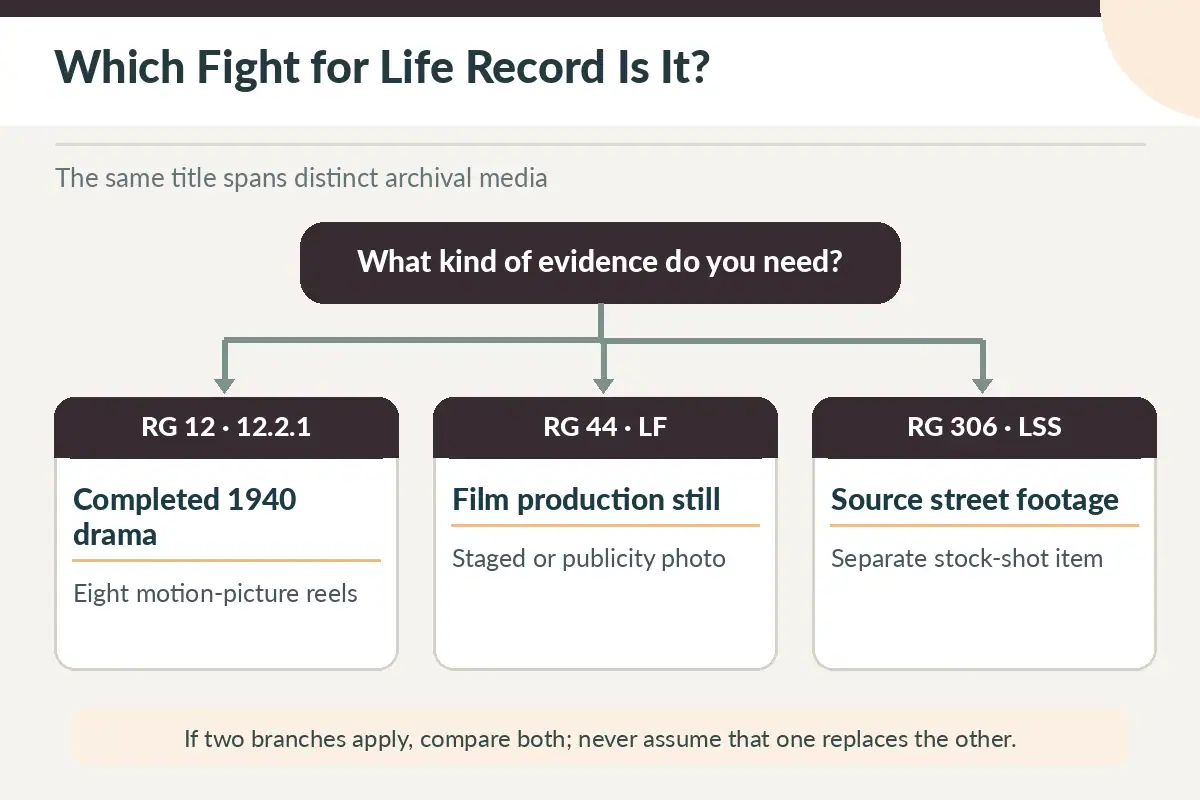
The RG 12 guide identifies the title, director, year and eight reels, within a larger group described as 16 motion-picture reels. That total includes other films and broadcasts from different periods; do not describe all 16 as Fight for Life. Begin with the exact holding and, if a specific scene matters, ask for a reel or item number, catalog identifier, film element type and the version available to view. A title-only internet clip may not preserve these details.
The film is explicitly called a drama by the archival description. Its educational and social themes may help explain contemporary attitudes toward obstetric care and training, but the screenplay is not a clinical case register. If a character carries a name that resembles a family surname, that resemblance cannot identify a patient. Record whether a scene is acted, archival footage, or an unidentified insert only when a reliable source or the item itself supports that classification.
Distinguish Dramatic Action From Recorded Medical Practice
Film imagery can make institutional rooms, instruments, clothing, and professional roles vivid, yet a set can imitate a hospital. Props and arrangements should not be presented as plans of a particular historical ward unless independently verified. A depiction of a doctor delivering care may indicate what the filmmakers wished to convey; it cannot demonstrate that a named practitioner worked in a given building or that a specific treatment was performed on an actual individual.
For research on maternal health history, use the film as a primary source about public presentation in 1940. To study a real hospital, consult administrative reports, building plans, contemporary medical publications, and records made in that hospital where accessible and legally appropriate. Patient records often contain sensitive information and may have restrictions. Avoid treating faces or fictional dialogue as an invitation to reconstruct someone’s private medical history.
Compare RG 12 Film to RG 44 LF Production Stills

The NARA Still Picture Guide separately lists photographs from Fight for Life and The City in RG 44 series LF. A production still might document costume, camera setup or publicity material, but its date and moment may not exactly match the final edited film. Match an LF image to a scene only when you can document visual and archival correspondence. Do not cite a still as an extracted film frame without evidence about how it was created.
If a researcher sees several online images labeled with the same film title, arrange them by record group and medium. Give separate lines to the RG 12 film, RG 44 production stills, and any other copy or publicity reproduction. The physical original or best source file may carry different caption wording. Keeping those items separate is more useful than assuming every screenshot and photograph is an interchangeable original.
Use RG 306 Stock Footage Without Mixing Provenance
A NARA audiovisual article describes Library Stock Shot footage in RG 306-LSS, including a Chicago street scene used toward the close of Fight for Life. That footage’s own catalog identity should be maintained even though it was incorporated into the film. Footage recorded around 1939 and presented in a 1940 film illustrates why image-exposure date and release date can differ. Confirm the particular stock-shot reference before attributing a street view to the drama.
A real exterior used in a dramatized film may be meaningful for urban-history research. It still does not prove that the movie’s characters lived or worked on that street. If identifying buildings from stock footage, record architectural landmarks, shot sequence, available slate information, and independent historic maps or city directories. NARA describes how adding tags and transcription improved identification; an identification should be supported by visible evidence and sources, not confidence alone.
Investigate a Family Story About a 1940 Hospital

Suppose a family story says a relative trained as a maternity nurse in Chicago during the late 1930s and recognizes the film’s hospital scenes. The film can show a contemporary depiction of medical education, but it does not place the relative among the cast, medical advisers or patients. Search the correct institution’s training rosters, yearbooks, personnel files if open, directories and professional licensing records for the actual person.
Likewise, a family belief that a baby appeared in the film must be checked against production documentation and releases, not facial resemblance. Names in film credits may identify actors, producers or advisers rather than care recipients. Keep the film chronology separate from the individual’s verified educational or residence dates. A grounded account may explain what the film illustrated for audiences and then cite family sources for the real biography.
Cite Each Moving Image and Still as Its Own Item
A citation should begin with National Archives, RG 12, section 12.2.1, Fight for Life (1940), and the available reel or item identifier. For a production image, cite RG 44 LF with its independent still-picture number. For stock-shot material, identify the 306-LSS item. If you have seen only the archival description, state that rather than writing as though you viewed all eight reels. Ask reference staff about viewing copies and use conditions.
When preparing a family-history presentation, caption the medium and purpose in plain language: film dramatization, production photograph, or identifiable real street footage. Do not crop away evidence of the shot’s source or re-caption actors as medical staff or patients. Accurate provenance allows the film to enrich a story about medical education without turning fictional narrative into a false medical or genealogical record.
More Family Story and Preservation Guides
How We Research and Verify Archival Claims
We compared the record-group guide with the relevant National Archives research guidance, checked the cited record-series distinctions and dates, and reviewed overlap with existing GenHis titles and the supplied WordPress inventory. Our decision charts summarize the scope of the inventories; they are not reproductions of historical maps or documents. Where an individual item has not been examined, the wording makes that limitation explicit rather than claiming a personal find or a confirmed event.
The purpose of this guide is to make the next check reproducible: record RG 12, the exact series or entry, title or item number, original date, later-copy date where applicable, and an independent confirming source. Online descriptions do not guarantee that every sheet or photograph is digitized. Check terms and access requirements for the specific item. Read our affiliate disclosure; this educational guide does not assume any compensated records service or an unverified partner arrangement.
The RG 12 guide describes eight reels for this 1940 drama, not the entire 16-reel group.
NARA describes it as a drama. A scene is not a named patient record.
NARA’s Still Picture Guide describes Fight for Life production stills in RG 44 series LF.
Yes, some separate RG 306-LSS footage does; the film story does not identify fictional characters as residents.
Cite its own archival record group, medium, series and item or reel identifier rather than the title alone.