
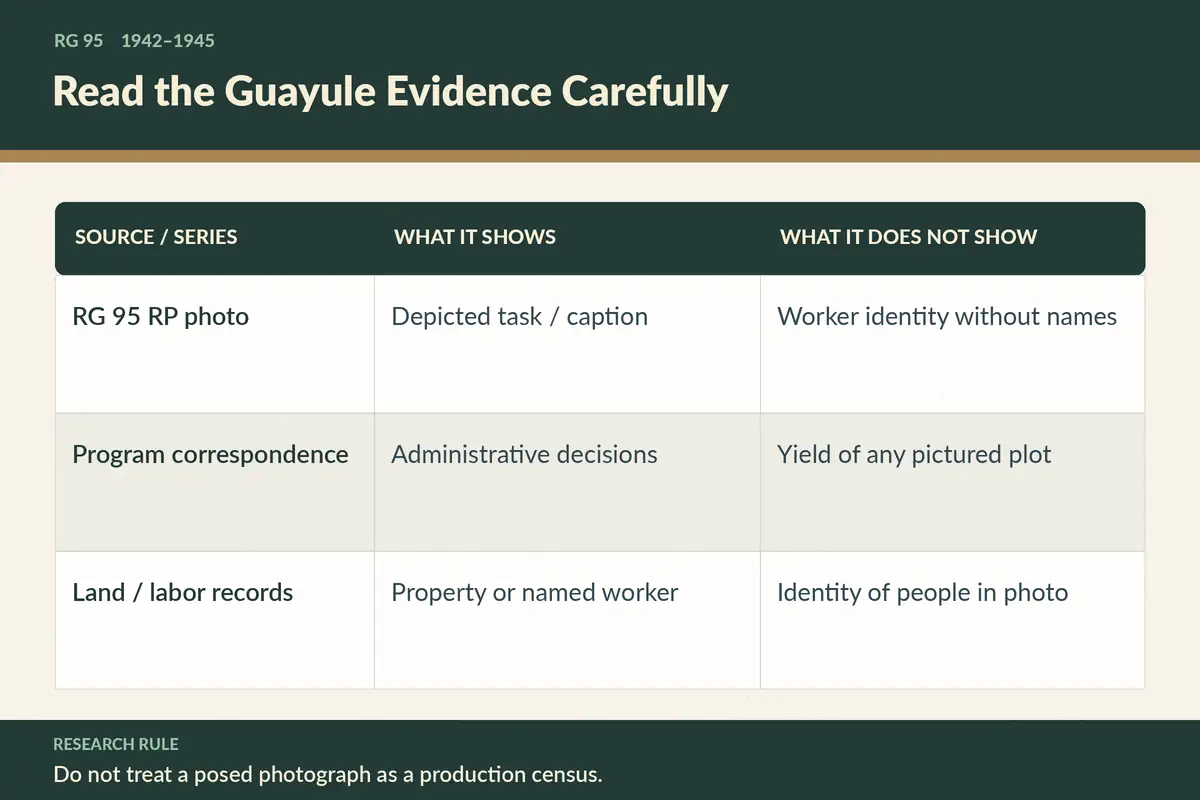
The Forest Service’s wartime emergency guayule program left a visual trail. The National Archives lists 907 images in the Guayule Emergency Rubber Program photographic series, identified as RP, dated 1942–1945 within Record Group 95. These images can help establish what a field operation, plant or processing scene looked like. They cannot automatically name workers, identify a particular farm owner, or prove how much rubber an operation produced. An effective search begins with image provenance and a question specific enough to test.
Guayule is a rubber-producing shrub, and wartime demand made it a subject of federal experimentation and cultivation. A photograph showing shrubs, equipment or workers records a moment selected by its photographer, not a representative census of the entire program. A family photograph alleged to show a guayule field may be compared with archival captions, but resemblance in rows of plants is weak identification evidence. A confirmed place and date must precede any claim that a relative worked in the scene.
Find the RP Photographs Within the Forest Service Holdings
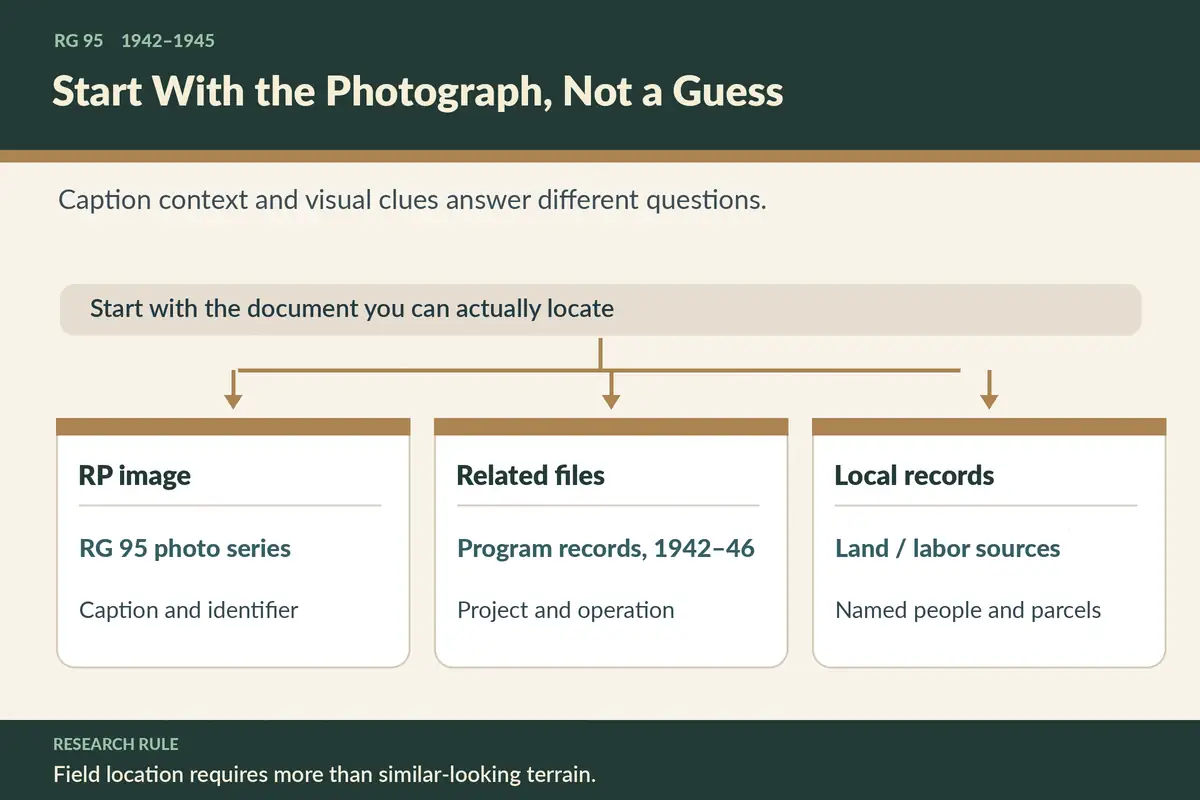
The NARA RG 95 guide explicitly describes the RP photographs as 907 images from 1942–1945. It also describes textual records relating to the emergency rubber project, including work extending to 1946, and separate guayule maps. These are related bodies of evidence, not necessarily one integrated name index. Search the Catalog by the exact photo-series phrase, RP designation, guayule and the likely place, then capture each result’s description, identifier, caption and any reproduction metadata.
Do not assume all 907 photographs are digitized. The NARA Still Pictures guide explains how digital images and descriptions may be located, with additional research support for holdings that lack online copies. An image without an individual item caption needs careful handling; archival arrangement may preserve a group or sequence rather than a standalone identity. Record the neighboring numbers or album context where accessible. Preserve capitalization and uncertain dates rather than silently modernizing them.
Distinguish Fieldwork, Processing, and Publicity
Classify the pictured activity before interpreting it. Low shrubs in agricultural rows, experimental plots, harvesting tools and processing machinery represent different stages of work. A posed group beside equipment may document a publicity moment rather than a normal shift. Look for legible signs, identifiable structures, irrigation features and any captioned institutions; avoid assuming that a photographed field is the same site as the adjacent mill. If the camera angle changes, the continuity of a photo sequence must be demonstrated rather than guessed.
A caption saying “guayule project” locates an organizational subject, not necessarily the ownership of the land in view. Identify whether a reference to a location comes from an original caption, later cataloging, family annotation or your own visual comparison. Those are different layers of testimony. If an image shows a test plot, a full agricultural yield claim requires corresponding statistical or laboratory records. A thriving shrub in one photograph does not establish that the program succeeded in that place or supplied a particular quantity of rubber.
Build a Defensible Site Identification
Collect candidate locations as hypotheses, recording which evidence ties each location to the image. Compare building outlines, terrain, plant layout, road alignment and visible signage with period maps or contemporary records. Geographic resemblance is not unique proof: dry fields and rectangular plots often look similar across regions. A photographic caption may be more reliable for place than a later collector’s guess, but captions themselves can be mistaken. Mark a site “probable” only when at least two independent clues support it.
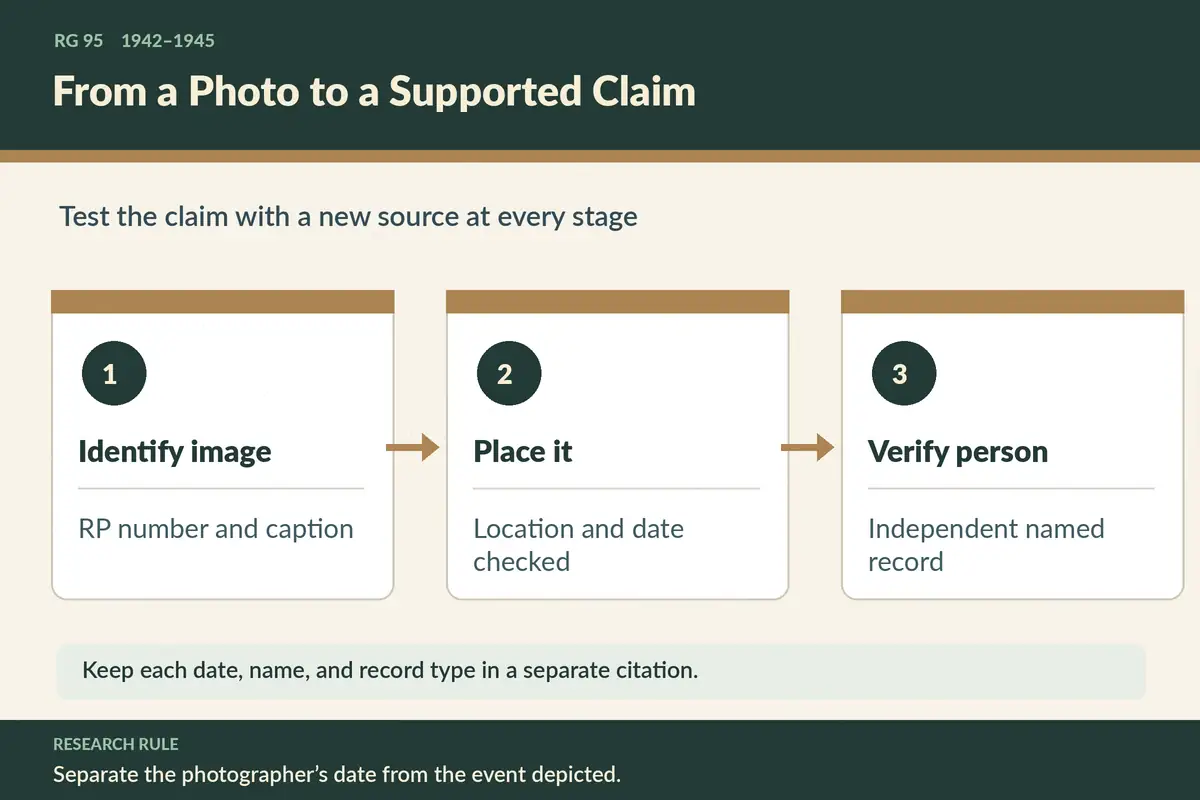
Separate the photo date from the date a file was compiled and the period the project operated. A photograph printed or cataloged later does not necessarily depict the date on its folder. If someone claims an image was taken in 1943, write down the evidence for that exact year. The RG 95 RP series spans 1942–1945; it does not assign every image a known year. Useful evidence can include a typed caption, a correspondence reference or a dated contact sheet, where such materials actually survive.
Do Not Identify Workers From Unlabeled Faces
An anonymous person in a wartime agricultural photograph should remain unidentified without corroboration. Even a strong family resemblance cannot resolve the thousands of potential workers across multiple activities. Search local employment records, program correspondence, labor rosters, dated letters and personal albums where available. Ask whether the person had a documented connection to the relevant place at the correct time. A name written on a later print is a clue whose author and date deserve their own evaluation, not automatic archival authority.
The provenance ledger should distinguish the photographer’s original caption, a repository’s modern catalog note, a family inscription and a researcher inference. State explicitly which source supports each claim. If the image includes buildings or machinery, do not convert their presence into employment, residential or property ownership for a named individual. The same photograph may be strong evidence of program activity and very weak evidence of a specific ancestor. Both judgments can be true at once.
Preserve Photograph Citations and Uncertainty
A research-ready citation records the repository, RG 95, RP designation, image or sequence number if available, description, approximate date and the consulted format. Retain the source URL for a digital image, but do not replace the archival identifier with a bare web address. Save captions separately from your transcription of visible objects, and note when a crop removes context. If you share a family comparison image, label it as an illustration or hypothesis rather than an authenticated historical reconstruction.
The next source depends on the claim: a program report for an administrative decision, a map or land record for a location, a named employment document for a worker, or a laboratory report for rubber processing and testing. A caption that describes a mill is a starting point for mill history, not a promise that personnel files survive. Build a narrow question and stop at the source’s actual limit. A carefully unidentified face is preferable to a confidently misidentified ancestor.
How We Research the Records and Verify Claims
We verify the series and date range against NARA’s RG 95 guide and use the Still Pictures service guidance for image access. We compare archival captions with location-specific records, preserve uncertain identifications, and never treat a photo as proof of named employment or land ownership unless a second record supplies that link. We also distinguish an image’s original context from modern catalog notes. Editorial practices and commercial relationships appear in the affiliate disclosure.
More Family Story and Preservation Guides
Frequently Asked Questions About These Records
It lists 907 images in the RP photographic series, dated 1942–1945.
No. Search the NARA Catalog and consult Still Pictures guidance for items that have not been digitized.
Not by itself. A land or property record tied to a verified location is needed.
Resemblance is only a clue; corroborating names, places, dates and provenance are necessary.
Cite NARA, RG 95, the RP series, image identifier or caption, and the reproduction consulted.