
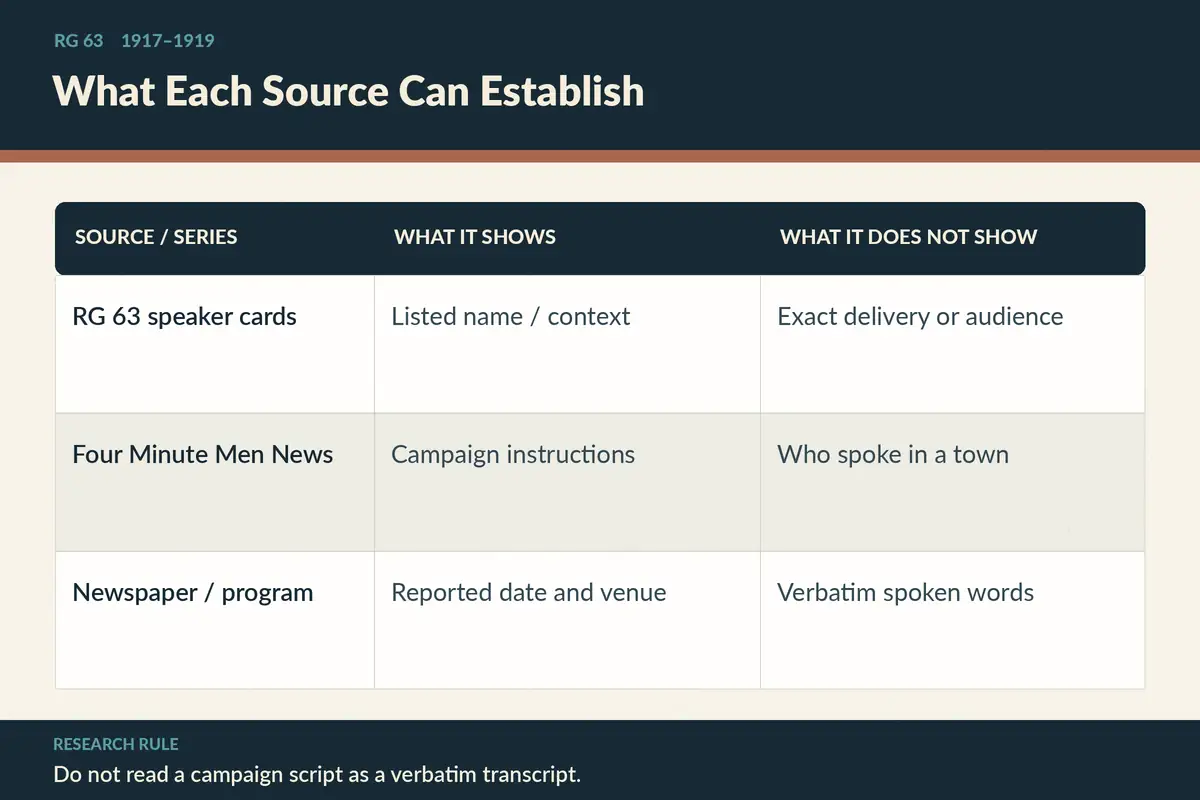
The National Archives places card lists of speakers, 1917–1919, in Record Group 63, the records of the Committee on Public Information. For family historians, this is a tempting path to a relative who reportedly gave short speeches during World War I. The cards can support a name-based lead; they do not automatically establish that a volunteer actually addressed a particular theater audience, read an approved text, or was present on a specified evening. A useful search follows the name into dated, place-specific evidence.
The Four Minute Men program recruited civilian speakers for brief talks supporting wartime measures. The Library of Congress documents the organized public-speaking campaign and its related printed materials. The practical question is narrower than whether the campaign existed: which person appears on which RG 63 list, how that name is recorded, and what independent document connects that person to an event? Build three separate evidence columns for listed participant, assigned or available message, and delivered speech before writing a family narrative.
Begin With the Committee and Its Speaker Lists
Start at the NARA RG 63 guide, particularly the domestic-activities description. It names card lists of speakers for 1917–1919 alongside reports, correspondence, speech copies, bulletins and the Four Minute Men News. That description is a guide to holdings, not a guarantee of name-level online indexing. Search the Catalog for the record group and relevant list series; if only a broad description appears, request a more detailed series or box reference and ask about access to the cards.
Record every spelling and locality exactly as encountered. A surname alone, particularly one shared by multiple adults in a city, is not an identification. Transcribe initials, middle names, place associations and any dates that are really present; do not invent an address field because it would be useful. The archival list may reflect an organizational roll kept by administrators. Treat it as evidence of inclusion in a working record, and reserve the words “spoke at” for a dated source that actually describes the appearance.

Separate Organizational Bulletins From Spoken Words
RG 63 includes the Four Minute Men News, 1917–1918, and copies of speeches, 1917–1919. These are essential for understanding subject matter and the message a speaker might have received. But a printed text is not a stenographic record of a personal performance. Several people could work from a common outline, omit paragraphs, or speak at different venues; some listed volunteers may never have delivered a particular script. Quote or summarize the printed material as a campaign document, not as what one named ancestor certainly said.
The Library of Congress exhibition provides contextual evidence for the public-speaking effort and posters. It is valuable for explaining why speeches appeared in public places, but it does not independently identify your family member. A printed poster with a blank space for a local announcement also cannot be silently filled with a guessed speaker. Preserve the distinction between national messaging infrastructure and one town’s actual program or newspaper report.
Locate a Specific Date and Venue
Once the person and locality are plausible, search dated newspapers, theater advertisements, meeting minutes, community calendars and organizational programs for the same spelling. Newspapers may report a planned talk rather than one that occurred, so examine past-tense coverage where possible. A notice published before a show has different evidentiary force from a report published afterward. When a headline says “Four Minute Men,” check whether it names individuals or only advertises the nationwide campaign.
Use a simple event ledger containing date, place, venue, speaker as written, subject, publication date, and whether the notice describes a plan or an observation. Compare that ledger with the time span of an RG 63 card. A matching city and surname are promising, but a later occupation or residence record might be needed to distinguish two namesakes. If no report survives, phrase the finding as “listed among speakers” and keep the unproved event separate from the documented participation lead.
Test Identity Across Other Civilian Records
A speaker might be a teacher, merchant, student, minister or another civilian; the program name alone does not establish occupation or military enlistment. Link the listed person to census records, city directories, civic club rosters or correspondence with compatible names, age and address. If a family story names a theater, look for its historical location before assuming a modern building of the same name is the venue. Where a local source names a middle initial, use it as an identification clue, not a license to collapse multiple people into one.
Keep the identification decision reversible. Write down what would disprove the match: a different address, conflicting middle name, overlapping activities in distant cities or an incompatible age. Distinguish the date a person joined a list from the date of any public address. A report printed in 1919 about the prior year’s activities could be retrospective; the paper’s date is not the event’s date. A short explanation of unresolved possibilities is more useful than an impressive but unsupported “wartime orator” biography.

Cite the Record at Its Actual Level
Cite the holding repository, RG 63, exact series title, card or entry details, and the digital identifier or box and folder if verified. For printed bulletins, include issue number and page when available. For a local newspaper, retain page, edition, date and clipping source. Do not transform a general records-guide paragraph into a fictional item citation. If only the RG guide is available, identify it transparently as the descriptive source and state that individual cards remain to be examined.
The strongest narrative may have three carefully limited sentences: the National Archives holds cards associated with the speaker organization; a particular matching name has been located on a specific card; an independently dated local report describes a related appearance. Only the last two, if actually checked, make an individual finding. When these links are missing, outline the next search instead of inventing attendance, exact words or political beliefs. Program membership is not consent to every message a campaign disseminated.
How We Research the Records and Verify Claims
We treat the NARA series-level description as an archival locator, the Library of Congress exhibition as historical context, and a named card or dated local report as the primary route to an individual claim. We compare spellings and places before connecting records, and label any theater event unverified until a source actually describes it. The method protects against turning a national propaganda effort into an undocumented biography. Our editorial and affiliate practices are described in the affiliate disclosure.
More Records and Archives Guides
Frequently Asked Questions About These Records
No. They may support a listed speaker’s association with the program. A dated event source is needed for delivery.
Not necessarily. Copies and bulletins show prepared messaging, not automatically each volunteer’s exact spoken words.
Search contemporary newspapers, theater programs, civic reports and directories for a date-specific match.
No. Four Minute Men were civilian public speakers; military service requires separate service evidence.
Cite NARA’s RG 63 guide as a holdings description, and do not present it as a card-level finding.