
The National Archives lists identification cards containing photographs of Prohibition agents, dated 1921–1925, among the other records of the Internal Revenue Service in Record Group 58. A card can be a powerful visual and name-based lead for a researcher tracing an employee during the early years of federal Prohibition enforcement. It is not, by itself, a complete personnel file, a chronological account of investigations, or proof that the person continued to serve after the card was made.
The key is to treat a card as one dated administrative artifact. First identify the card holder and any wording actually present; next establish what date and office the card represents; finally test whether a different record supports appointment, assignment, resignation, or transfer. Do not supply a badge number, job title, or expiration date from expectation alone. The archival description establishes the existence and date range of the series, not a universal template for every card.
Find the Photo Cards in the Correct Record Group
Begin with the NARA Guide to RG 58, section 58.3.4, rather than a modern search for Prohibition badges. That section identifies photographic identification cards of Prohibition agents, 1921–1925. Copy the series description verbatim into your research log, including “with photographs,” and use the range as a locator—not as an employment date for any individual. Ask the holding archives about series arrangement, finding aids, digitized items, and whether the physical cards have reverse-side markings.
A successful name search may point to a scanned portrait divorced from its original card. Record the complete archival citation and inspect surrounding fields, backs, attached slips, and sequence if available. A cropped photograph may conceal the date of issue or the office that created the credential. If a catalog result supplies only a collection-level description, do not claim that the person has been found. A request for a name or a card range is an inquiry, not evidence that the relevant item survives.
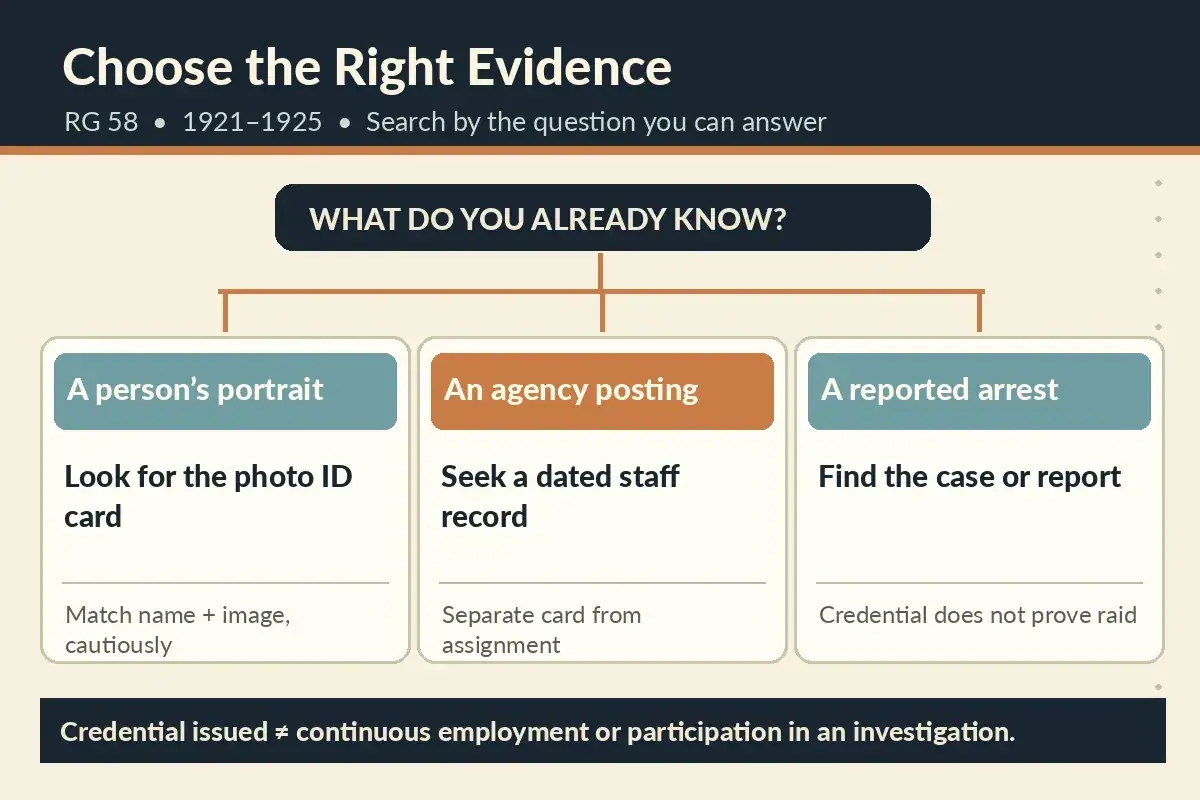
Read Issuance and Identity as Separate Questions
Transcribe the visible name exactly, preserving middle initials, spelling, any rank or position and the particular issuing authority. Put hard-to-read text in square-bracket notes rather than silently “correcting” it. If there is a photograph, describe features neutrally and note print condition, retouching, or damage. An image can help compare a person across independent portraits, but it does not establish a family relationship merely because the faces appear similar.
Make three distinct entries in your ledger: the identity asserted by the credential, the occasion or date the card was issued, and any service facts explicitly recorded. The first two may be supported on the card itself. A later assignment in another state, a period of active duty, or participation in a particular arrest generally requires separate dated evidence. Do not turn a credential’s initial issuance into a continuous 1921–1925 career simply because those are the archival series dates.
Cross-Check the Individual Beyond a Single Card
Search period federal employee registers, official correspondence, appointment notices, and local directories where appropriate, using the exact spelling and an alternate-name search. Match not just the name but a compatible place, approximate date, and position. A common surname paired with a sharp photograph is still vulnerable to mistaken identity. When another source identifies the same person, note whether it names an agency, an office, a home address, or merely a similar occupation.
If a newspaper reports a raid, distinguish a named agent from a person quoted as a witness or described as a suspect. Newspaper language such as “federal officer” is not interchangeable with the exact employing bureau. Official credentials can be forged or outdated, and press descriptions can be inaccurate; corroboration matters. Build a dated sequence of independent references, retaining discrepancies in initials, age, and place instead of smoothing them into an attractive but unprovable narrative.

Handle Administrative Changes Without Guessing
Prohibition enforcement operated amid administrative change, so office and agency language should be interpreted in its own year. The placement of the ID cards within RG 58 tells you where this particular body of records is described; it does not mean every person represented had the same employer throughout their career. Record precisely what the card says and compare it with a dated government organization chart or personnel notice before describing a transfer.
When a card has no clear expiration or cancellation, neither continued service nor departure can be inferred from silence. Another card issued later could represent replacement, promotion, lost credentials, or an office change, depending on evidence not supplied by the first. If a later person-level file is missing, keep a bounded conclusion: “An identification card existed in this archival date span,” then identify which other record class might confirm the next claim.
Build a Small, Auditable Evidence Table
Use columns for item, date written on item, exact name, issuing office, visible photo, and claim supported. Add a separate column headed “Not demonstrated.” For a card, that often includes length of service, case participation, or the identity of pictured relatives. A second row for a staff list might support an office assignment but not a particular enforcement action. A third row for a contemporary address record might establish residence without independently confirming employment.
Retain full citations and, where permitted, a copy of both sides of the card. Note whether an image came from an original, an archival scan, or a re-posted image without context. Record that distinction even when all three copies display the same face. The resulting table makes a stronger family-history narrative because each claim can be traced to a dated source instead of being inherited from an uncertain online caption.

More Records and Archives Guides
How We Research Prohibition Agent Credentials
We anchor the series statement to RG 58, section 58.3.4, and then treat the current NARA catalog guidance as a reminder that the older Guide is not an up-to-date inventory of digitized items. The 1921–1925 span is the described range of the cards. It is not an assertion about the tenure or legal powers of a named agent.
Before publishing a particular biography, we would seek a visible or cataloged individual card, preserve its fields, and corroborate an appointment or posting from an independent dated record. We would disclose any uncertain reading and refrain from connecting an officer to a case without case-level documentation. For readers following a paid service link, our affiliate disclosure explains our editorial separation; no paid provider is necessary for this source-first workflow.
Yes. NARA lists identification cards with photographs dated 1921–1925 in section 58.3.4. The Guide does not say that every agent has a surviving card.
No. The 1921–1925 range describes a record series. A person’s period of service needs dated employment or assignment evidence.
Not alone. Check initials, period residence, agency affiliation, and independent person-level documents.
Usually not. A raid or arrest must be supported by contemporaneous case documents or independently verified reporting.
Start with RG 58 and the current NARA Catalog, then request the relevant arrangement and access information from the holding office.