
Identify Which Maritime Milestone Is Claimed
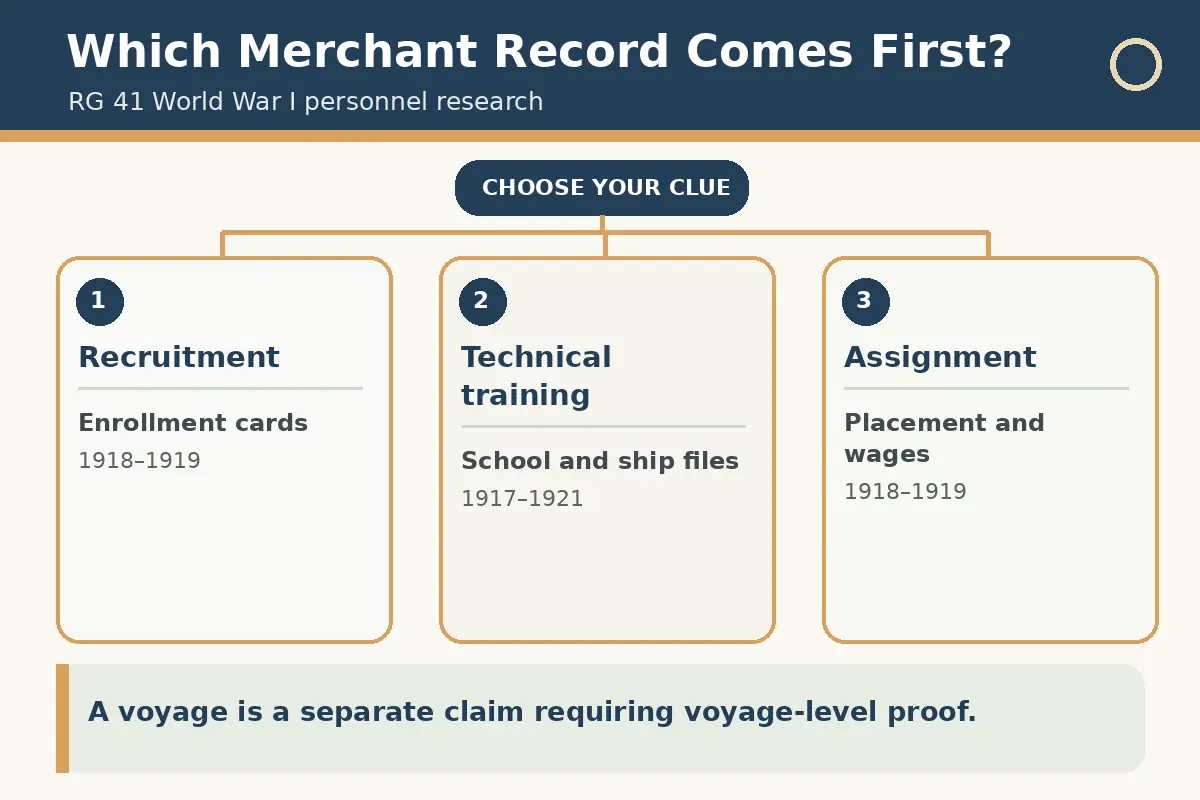
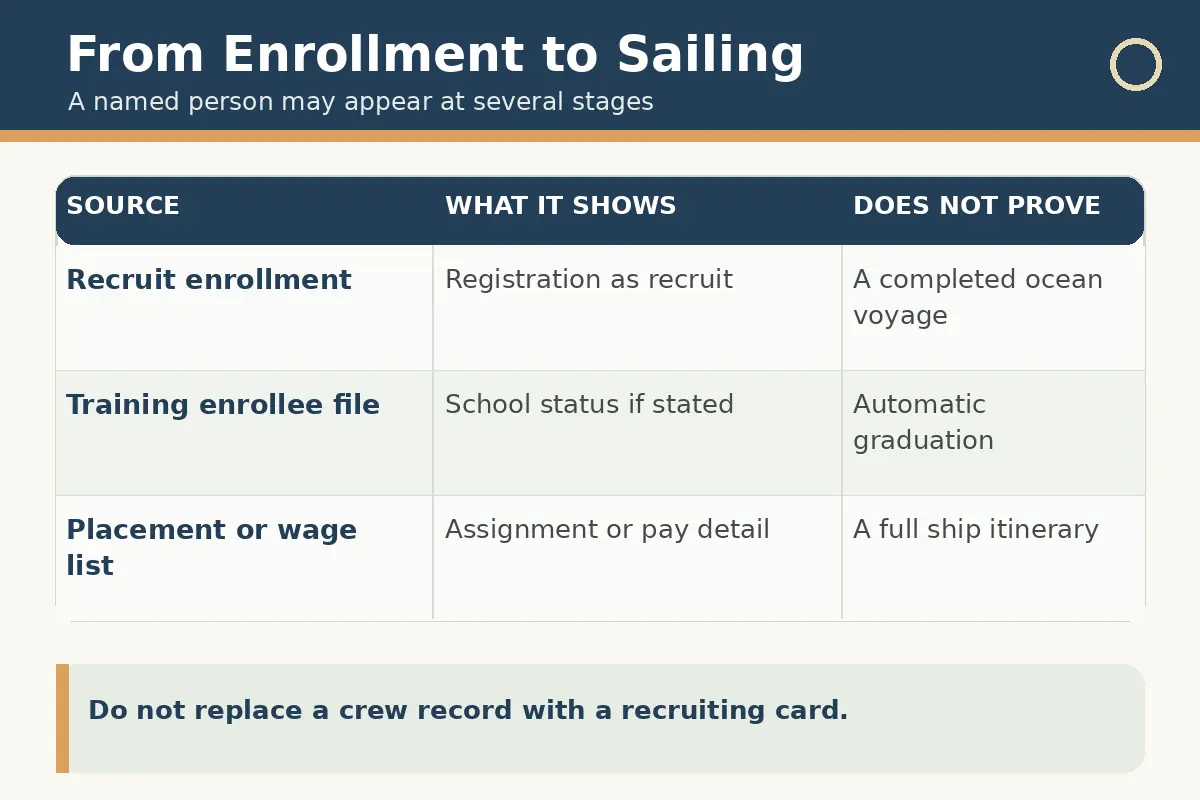
Record Group 41 includes recruiting materials for the U.S. Shipping Board and its successor shipping organizations. NARA specifically lists recruit enrollment cards for 1918–1919, along with applications, personnel files, placement records, and maritime training materials in section 41.7. A card from this system can be highly relevant to an ancestor’s attempt to enter wartime merchant service. It cannot, from its title alone, prove that the recruit sailed, worked aboard a particular ship, or traveled to a remembered foreign port.
Translate a family story into separate propositions. Was the ancestor registered as a recruit? Did the individual receive training? Was a placement offered? Did a seaman sign shipping articles and depart aboard a vessel? If all the family knows is a portrait in uniform, date the photograph independently and look for a printed organization or vessel identifier. A uniform, card, or recruiting advertisement can identify affiliation without establishing a particular voyage or wage payment.
Understand the Agencies Behind the 1918–1919 Cards
The Shipping Board Recruiting Service existed during the World War I expansion of the merchant marine. NARA traces changes in oversight, including the transfer of Recruiting Service functions to the Sea Service Section in September 1919. The description of section 41.7 has a broad administrative span, while individual record types have narrower dates. Search under both the recruiting service and related later office names only when your claim’s year and record creation justify the move.
A document dated 1920 could appear in a personnel file even though the specifically described recruit enrollment cards are dated 1918–1919. Likewise, a 1917 application might be in a different category from the enrollment card series. Avoid treating every federal maritime card as the same type of record. Record the creating office as printed on the original and keep a timeline of institutional names, rather than retrospectively labeling all early material “Coast Guard” or “Navy.”
Use Training Records as a Separate Branch
NARA lists records relating to training ships and stations, 1918–1921, plus correspondence, applications, and enrollee records for navigation and engineering schools, 1917–1921. A recruit could be documented in training without having completed it. An application may show intent or admission processing, whereas an actual attendance record, exam result, or completion notation might support a narrower educational conclusion. Do not assume that each named person entered a school or earned a certificate merely because the institution survives in the archives.
Build a training timeline only from dated entries. Transcribe school name, program, role, document date, and any status word exactly as written. If a training photograph identifies a crew, compare its date with the person’s card before assigning names to faces. A similar surname on an enrollment list may be another person. When training and placement dates conflict, identify the conflict openly and verify whether the records relate to one recruit.
Distinguish Placement, Wages, and Actual Sailing
The RG 41 guide mentions placement lists and wage records from 1918–1919. These are important leads, but a placement list may concern an assignment process and is not necessarily the vessel’s official record of departure. A wage entry may establish a payment relationship when the original explicitly states it; the transaction still needs interpretation. To demonstrate shipboard service, look for separate shipping articles, crew agreements, discharge books, or dated vessel-related evidence appropriate to the port and year.
Suppose a recruit appears on a placement list beside a ship name. That may support an administrative placement at a particular time. To claim that the person crossed the Atlantic, look for a voyage-specific source and check the vessel identity. Multiple ships could share a name; port departure dates and official vessel numbers, if available, help establish the match. A single assignment should never be expanded into a complete maritime career or an exact itinerary.
Search the Record Group Without Assuming Digitization
Begin with NARA RG 41 section 41.7 and copy the named record categories and date spans into a short research plan. Use the Catalog search tips to try “recruit enrollment cards,” “Shipping Board Recruiting Service,” a port recruiting office, or a relevant training school. A finding aid may use agency and arrangement terms instead of the recruit’s name. A surname-only search cannot establish whether an undigitized card exists.
Ask the repository whether the original cards are arranged alphabetically, numerically, by local office, or another way. The group guide does not guarantee one particular arrangement, that every individual card survives, or that all documents can be downloaded. If the collection uses a finding aid or physical index, save its identifier and exact search instructions. Distinguish “not in Catalog search results” from “not present in the original card series.”
Build a Recruitment-to-Voyage Evidence Table
For each person record spelling variants, age or residence only if actually present, agency, document type, card date, personnel reference, training evidence, placement evidence, and vessel evidence. Use a status column for each separate proposition: identified recruit, training verified, placement recorded, departure independently documented, and additional service unverified. A blank cell is not a false claim; it is an unanswered question that directs the next record search.
Cross-check an identity using contemporaneous details rather than assuming that a matching name belongs to your ancestor. The family’s city, wartime address, occupation, and an independently dated photograph can be useful comparators when a card actually contains similar information. Do not import a later census address into the original card as though the record itself stated it. When several men shared a name, keep separate profiles until a unique identifier or persuasive combination of independent facts permits a merge.

Follow a Port and Vessel Only After Verification
Once a placement or vessel name appears in an original source, investigate the port and date rather than searching every ship in the wartime merchant fleet. A vessel’s registry, crew agreement, departure report, or discharge document may address actual service more directly. Select the repository and record type for that vessel and place; not every maritime document belongs in RG 41. Keep a record of negative searches and ask whether wartime routing, aliases, or changed ship names complicate the trail.
A useful final statement might be that an individual enrolled through a specified recruiting office in 1918 and appears in a separately dated placement record, if both originals show those facts. That is already worthwhile genealogy. If no voyage-specific document survives, stop at the verified administrative relationship. Do not turn a wartime recruitment card into a claim of naval rank, combat service, or Atlantic crossing without appropriate independent evidence.
More Records and Archives Guides
How We Research Wartime Merchant Recruitment
We distinguish card creation, training, assignment, and shipboard activity because NARA describes these as different RG 41 record types, with different date spans. We also separate the World War I Shipping Board system from the Navy and later Coast Guard organizations. The National Archives Catalog is a discovery tool, not proof of a complete surname index or of digitized coverage. Our conclusions use the wording of the original document, not guessed occupational fields.
Keep an evidence log and full archival references for both the record that supports enrollment and any later sailing claim. Our affiliate disclosure explains site relationships; this guide requires no commercial subscription. When the voyage is unknown, report a verified recruitment milestone and specify the unresolved person-to-ship link so another researcher can continue without inheriting an invented route.
NARA section 41.7 specifically lists recruit enrollment cards for 1918–1919; related personnel, placement, and training records have different ranges.
No. Enrollment is an administrative milestone; shipping articles, crew records, or other voyage-level evidence are needed for a particular sailing.
The RG 41 guide identifies records of training ships and stations from 1918–1921 and school enrollee materials from 1917–1921.
No. Placement records and voyage-specific crew agreements are different document types and answer different questions.
The Catalog may describe a series without indexing every person. Check the creating office, card arrangement, and original holdings.