
The National Archives guide to RG 84 states that records maintained by U.S. consular posts include marine protests, vessel arrivals and departures, cargo descriptions, lists of seamen and related shipping papers. A marine protest is valuable because it may preserve a contemporary account presented to an official after an alleged difficulty at sea. The existence of that statement does not establish that every detail was true, that a particular sailor was at fault or that a court reached a finding.
This guide works from the consular post and vessel outward, rather than from an index of family names. First identify the foreign port or district and approximate date. Next distinguish an incident declaration from movement or crew documentation. Finally seek independent ship, insurance or legal material to test claims about damage, weather, collision or conduct. The separate sources may survive in different archives; an entry in a post’s register does not imply that every related file is online.
Begin With the Correct Consular Post and Era

RG 84 comprises records from U.S. diplomatic and consular posts over a long period. The guide distinguishes diplomatic-post holdings in section 84.2 from consular-post holdings in section 84.3. Start by identifying the actual consulate or consular agency that handled the vessel, not merely the country where a later newspaper reported the voyage. A foreign city could have multiple administrative names across time, and boundaries of a consular district were not necessarily national boundaries.
For a ship calling at two foreign ports, search both jurisdictions if the incident location or date is uncertain. A marine protest may have been entered where the master reached an official, not where the incident occurred. Capture the contemporary spelling of the port and any later place name separately. If the ship had a common name, combine the vessel name with the master, registry, home port and time period before selecting a candidate record.
Read a Marine Protest as Attributed Testimony
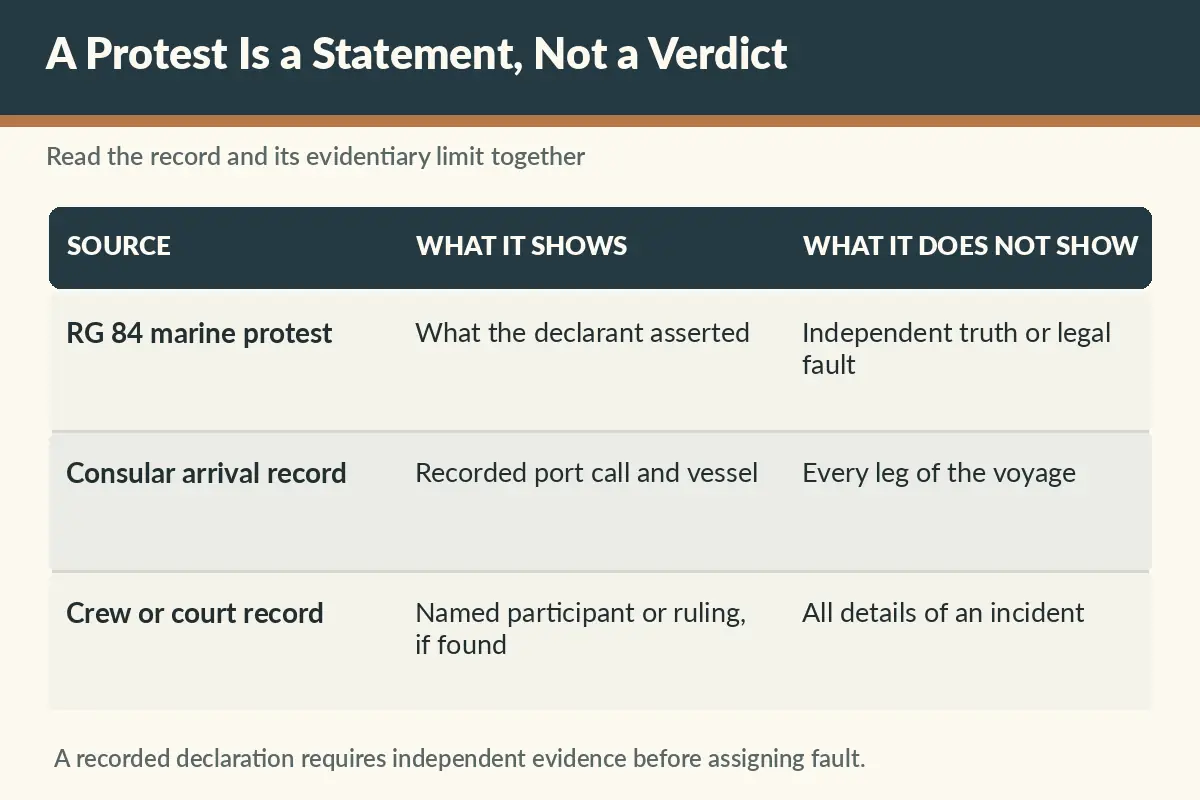
A protest records statements presented in an official setting. That makes it important evidence of what a declarant reported, not an automatic judicial decision about causation or damages. Note who made the declaration, when and where it was recorded, the vessel identity, and whether the text refers to crew testimony, documents or attachments. Separate firsthand observation, hearsay and a summarizing formula. Preserve qualifiers instead of simplifying an account into an unconditional fact.
If a protest describes heavy weather or damaged cargo, do not infer insurance acceptance, criminal liability or the outcome of later litigation. A statement may support a claim later examined by shipowners or insurers, but the decision belongs to a separate file. If the protest refers to earlier events at sea, keep event date and consular recording date distinct. Apparent inconsistency in dates may reflect travel time, a different calendar convention or an error that needs testing.
Cross-Check Arrival, Cargo and Crew Evidence

The RG 84 guide also names arrival and departure records, cargo descriptions and lists of seamen. These provide different kinds of evidence. An arrival entry, if found, can place a specified vessel in a port on a recorded date. A cargo description can describe what the consulate recorded, but may not list the final consignee or prove that all goods arrived undamaged. A seamen list can connect a named person with a vessel at the recorded point, not automatically with every leg of its wider itinerary.
Transcribe names as written and record rank or occupation only when stated. Ship names are frequently reused; match registry details and the master to avoid combining two vessels. A different captain in a later record may indicate a change of command rather than an inconsistency. If a list shows fewer crew than a family story suggests, consider whether it covers only a port call or a partial document before concluding the person was never aboard.
Test the Incident With Separate Maritime Records
A logbook, port authority record, shipping newspaper, insurance correspondence or court case can provide a second perspective. Select comparisons that match date, route, vessel and type of event. A vessel may appear in a newspaper a week after its arrival, so distinguish a publication date from the event date. Multiple reports repeating the same marine protest are not independent corroboration just because they appear in different publications.
Create a claim table: the master asserted a particular hazard; the consulate recorded that statement; a later survey observed damage; a court may or may not have ruled on liability. Document each step rather than presenting a finished verdict. For family history, an ancestor’s name in a crew list may establish service at a point in time, while the protest tells us only about a claimed event associated with the ship unless the individual is independently connected to that account.
When preparing a ship timeline, preserve all of the dates separately: the alleged incident, arrival at the consular port, date of any formal declaration, date of a voyage-related survey and date of the newspaper report. The order may be logical without being exact, and older reports sometimes contain transcription errors. A master could make a statement about a period before the vessel reached land. A crew member might have signed on or departed between those dates. Do not move a person through the timeline simply because a similar name appears in one consular list. If the protest text contains no crew name, say the crew connection remains a research question, then seek original vessel articles or employment documentation.
Request Files With a Port-First Archival Citation
Use the National Archives Catalog to search RG 84 by consular post, years and record type. The guide’s long list of countries and dates describes broad post holdings, not proof that every post retained a complete continuous run of marine protests. Ask for the exact consular series and any surviving volumes or enclosures when only a series-level description appears. Different restrictions may apply to later citizenship and personnel records, so consult the current access rules.
For reproduction requests, provide the port, post name, event date, vessel, master and any volume or file number. Review NARA’s ordering guidance after finding an identifiable item. Cite a protest as a recorded declaration and cite a separate log or judgment for a verified event or finding. If no independent record is found, say the allegation remains uncorroborated; an archival reference can be informative without settling every dispute.
More Records and Archives Guides
How We Research This Record Series
Our method begins with the official NARA record-group guide, checks the Catalog search instructions for description levels and uses reproduction guidance where item citations are needed. The years and categories here describe the holdings documented in the guide; they do not promise complete online digitization, named people, or uniform local coverage. We distinguish what a document states, a testable inference, and an unverified claim. Our affiliate disclosure explains site policy; these public archive links do not represent a paid partnership.
Yes. NARA lists marine protests among the records of U.S. consular posts in section 84.3.
No. It records an attributed declaration and must be tested against independent evidence.
Potentially. The guide also names lists of seamen, but coverage and identity must be verified for a specific post and ship.
Use the consular post, date, vessel name, master and related registry identifiers.
No. It documents a recorded port event; other legs require separate evidence.