
RG 84 preserves records of U.S. embassies and consulates overseas. Search by post, date and record type without assuming complete coverage. Begin with the official archive guidance, distinguish a catalogue entry from an original image, and review our affiliate disclosure before choosing paid collections.
Start With an Overseas Post, Not a Global Name Index
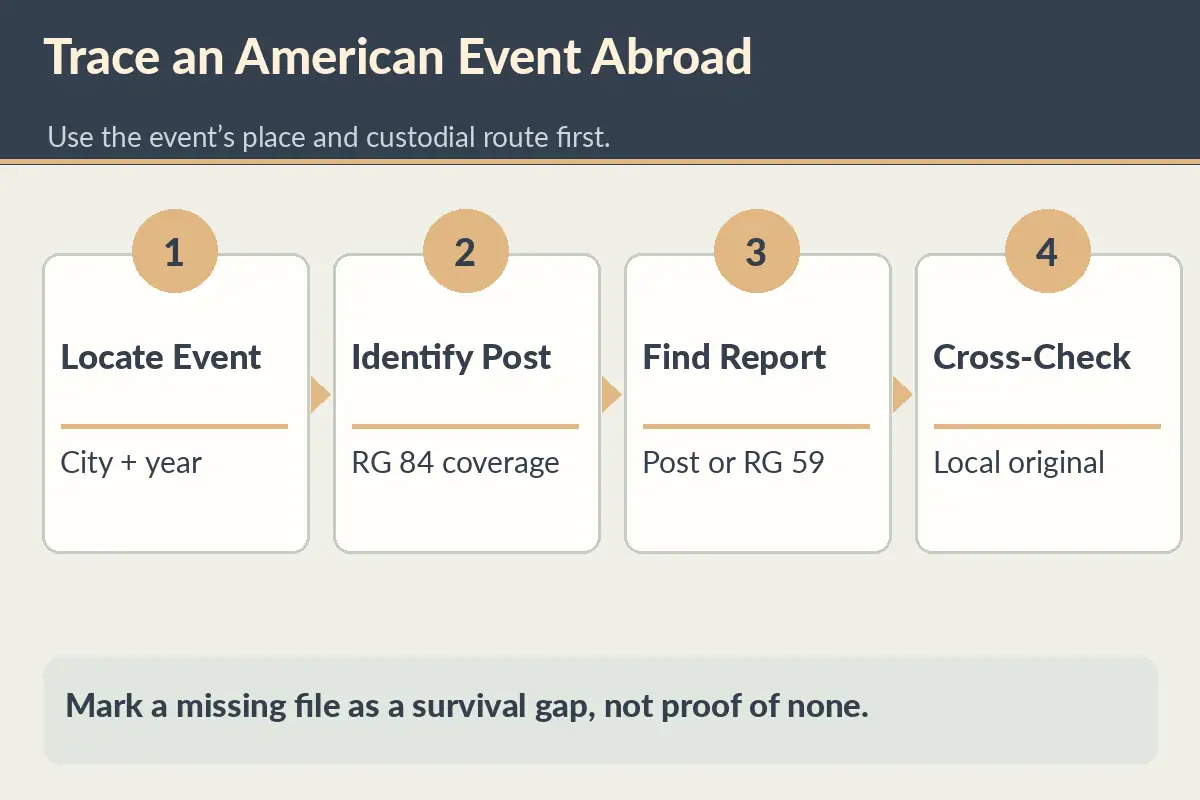
Record Group 84 preserves records of U.S. diplomatic and consular posts overseas. The National Archives explains that many post files are arranged by embassy or consulate and by time period, rather than forming one nationwide alphabetical vital-register collection. To start, identify the city or consular district where a reported birth, death, marriage or seafaring event occurred. Note the possible dates and the historical name of the U.S. post. A person dying abroad may have been reported to a nearby consulate, not necessarily to the post in the town where the event occurred.
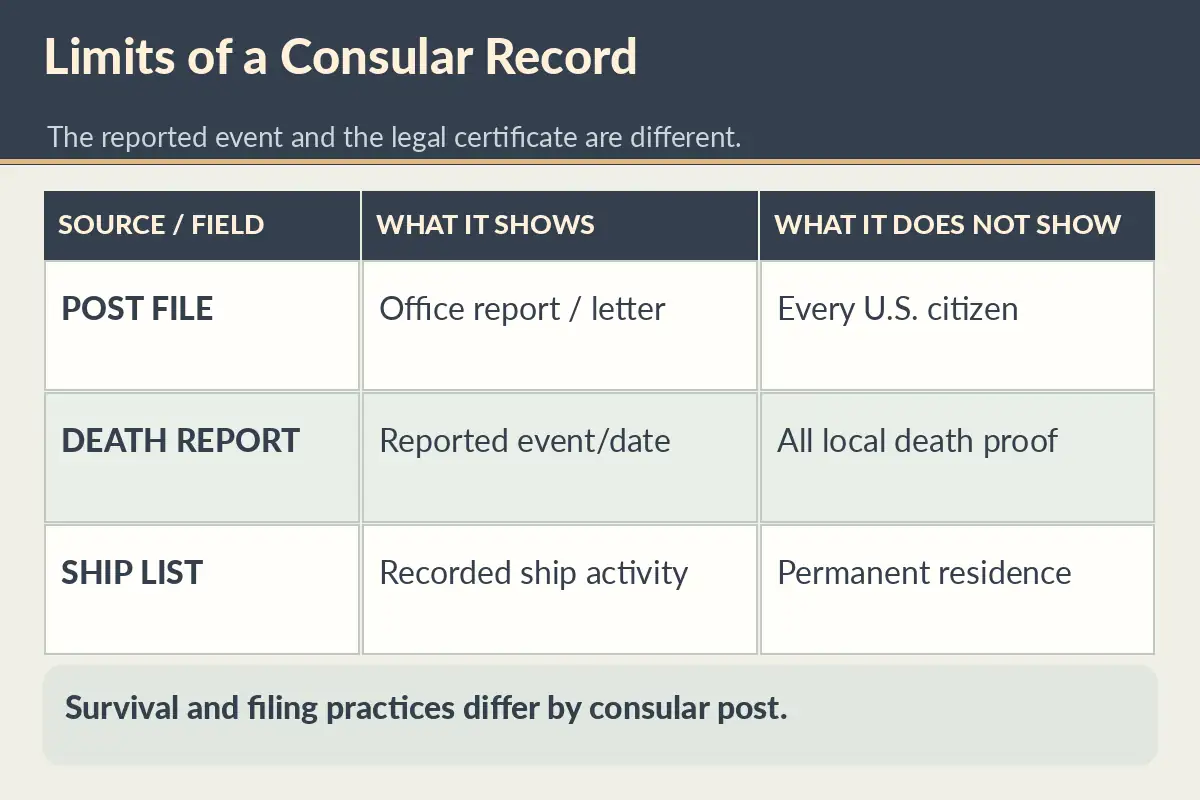
The RG 84 reference paper cautions that surviving coverage is far from complete. Very few early post records survive and collections were lost in wars, disasters and approved disposal. A post’s files may include incoming and outgoing correspondence, passports, ship arrivals or individual event reports, but not every office maintained every type. Avoid claiming that an empty catalogue search proves an American citizen never visited that place. First ask whether the relevant series exists for that post and the years in question. The unit of research is the recordkeeping office before it is the individual name.
Separate RG 84 Local Files From Washington’s Central Records
The Archives distinguishes locally retained RG 84 documents from Department of State central files, including Record Group 59. Correspondence between a consulate and Washington can be duplicated in both, but some local messages, communications between posts and contacts with local officials may appear only in the post files. Therefore a central report and a consular copy might be two manifestations of one information chain rather than independent eyewitnesses. Note the date, sender, receiving office and record group on every item.
When a report is missing from one custody route, test the other if historical file arrangements make that reasonable. Prior to 1912, post files were generally grouped by record type and time; after 1912 overseas offices adopted a numerical arrangement related to the State Department’s central filing system. This transition matters because the same family event may be catalogued differently depending on year. Do not move a modern federal form backwards in time as though every nineteenth-century consulate kept it. Name, place and date are clues, not a universal finding aid.

Follow a Death Report Through Its True Source Chain
The NARA genealogical guide describes consular reporting of American deaths abroad from the nineteenth century onward. It explains that for 1789–1906, reports to Washington generally appear among Consular Despatches organized by post and date, while later centralized report series follow different indexing regimes. The material transferred to the National Archives reaches through 1974; later death records remain with the State Department. These are not all RG 84 pieces, and the research route must not silently label centralized death reports as local post files.
A consular death report may be an invaluable contemporary record, but distinguish an officer’s report, a locally supplied certificate and secondhand information. Copy the reported place and date of death, informant and attachments where present. Verify the death with civil registration, cemetery registers or another source from the country where the event happened. An overseas death report can describe arrangements or personal effects without proving ownership or family relationships in the home country. If there are two persons with the same name, test travel history, age and residence rather than relying on a surname alone.
Route Birth and Marriage Clues by Era and Custody
An overseas birth or marriage can generate both local civil or religious records and a U.S. consular or State Department report. The Archives’ genealogical guide identifies historically distinct files for reports of births and certificates of witness to marriage, with variations by date. These federal documents must not be described automatically as the original local marriage license or birth certificate. Determine whether the paper reports an event, witnesses a ceremony, records a citizenship assertion or issues an administrative certificate. The legal implication depends on the actual form and law then in force.
The official finding aids make clear that some historical birth reports are filed with State Department central materials rather than RG 84 post holdings. Search by the reported consulate and date, then follow the repository’s era-specific index instead of expecting one continuous digital collection. For a marriage, check the marriage register maintained by the relevant local authority, including the original spouses’ identities. For a birth, preserve whether the report states the father’s or mother’s citizenship as supplied information. These statements are not a substitute for examining the person’s legal nationality documents where that is the actual research question.
Use Maritime and Passport Clues Without Inventing Residence
Consulates at seaports sometimes kept records of vessels arriving and departing, services to American ships, and lists of seamen hired, discharged or deceased. The RG 84 reference paper notes that such files vary substantially between posts. A sailor mentioned in a shipping entry may have been transient; a consular passport or visa service entry is an administrative contact rather than proof of permanent residence. Match names to independent ship registers, crew agreements and arrival lists before assigning a particular voyage. Note vessel name, official identifier, port and the date as written.
A consular message about lost papers or a wage dispute may be a statement by one party rather than a final finding. Keep the reported allegation separate from an official outcome. Use the same practice with emigration letters or requests for aid: an American consulate’s involvement does not by itself establish citizenship. The post may have acted for a traveler, a ship, an employer or a relative under different conditions. Where personal material concerns people who might still be living, respect access restrictions and avoid reproducing unnecessary details. The archival context gives the document its meaning.
Build a Post-by-Post Search Log and a Cautious Conclusion
A reproducible RG 84 citation needs the post, series or filing category, date, piece and folder or image identifier. Record the archive location, catalogue wording, access method and any restriction. When seeking a negative result, list which posts, series, years and names were searched. A missing index hit from one city is not evidence of absence from another consular district. If the likely post’s files are incomplete, write ‘coverage unverified’ or ‘records missing’ rather than concluding that the event did not take place.
A final narrative should say precisely whether a U.S. consulate recorded an account of an event, received a copy of a local certificate, witnessed a document, or reported a fact to Washington. If the central and local copies derive from the same message, cite them as a connected chain, not independent confirmation. Test namesakes with location, dates, travel and family documents. The strongest genealogy result may be a narrowly verified date or ship name, together with a transparent list of what remains unknown. Avoid replacing those uncertainties with an imagined life abroad.
How We Research This Specific Archival Claim
Our review first distinguishes the office that created the records from the later catalogue, digital provider and modern interpretation. We check the repository’s period, surviving extent, original arrangement, access rules and description of each series. Every source is read for exactly what it reports: an original statement may be accurate about one event yet inadequate for a family relationship, legal outcome or residence claim. We test competing namesakes with independent dates, places and record identifiers, keep conflicting claims in separate rows and document precisely which portions of a collection were searched. A negative online search is not a negative archival finding without a documented coverage assessment.
More Records and Archives Guides
Archive Sources and Their Evidentiary Limits
The primary archival guide explains Explains that RG 84 records are arranged by overseas post, include unique local correspondence and are incomplete due to record loss and disposition.. An additional official research source confirms Details routes to consular reports of births, marriages and deaths and separates central-file and post-level custody by period.. These institutional descriptions establish the existence and general scope of records; only the original document can establish what it says about a particular person. Date your retrieval, cite the full piece and page, and keep unresolved namesakes open rather than borrowing unverified details from a published tree.
No. It is organized primarily by consular or diplomatic post, with uneven surviving record types.
No. Many belong to central reporting series and different record groups.
Not necessarily. Locate the original local civil or religious entry.
Some offices kept few records and losses occurred through war, disaster and approved disposal.
No. It can document a dated contact, but long-term residence requires independent evidence.