
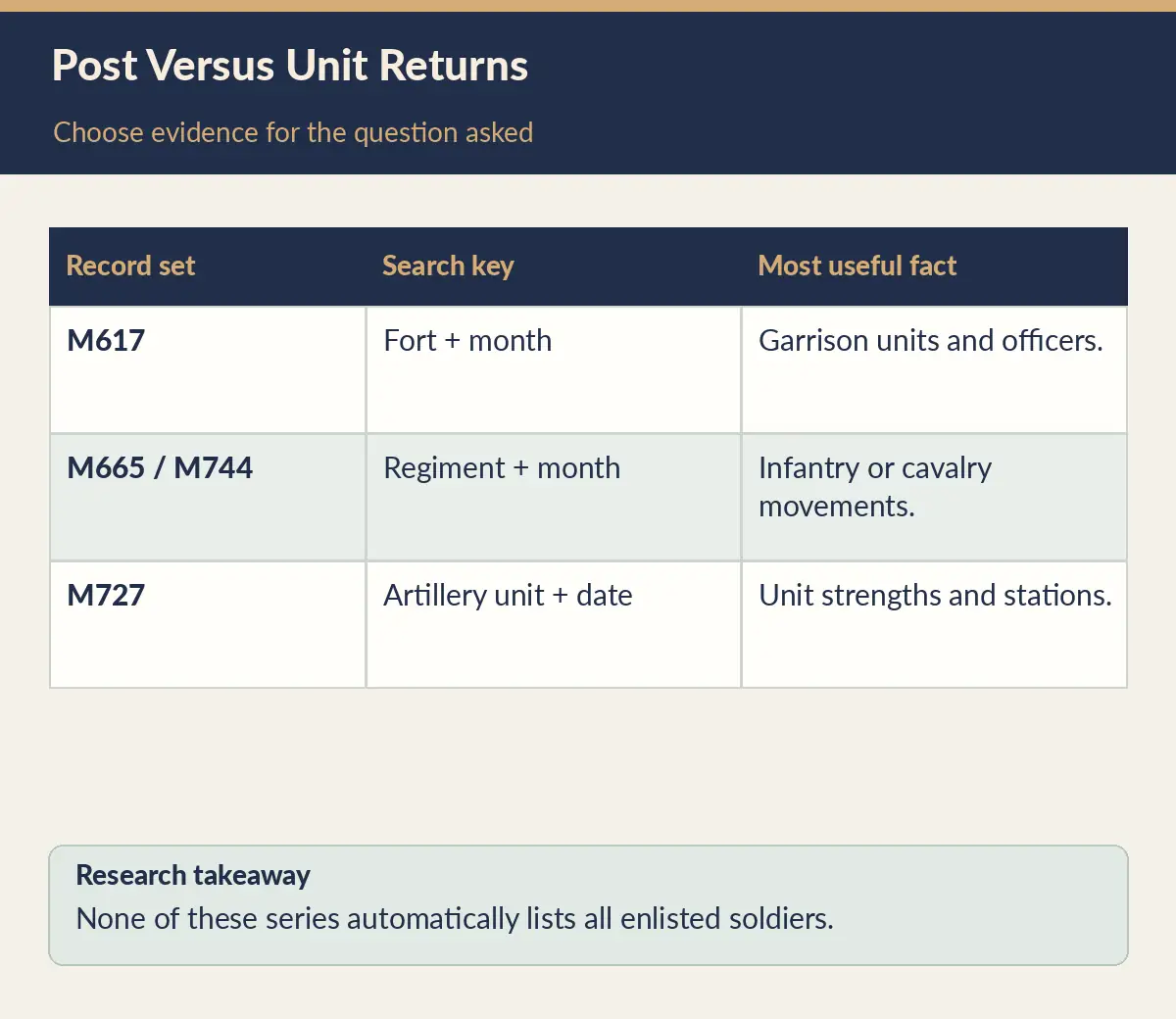
For U.S. Army post returns, start with a specific fort, camp or post and a month, not a soldier’s surname. NARA microfilm publication M617 chiefly documents which units were stationed at a post, their strength, named officers and selected events. The National Archives military-records overview makes the scope clear: an enlisted soldier may have served at that post without being named in the return.
Identify the Post and Exact Search Interval
Search a military-history source, family letter, veteran account or dated muster to learn the historic name of a fort or camp. Army posts often changed names, and one town could have multiple installations. Record the event date and distinguish military post, troop station and civilian settlement.
M617 reproduces material from the early nineteenth century through 1916, with a few returns extending into 1917; the title range does not guarantee a return for every post-month. Start with a two- to six-month span around a documented unit movement. A vague family statement such as “stationed in Texas” is not precise enough to identify one post record.
Understand How NARA Arranged M617
M617 consists of 1,550 microfilm rolls reproducing returns from U.S. military posts, 1800–1916. Its underlying material comes principally from RG 94, with some returns from RG 393 and RG 395. Returns are arranged by the name of the post and then chronologically, according to NARA’s research material.
A post report is an administrative return sent to higher command, typically monthly, rather than a diary written to describe every enlisted man. Use the roll guide and a historically accurate post name before browsing. The date printed on a return is not necessarily the date of every incident listed inside it.

Extract Units, Officers and Strength Separately
The basic form records garrisoned units, numbers of officers and enlisted men present or absent, duties and names of officers; some include communications and a record of events. A line naming a captain can substantiate the captain’s reported duty, but a strength figure such as sixty enlisted men does not identify sixty named people.
Create separate fields for officer names and aggregate personnel counts. Beware of claiming that the return lists every soldier: it usually does not. If the post served as a headquarters, some recorded officers may have responsibilities spanning units or stations, so read the heading carefully.
Switch to Unit Returns When Names Are Missing
When a personal ancestor is not named in the post return, seek a regiment or company. NARA identifies M665 for regular infantry regimental returns, M744 for cavalry and M727 for artillery. These returns are arranged by unit and date and also emphasize officers, strengths and company commanders.
Neither a unit return nor M617 should automatically be treated as a complete roll of private soldiers. Combine it with the soldier’s enlistment register M233, pension file, compiled service material where appropriate or individual letters. The central distinction is between knowing where a unit served and proving that a particular person was a member at a given time.
Cross-Check a Hypothetical Fort Posting
Imagine a family account saying Samuel Price was at Fort X in spring 1884. An April post return lists a cavalry company under an officer but not any Samuel Price. That is evidence the unit was reported there, not direct evidence for Samuel.
Seek an independently identified company, a same-period enlistment or a pension statement giving the unit and service dates. If the company history conflicts with the claimed fort, do not adjust the documentary timeline merely to preserve the story. Record each observation with its date, military hierarchy and source type; competing namesakes can have similar initials and serve in different regiments.
Distinguish Post Events From a Soldier’s Experience
Post returns can summarize detachments, changes in command, communications, sickness statistics or other notable events. These administrative descriptions may provide context for a family letter about travel, conflict or deployment. They do not make an unnamed soldier an eyewitness, combatant or patient.
A list of sick men could be aggregated rather than individually named. Quote only the fact actually stated on the page, then ask what other personal evidence could establish participation. The NARA Philippine-service guide illustrates why post and regular-unit returns can be useful supplements while still not replacing individual records.
Track Name Variants and Post Renaming
A search failure may reflect a renamed military installation, a different spelling or a shift between department, division and fort headquarters. Try the contemporary designation from a dated map or Army report before abandoning M617. Watch for forts with similar names in different states.
Save both the term searched and the actual roll heading. If a fort operated seasonally or during a campaign, there may be no continuous monthly sequence. Absence of an expected month is a limitation of the return set, not proof the entire installation was abandoned. Preserve a reproducible list of dates and post spellings tested.
Record a Usable Archival Citation
For each assertion, cite National Archives and Records Administration, M617, the named post, date of return, microfilm roll number and page or image if available. A citation to a general microfilm publication without the fort and report date is too broad for another researcher to retrace.
When the page includes a list of stationed companies, transcribe the exact designation and mark uncertain letters. Separate a downloadable roll image from a catalog description or later NARA explanatory article. If using M665 or M744 for corroboration, supply its own distinct publication and unit citation rather than attaching every observation to M617.

How We Research Military Post Evidence
Our method builds a location-and-month query from an independent dated source, locates the right M617 return, then transcribes unit names and officer names in different columns from headcounts. We compare adjacent months to identify movements and stop at a clear evidentiary threshold: a post return supports unit context, not unnamed individuals. Where individual identity is the question, we pivot to service and pension records and test alternative soldiers. We consult NARA’s military source guide for series definitions, and the site’s affiliate disclosure explains our publication relationships.
More Records and Archives Guides
Make the Next Search a Falsifiable Question
A good next task is “Did the named company serve at Fort X in April 1884?” rather than “Prove that Samuel was there.” Once the company’s presence is supported, separately ask whether Samuel belonged to the unit that month and what personal source could prove it. A reliable research log records searched posts, months, alternate names, record type, and findings or genuine gaps. This avoids converting a unit-strength statistic into a fictional individual biography. Keep the family account as attributed testimony when it remains uncorroborated, and document why a promising military-post entry still falls short of a genealogical identification.
No. It principally reports garrison units, troop strength and officers, not a complete named roster.
By post and then date; establish the historic fort name first.
Returns chiefly run from 1800 to 1916, with a few extending into 1917.
NARA identifies M665 for regular infantry unit returns, a separate series from post returns.
No. The person’s membership and dates must be established independently.