
The fastest way to trace an individual in the British Home Office’s HO 8 series is to identify a prison hulk or convict prison and a quarter before attempting to locate a surname. These are administrative returns, not a single alphabetical database. A State Library of New South Wales research guide shows why knowing the establishment or a prisoner number can matter more than a broad surname search. A prisoner sentenced to transportation was not necessarily transported.
Understand Which Prisoners HO 8 Actually Covers
HO 8 is titled Home Office: Convict Hulks, Convict Prisons and Criminal Lunatic Asylums: Quarterly Returns of Prisoners. The series covers 1824–1876 overall, but the constituent institutions enter the record at different times. Hulk returns are particularly important in the earlier decades; prison returns appear from the 1840s and asylum material later. Treat the overall span as a catalogue boundary rather than a promise that every facility reported every quarter. The National Archives transportation guide places HO 8 among several distinct prisoner sources.
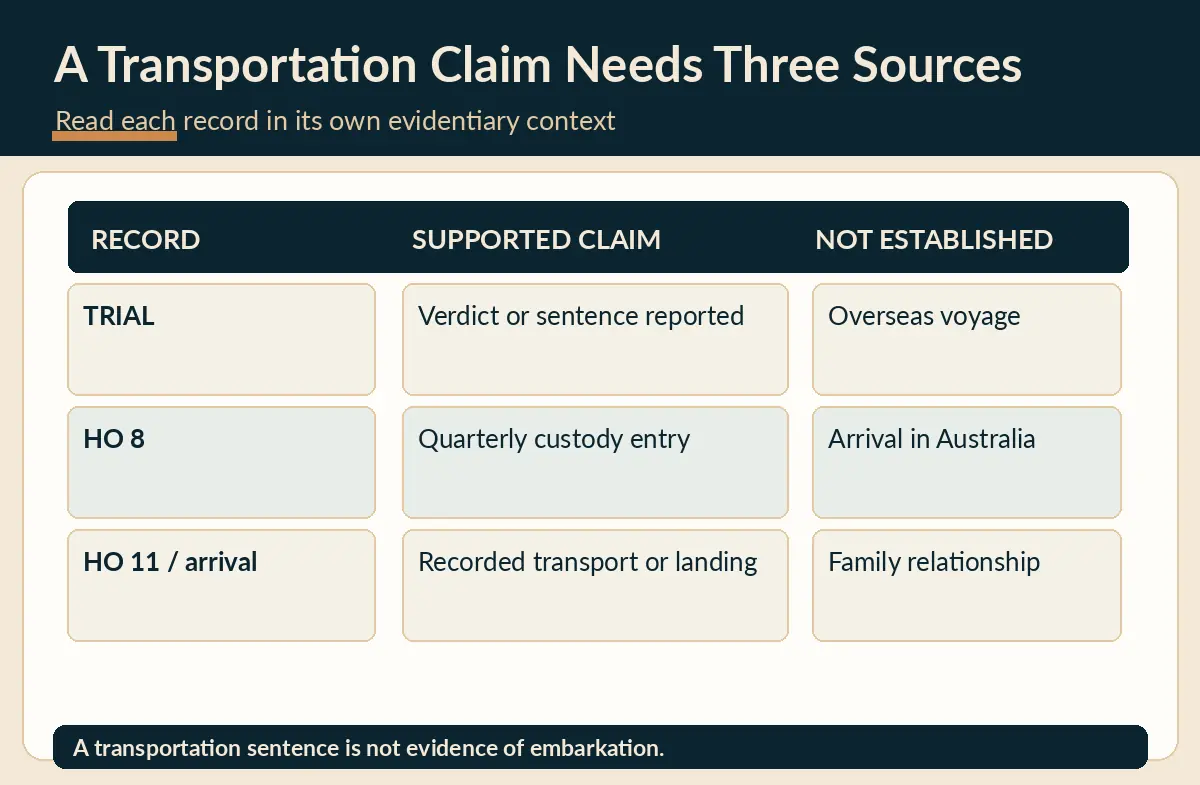
Each quarterly return captures a roster at an administrative moment. The recorded particulars can include an age, conviction venue and date, offence, sentence, health and conduct notes, plus a prisoner number. These are statements on a form, not a complete biography. In particular, quarterly appearance establishes a reported custody entry around that date; it does not by itself establish birthplace, family connection or the final outcome of a transportation order.
Begin With Hulk, Port, and Quarter
Make a working line with the vessel or establishment, associated port, approximate quarter and the earliest reliable source of that clue. Hulk names can resemble ordinary ship names; do not confuse them with transport ships that sailed to a colony. If your source says only Portsmouth or Woolwich, search the catalogue for the institutions listed there within the relevant time span rather than guessing one ship. A conviction date gives a search starting point, not the date of incarceration.
The June 1827 catalogue description HO 8/12, for example, lists separate entries for hulks at Sheerness, Deptford, Chatham, Woolwich, Portsmouth, Devonport and Bermuda. Its descriptive page numbers illustrate how one bound piece may contain many institutions. Cite the exact piece, quarter, institution and image or page you inspected; a loose screenshot of a name is not sufficient for rechecking.

Use a Prisoner Number Without Mistaking It for Identity
The library’s HO 8 workflow recommends consulting related HO 9 hulk registers when a prisoner number is needed. Enter the number alongside the institution and date in your research log. It is a filing aid within a custody context, not an enduring national identity number. Never carry it across institutions or decades without confirming that the numbering system and person remain the same.
If no number can be found, browse the relevant quarter and institution rather than declaring the person absent. Older manuscript spellings, shortened given names and indistinct handwriting can obstruct indexed searches. Compare the prisoner’s age, offence, conviction location and sentence before assigning a name hit to the target. An exact spelling with a conflicting trial date is a weaker candidate than an altered spelling with matching surrounding identifiers.
Read the Return as an Administrative Snapshot
Transcribe the entire line, including negative or routine remarks. Health or behavior columns tell you what a prison official reported for that quarter. They cannot prove an underlying medical diagnosis or a later life event. Note the difference between a stated age and a birth date calculated from it. If a return shows an age of twenty-three in 1836, preserve that age as written rather than inventing an exact birth year.
Compare surrounding quarters when available. A person may appear repeatedly with the same sentence but different condition notes. Track the presence or absence of a number and the placement under the same institution. A missing appearance in a later return is a question to investigate: transfer, discharge, embarkation, release, incomplete preservation and transcription mistakes are competing explanations, not conclusions to pick in advance.

Separate Sentence, Custody, and Overseas Voyage
The key evidence distinction is chronological. A court records a verdict and punishment; HO 8 records custody within a reported institution; a transportation register such as HO 11 concerns a transport record; and arrival papers may document the colonial endpoint. These records answer different questions and may use different identifiers. Never collapse them into a single sentence such as “transported in 1836” merely because a return records seven years’ transportation.
For a credible voyage statement, identify a specific sailing and compare available passenger or convict embarkation material with the prison return. Confirm ship, name, date, and court or sentence details. If the evidence stops at HO 8, write “recorded aboard the hulk” with its date instead of a destination. The National Archives explicitly separates hulk returns from transportation registers and other prison collections.
Solve Two Same-Name Prisoner Candidates
Imagine two hypothetical men named Thomas Miller, both described as being in their twenties. Candidate A has a Liverpool conviction and a seven-year sentence; Candidate B has a London conviction and a different sentence length. If a family letter names a London trial, a general age match is not enough to attach Candidate A to the family. Make a side-by-side worksheet with source, institution, quarter, number, conviction court, offence and sentence.
Resolve conflicts by obtaining the court’s sentencing record and checking consecutive prison entries. Do not infer a family tie from a shared destination or criminal label. A well-documented decision may still say “identity not resolved.” Preserve contradictory statements and explain which additional record would discriminate between candidates before adding either to a family tree.
Deal With Missing or Unavailable Pages
An online search result is not an inventory of all originals. Catalogue records can describe bound documents that require a reading-room visit or a copy request, and microfilm may be available through specialist libraries. Confirm the exact piece and page coverage before spending on an access service. If a scan is difficult to read, check adjacent pages and other copies rather than silently correcting the manuscript.
A sound negative search entry records which quarters and institutions you examined, their archival references, spelling variants and coverage caveats. A missing indexed name is weaker than a complete browse of known surviving pages, and even a complete browse speaks only to the chosen holdings. Use alternate court, pardon or transport sources only when they genuinely address the unresolved step.
More Records and Archives Guides
How We Research HO 8 Prisoner Entries
We first verify the series description and the prison-or-hulk arrangement against the National Archives and State Library of New South Wales instructions. We then test candidate identity using the record’s own dates, number and conviction details, not surname alone. Finally we separate three claims in the evidence note: a documented courtroom sentence, a reported quarterly custody entry and any independently evidenced voyage. This method is designed to prevent an attractive indexed hit from becoming an unsupported transportation narrative.
For a reproducible citation, keep repository, series HO 8, piece identifier, quarter, hulk, page or image reference, name as written and access route. Ask another reader whether the cited reference actually locates the entry. Research advice here is independent; read our affiliate disclosure before following any commercial discovery options mentioned elsewhere on the site.
No. A sentence of transportation and appearance on a hulk do not document that a ship actually carried the person overseas.
No. The returns are arranged in dated institutional sequences, and name indexing or digitization varies by access service.
HO 9 hulk registers or correspondence may provide a number to help locate the same person in an HO 8 quarter.
Check spelling, location, the quarter and the catalogue piece. Institutions change between lists, and not all expected returns survive.
No. A behavior assessment is a prison administration entry; consult a court record to establish the verdict and sentence.