
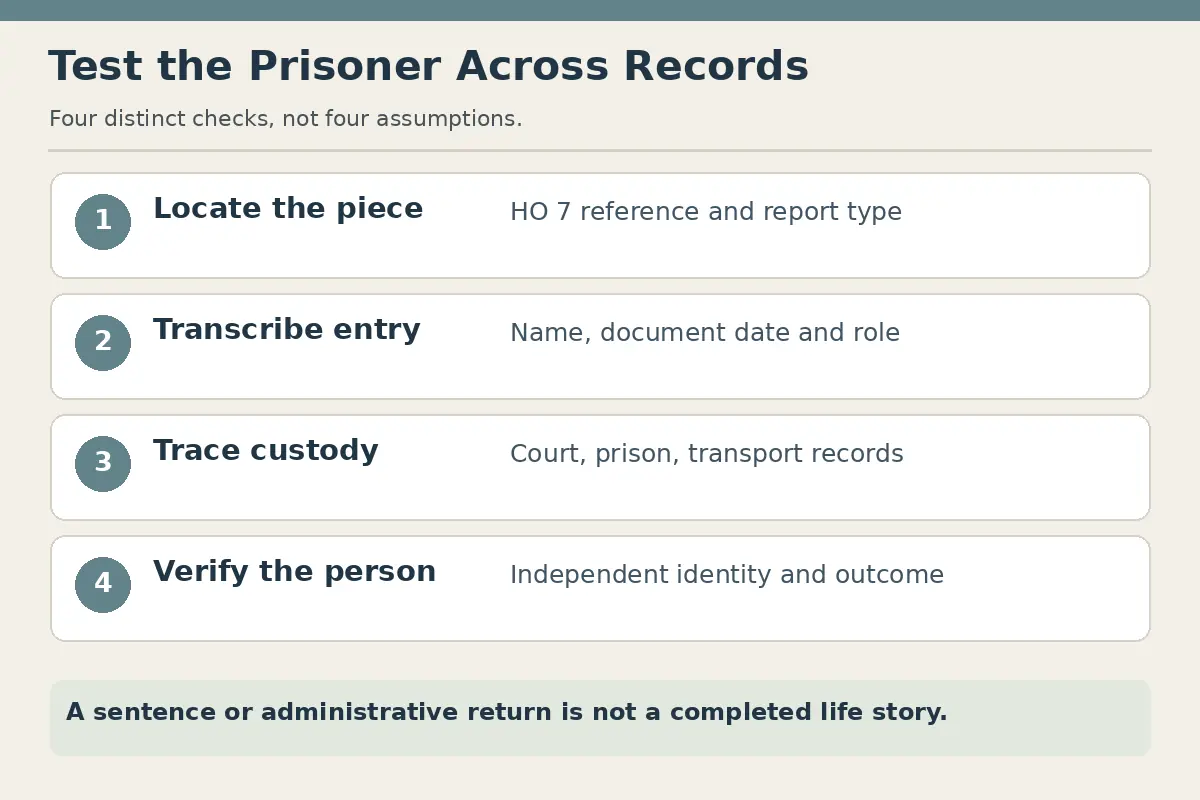
HO 7 is a small but varied Home Office collection of convict miscellanea covering a 1785 parliamentary investigation and later papers chiefly from 1823–1835. It is not a single alphabetical list of everyone transported from Britain. Some records concern conditions and administrative policy; others can mention named convicts or deaths abroad. To use it responsibly, first establish which part of the series you have, transcribe what that document says, and search for a separate transport, custody or civil record before claiming where an individual actually went.
Identify the Three Different Documentary Questions
The earliest material concerns inquiry and policy surrounding proposed transportation rather than a manifest of completed journeys. Later correspondence and reports may discuss prison hulks, colonial institutions, or the treatment and mortality of particular groups. A document headed with a country or ship can therefore be describing an administrative question, not a precise entry for one ancestor. Determine its originating office and the purpose of the document before searching names.
Make a three-column intake record labeled document type, stated population, and claim supported. A committee minute might prove that an option was debated; a return of deaths might document persons listed by an official; a ship register might record custody. These are not interchangeable. Preserve the original archival reference, page, reporting period and any headings that specify the geographical or administrative scope.
Begin With the Exact Reference Rather Than a Database Hint
The National Archives lists HO 7 among selected digitized criminal record collections, but a commercial index can mix series with different purposes. Look for HO 7 on the transcript or search filter; then examine the image and the surrounding page. A surname appearing in a database result is not evidence that every field indexed belongs to the same category of source. Avoid copying a commercial collection title as though it were the original manuscript heading.
A practical search can begin with a documented name and a likely date or with a known vessel and institutional location. Note alternate spellings and initials, but do not expand the search so widely that every person with the same surname becomes a candidate. When only a date and port are known, browse records in a constrained interval and write down negative searches and missing coverage separately.

Separate a Death Return From Its Underlying Event
Some HO 7 papers relate to deaths of convicts in New South Wales. If a return contains a name, first copy its exact date heading, location, source or informant if stated, and any qualifying remarks. A reporting period can be later than the death it summarizes. Never convert the date a return was sent to London into the date a person died unless the original entry actually makes that identification.
A death return offers a strong lead for independent colonial death, burial, institutional, or muster evidence where those sources survive. Identity requires comparison of age, occupation, convict ship, sentence or other distinguishing facts when they are genuinely recorded. If the return names a person without a full description, do not silently attach a parent, spouse or hometown from a modern family tree.
Keep Sentencing, Embarkation and Arrival on Separate Lines
A person could be sentenced to transportation yet remain for a time in an English prison or hulk. The National Archives warns that not all people sentenced to transportation sailed overseas. That makes an HO 7 discussion of transportation especially unsuitable as sole proof of a completed journey. Record the distinct events: trial and sentence, transfer to custody, embarkation, colonial arrival, and any subsequent disposition.
If you have a plausible person in HO 7, test the claim against other record classes. HO 11 transportation registers can provide a voyage-oriented route, while colonial musters, certificates and institution papers address different later questions. Check each series against its documented period and coverage; absence from one index is not proof that an embarkation never took place or that an individual did not survive.

Interpret Officials’ Assessments as Historical Testimony
An officer’s description of character, conduct, health or reliability is testimony from a particular authority. It may be revealing about institutional assumptions but is not a neutral modern diagnosis. Quote briefly and exactly when it matters, identify the author, and explain whether the writer directly observed the person or repeated earlier information. The moral vocabulary of nineteenth-century penal administration should not become an unsupported statement about character.
Use two notes: one for what the document literally states, another for your interpretation. This practice is important when an official letter exaggerates a complaint, when a later summary contradicts an earlier register, or when the surviving source refers to a whole institution. An institution-level report on overcrowding is valuable social history; it does not establish conditions experienced by every named individual.
Test a Fictional Two-Person Collision
Suppose an HO 7 return contains “John Brown” and an indexed transportation list contains the same name. One shows a place abroad, the other a sentence in Britain. Without additional identifiers, the documents may concern two different people. Record the complete wording of each and ask which one supplies an age, trial court, ship, identifying mark or other detail that can actually connect the entries.
This example is hypothetical, not a purported archive discovery. If there is a discrepancy between a reported death and a later appearance in a register, keep the conflict visible. It could be different namesakes, a copied date, or an administrative error. Resolve it with independent contemporaneous sources rather than choosing whichever version makes a simpler family story.
Cite the Record and Define the Remaining Research Gap
A reproducible citation should identify The National Archives, HO 7, piece number, document heading or date, folio or page, and whether the evidence came from a full image, a transcript or a catalogue description. When viewing a copy through a licensed platform, also record the platform and image identifier without replacing the original archival reference. This makes another researcher able to recheck the claim.
Finish with a precise conclusion. You might establish that an office recorded a death, that a committee investigated transportation, or that a named convict appeared in a register connected with a vessel. Each is useful on its own. A completed voyage, cause of death, and relationship to your family need their own tests. If the original page or a linked register is missing, say the matter remains open.
More Records and Archives Guides
How We Research the Archive and Check Historical Claims
Our starting point is the relevant official research guidance, cross-checked with a separate authoritative description. We distinguish the series purpose from the contents of a particular piece and from family or local claims made later. A source may be an original, an official summary, a commercial transcript or a modern interpretation; each deserves an explicit label. The original date, jurisdiction, informant and document’s administrative purpose determine which proposition it can support. Illustrative scenarios in this article are invented for teaching, not disguised transcriptions.
Availability depends on the particular item: indexes can be incomplete, paper files may need an archive visit or copy request, and some records have legal access restrictions. We describe verifiable research routes, not guaranteed individual results. We do not infer sponsorship from citing a repository, and we do not recommend unconfirmed commercial links. See our affiliate disclosure for site policies. Where evidence conflicts or a necessary piece has not been examined, we preserve that uncertainty in the conclusion rather than filling the gap with a convenient story.
No. Parts of the series concern policy and administration, while other records may identify people.
No. Search separate transportation and colonial records for a documented voyage and arrival.
Not by itself. Match the person to independent records with identifying details.
Inspect the surrounding page and index context; record the discrepancy instead of adopting the index without qualification.
Choose a court, custody, voyage or colonial record that tests the specific claim the entry leaves unresolved.