
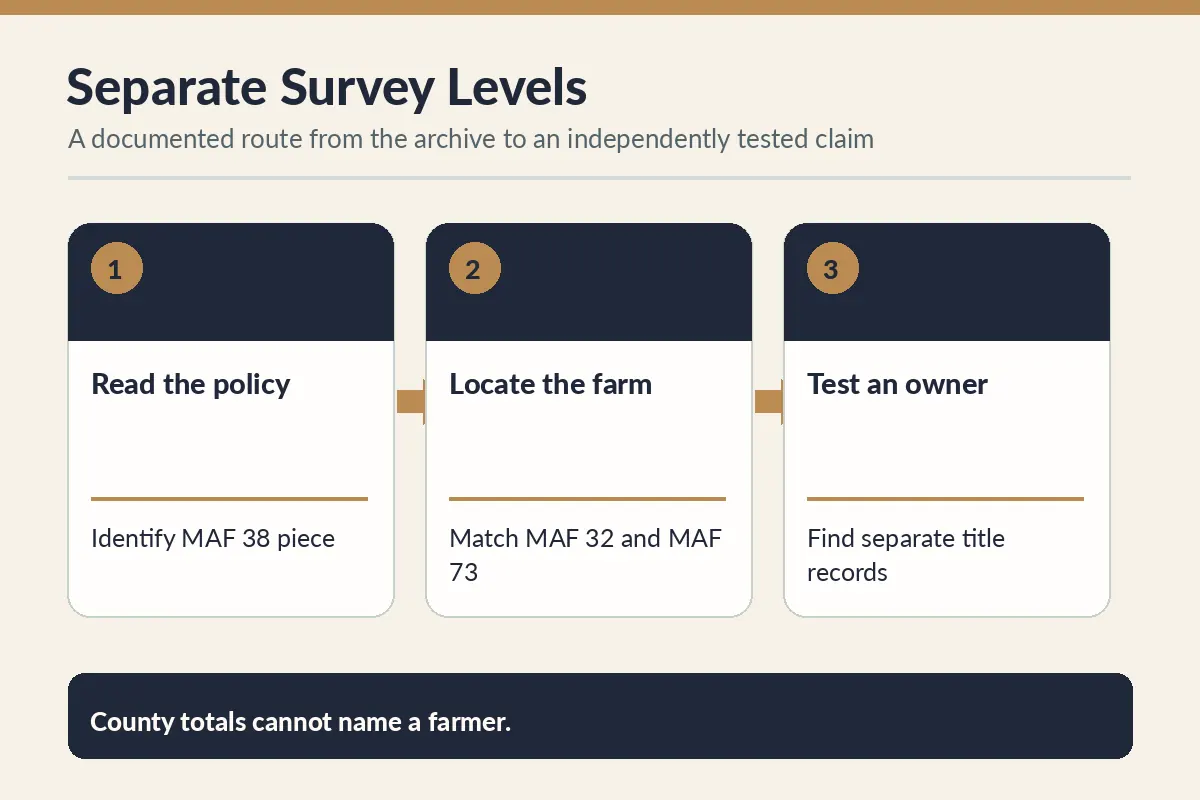
For the 1941–1943 National Farm Survey of England and Wales, MAF 38 is useful when the question concerns how officials planned, administered or analyzed the exercise, not when the aim is to identify the occupant of one farm. The National Archives identifies survey planning material in selected MAF 38 pieces and county statistical analyses in MAF 38/852–863. Individual farm forms belong principally to MAF 32, while marked parish maps belong to MAF 73. These three archives answer different questions, and a county total must not become an invented statement about a particular farmer.
Choose a Survey Question Before Choosing a Series
Start with the kind of assertion you need to test. If a family story says a holding was inspected in wartime, identify its civil parish and look for the individual farm record in MAF 32 and the corresponding farm-number map in MAF 73. If the question instead concerns why particular farming information was collected or how officials organized inspections, look for administrative papers in MAF 38. A county-level statistic can describe the aggregate survey but cannot by itself identify the owner, tenant or working farmer. Write the scope of the intended claim as farm, parish, county or national policy before searching.
The National Archives distinguishes the 1940 farm-related survey from the detailed National Farm Survey undertaken in 1941–1943. Record which operation a document concerns instead of merging all wartime agricultural papers. For MAF 38, published guidance identifies planning and implementation pieces MAF 38/206–217, 469–473 and 865–867; those are finding aids to groups of records, not proof that every paper exists for every county. Search using the survey name, approximate dates and an administrative subject, and read the catalogue description of the actual piece before assigning it to a county or policy decision.

Read County Statistics Without Creating Individual Data
The county statistical analyses in MAF 38/852–863 are aggregated products. Extract the county name, survey period, unit of measurement, table heading and any definition that governs the category. A reported acreage, for example, may depend on the survey’s classification and need not equal modern land registry area. A total for holdings is also not an exhaustive list of farm names. Avoid dividing an aggregate by a guessed number of farms and attributing the result to a named ancestor. If denominators or category definitions are missing, record that limitation instead of computing a neat but misleading figure.
Compare a county summary with other county summaries only after confirming that the same definitions and dates were used. A document drafted for internal administration, a proof copy of a summary report, and a public press release can present different levels of detail. The National Archives identifies a proof copy of the 1946 summary report, with press material, in MAF 38/216. Treat that report as an interpretation or presentation of survey findings, not as a substitute for the original holding’s form. Note whether an apparent contradiction reflects aggregation, rounding, revision or a different geographic boundary.

Keep the Farm-Number Link Separate
When researching a specific holding, use the three-part farm number as a link between MAF 32 survey forms and the associated MAF 73 parish map, where the surviving material supports that link. Put the exact farm number, civil parish, map sheet, year and full archival references on one research sheet. Do not infer that a listed farmer owned the land: survey records can identify an occupier, another owner or a different type of contact. These distinctions matter if a family occupied a property temporarily or farmed acreage spread across several areas. An administrative county chart supplies context but cannot repair a missing farm-number match.
Availability is changing as digitization proceeds. The National Archives’ project guidance describes online publication of MAF 32 and MAF 73 by county through March 2027, with some counties appearing earlier. That schedule is a project intention rather than proof that each intended image is already accessible today. Check Discovery at the time of research, save a record URL and record whether you inspected an image, only a catalogue entry, or a paper copy at Kew. An unsuccessful online search may reflect the publication schedule rather than the historical absence of a surveyed farm.
Build a Defensible Wartime Agriculture Narrative
A useful historical account places three kinds of evidence on separate lines: government planning in MAF 38, aggregate county findings in MAF 38, and individual holding records in MAF 32 with maps in MAF 73. Place any dated local newspaper report or county committee document beside them as a fourth, independently created source. Government policy may have influenced local agriculture, but that does not prove an individual complied with, received or even saw a particular instruction. Describe a national recommendation as a recommendation and verify any claimed local implementation with local records.
Consider a hypothetical researcher studying a Somerset farm. They locate a county figure in an MAF 38 analysis and a wartime family letter discussing shortages. Neither names a particular survey form. Only after a farm-number and parish match can the researcher describe the specific holding. Even then, there may be a mismatch in acres or occupier names because dates and reporting purposes differ. Preserve the discrepancy rather than silently choosing the larger number. A strong conclusion identifies which level of the wartime evidence is certain, which is inferred, and what original record would settle the remaining question.
A practical ledger needs five columns: question, source and archival reference, geographic level, exact observation, and unproven inference. Enter ‘county aggregate’ as the unit when using MAF 38/852–863; enter ‘farm number and parish’ for a linked MAF 32/MAF 73 item. Never let a number copied from a county table migrate into a named person’s row. For a negative search, note the county, time, online availability and the precise catalogue searches tried. That separation makes later discoveries useful without forcing a family narrative to fit a statistical report.
More House and Local History Guides
How We Research This Archive Series
Our editorial source review on November 8, 2026 used The National Archives research guidance for the archive-specific series and its complementary record guidance for evidence context and access limits. We have not claimed to consult an original file or a named person’s unpublished record. Hypothetical examples are explanatory only. A series description establishes coverage and arrangement, not the facts of every individual document. The graphics explain research decisions and are not facsimile images of historical sources.
A reproducible finding needs the research question, contemporary date and locality, creator or department, exact piece and page if known, a literal description of what is actually recorded, and an independent source where one is available. Keep catalogue descriptions and third-party indexes separate from original page evidence. A negative search establishes only what was searched and what was accessible, not that an event could not have happened. Check the current access conditions and any privacy restrictions before ordering or publishing historical material. See our affiliate disclosure; these archival links are not paid endorsements.
No. Use MAF 32 for individual farm records and MAF 73 for linked parish maps; MAF 38 is chiefly relevant here for administration and analysis.
The National Archives identifies MAF 38/852–863 as county-arranged statistical analyses.
No. Aggregates cannot safely be assigned to a specific farm without its original return.
Do not assume so. The National Archives describes staged digitization through March 2027; check current catalogue access.
Match the surviving farm number and civil parish between MAF 73 and MAF 32, documenting both references.