
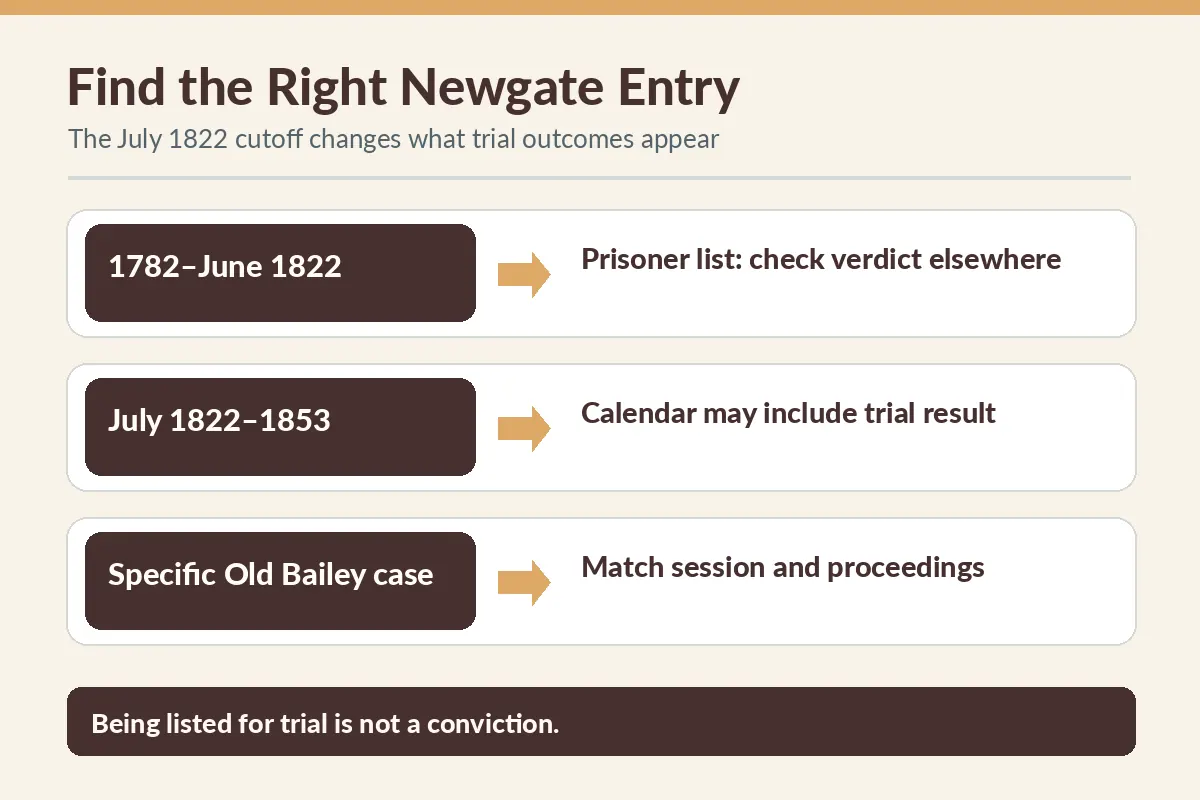
HO 77, the Newgate Prison Calendar, covers 1782–1853 and is a vital way to locate people listed for trial at the Old Bailey. These printed and annotated calendars are not the same as full transcripts, nor is a name appearing in a prisoner list proof of conviction. The National Archives states that from July 1822 the calendars also include trial results. That change matters: researchers should not read an absent earlier verdict as an acquittal or a guilty finding. Start with the session date and the exact entry, and then compare the independent court proceedings.
Use the July 1822 Change to Choose Your Evidence
The National Archives describes HO 77 as chronologically arranged volumes. Earlier volumes contain printed lists of prisoners to be tried, sometimes with manuscript additions; from July 1822 the series also records results. Search by the likely trial session and inspect the appropriate volume rather than assuming a single national index covers all years. Where a name appears in an earlier list, transcribe the listed offence and other details but mark the actual verdict as unknown until a trial or a separate register supplies it. Never interpret the word ‘prisoner’ as a modern conclusion that the person was convicted.
Even for the later period, read the form carefully. A printed charge can be followed by a handwritten alteration, a not-guilty verdict or a different sentence than an earlier note suggested. The series description mentions later columns for age, trade, committal information, verdict and sentence, but the exact fields vary by volume and period. Do not add missing age or occupation data from a later edition. Copy the entry in its contemporary spelling and mark corrections, marginal notes and uncertain handwriting separately. A trial result on one calendar does not by itself establish an entire custodial history.
Trace the Session Rather Than a Famous Name
Locate the court date or session from a family source, old newspaper or published proceeding. The National Archives’ Old Bailey guide describes the court’s name and institutional changes; it became formally known as the Central Criminal Court in 1834. Search its printed proceedings at Old Bailey Online where appropriate, but remember that publication practices and levels of detail varied. A case with the same common surname may involve a different defendant or court. Match the date, charge, age where supplied, occupation, associates and place, keeping a row for each possible person instead of combining all search hits.
For cases in the overlap 1815–1849, HO 16 contains lists of prisoners awaiting trial at the Old Bailey; HO 26 and HO 27 provide different criminal-register coverage. These are alternate record types, not three independent verdicts automatically confirming one another. Ask which record first reported the charge and which explicitly records the trial outcome. When different sources copied the same court announcement, document that shared origin. If a person appears in HO 77 but not a keyword index, test date browsing and variant spelling, and note the possibility that no full contemporary proceedings survive or are accessible in the searched edition.

Record an Acquittal, Sentence or Further Action Exactly
A calendar entry can show an accused person, a committal, a verdict or a sentence, depending on date and form. Use four separate labels in your timeline. The National Archives warns that people listed in criminal-register sources include those not convicted; historical administrative records are not universal proof of guilt. If a sentence was later commuted, pardoned, appealed or otherwise changed, the original calendar’s verdict does not establish the final disposition. Search related Home Office correspondence, petitions or transportation records only if the original case makes that route relevant. A transportation sentence also does not guarantee a person actually embarked.
Imagine a fictional case where Mary Brown appears in a Newgate list and a later newspaper alleges theft. Before July 1822, the HO 77 entry may not record an outcome. A similarly named defendant in a different session might have been convicted, but cannot be merged with Mary without corroboration. The appropriate record statement is ‘listed for trial at Newgate in this session on a specified charge.’ If a later trial report records acquittal, update that claim with a separate citation and explain the relationship of the two records. Keep allegations distinct from judicial findings.
Protect the Citation and the Family History
For every entry note the full HO 77 piece, session date, volume or page, name as written, alleged offence, any explicit result and whether an annotation appears in a different hand. Add the identity of the image provider if you used a subscription copy, but cite the underlying archive reference as well. The National Archives’ Old Bailey guide describes the HO 77 material as browsable by date, with third-party digital images also available. An index-only result is a discovery aid, not a substitute for checking the calendar image where possible.
Historical criminal proceedings can carry stigma that was never warranted by a verdict. Write carefully when sharing family stories: say ‘charged with’ if a charge is all you can verify, ‘tried and acquitted’ when that is explicitly documented, and ‘sentenced’ only with a supported outcome. Do not infer motives or moral character from a single calendar line. When someone subsequently appears in a transport or prison source, prove identity with date, location and description rather than attaching the nearest matching name. The goal is an accurate source-based account, even if the verdict remains unknown.
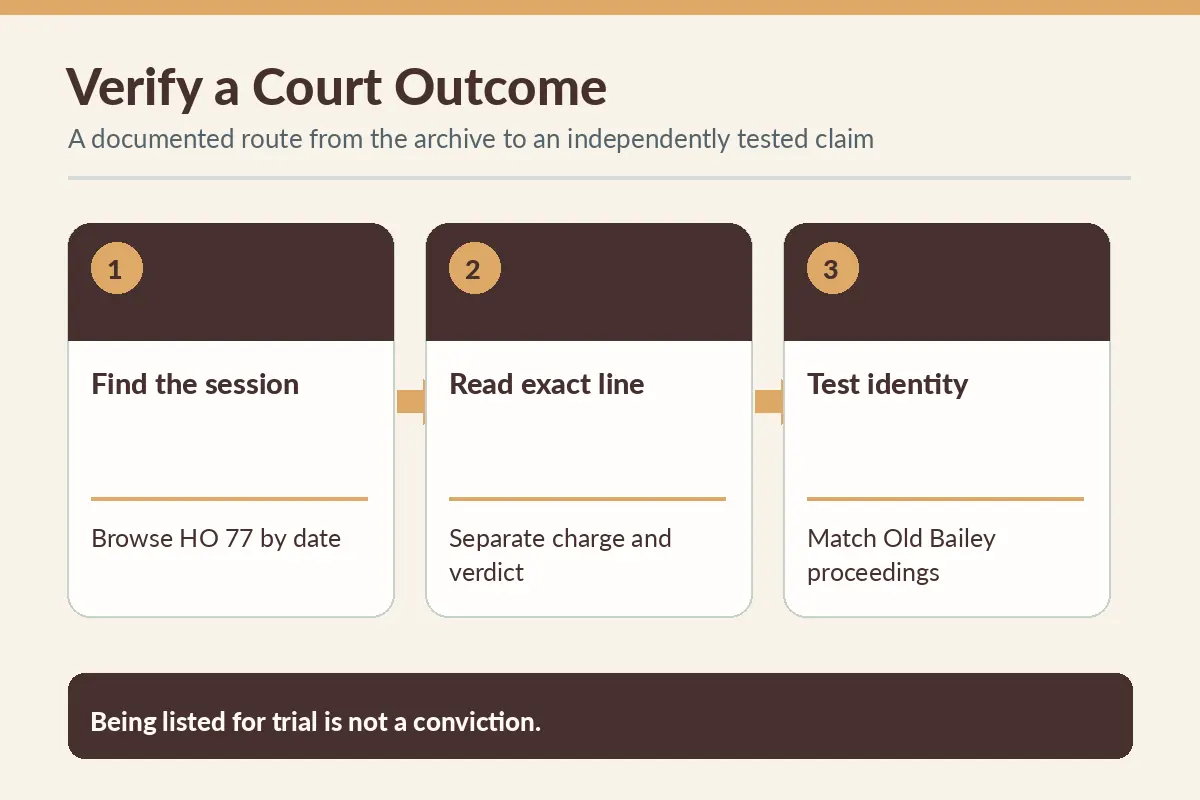
An effective HO 77 search sheet has separate columns for listing date, trial date, charge, stated verdict, sentence, source type and comparison result. Use ‘not recorded in this source’ where a field is blank. Do not use ‘not guilty’ unless that is actually the recorded decision. If the same proceeding appears in a newspaper and printed Old Bailey account, record whether one copied the other. In a negative search document which session volumes and indexes you actually examined. This prevents the dramatic title ‘Newgate Calendar’ from overshadowing the careful distinction between imprisonment, accusation and conviction.
More Records and Archives Guides
How We Research This Archive Series
Our editorial source review on November 8, 2026 used The National Archives research guidance for the archive-specific series and its complementary record guidance for evidence context and access limits. We have not claimed to consult an original file or a named person’s unpublished record. Hypothetical examples are explanatory only. A series description establishes coverage and arrangement, not the facts of every individual document. The graphics explain research decisions and are not facsimile images of historical sources.
A reproducible finding needs the research question, contemporary date and locality, creator or department, exact piece and page if known, a literal description of what is actually recorded, and an independent source where one is available. Keep catalogue descriptions and third-party indexes separate from original page evidence. A negative search establishes only what was searched and what was accessible, not that an event could not have happened. Check the current access conditions and any privacy restrictions before ordering or publishing historical material. See our affiliate disclosure; these archival links are not paid endorsements.
No. Early entries can list persons for trial; a verdict must be found where the form or another source actually records it.
The National Archives says HO 77 calendars begin recording results of trials from July 1822.
HO 77 consists of chronological volumes containing printed prisoner lists and some manuscript additions.
No. Establish embarkation and arrival with relevant transport or passenger records separately.
Compare the calendar session with the Old Bailey proceedings and matching age, trade or locality where recorded.