
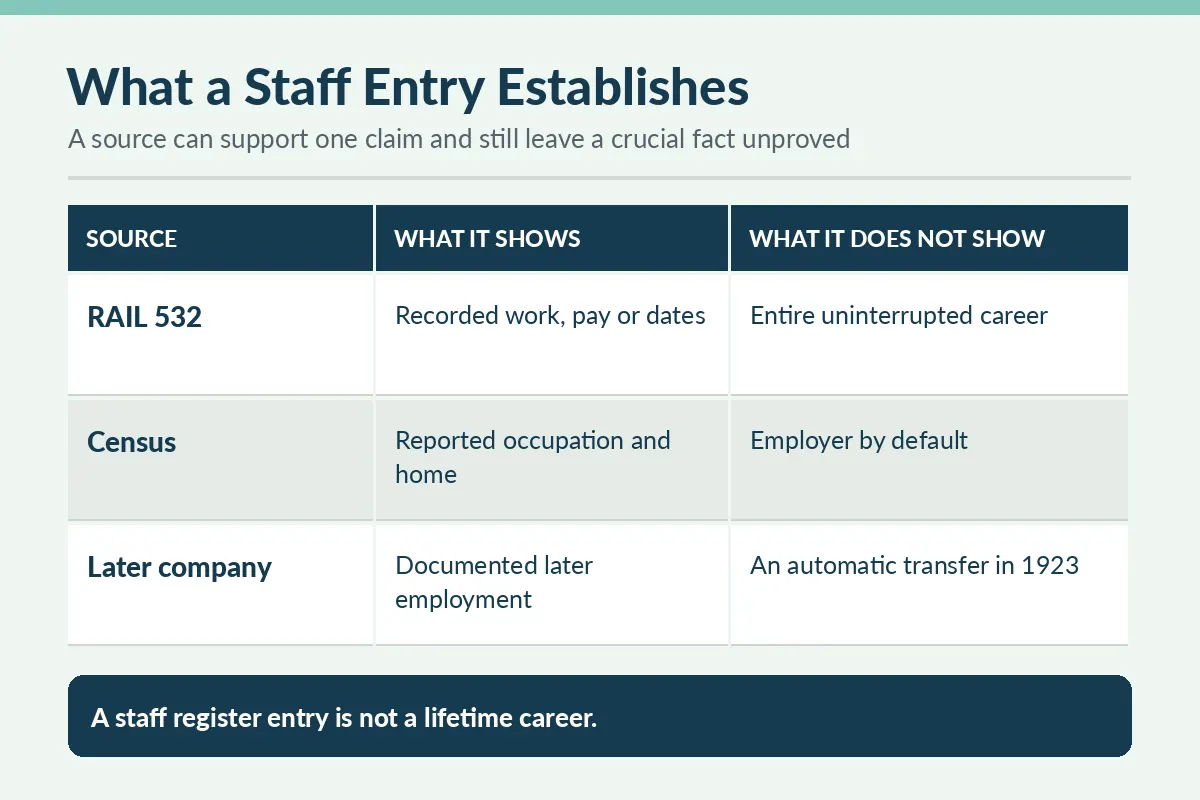
For a possible employee of the North Staffordshire Railway, The National Archives’ railway workers guide identifies staff material in RAIL 532/58–67, with broad covering dates of 1847–1923. Those dates describe the surviving collection, not uninterrupted employment for any named person. The records may help locate an employee by department, workplace or staff number, but a railway job named on a census cannot by itself prove which company employed that person. Start with a dated company-and-place match and then inspect the relevant original staff entry before constructing a career.
Establish the Company Before Looking for a Surname
North Staffordshire Railway records sit in the wider history of British railway companies and eventual groupings. The National Archives explains that more than 120 companies merged into four large groups in 1923 and recommends establishing which company owned or operated through a relevant station. A town served by a railway is not enough: different companies could share stations or routes. Match a historical location, employment date and line operator using contemporary gazetteers or mapping sources. Record a company name precisely before opening RAIL 532, and avoid projecting the modern railway network onto an earlier employment period.
A family certificate or census occupation such as ‘railway porter’ can be a useful lead, but it usually does not identify a specific employer. Compare addresses and time periods with surviving directories and railway timetables, then ask whether RAIL 532 has the right staff division. If the person moved to another station, a later location may fall under a different archival company series. A 1923 date near the collection endpoint does not by itself document an individual’s transfer to a successor employer. Require a dated employment entry or company correspondence before asserting continuity of service.

Search RAIL 532 by Record Arrangement and Job
The National Archives’ staff guide lists RAIL 532/58–67 as North Staffordshire Railway staff records. Search by the company and the surviving piece descriptions rather than assuming that every surname is indexed. Some railway staff registers are organized around departments, workplace, staff numbers or pay systems. The guide offers historical search variants: signalmen may be in traffic or coaching material, while engine drivers may be indexed under locomotive departments. Keep both the colloquial job title and the historical record-office term in a search log; an unsuccessful surname search may be an indexing limitation, not an absence from employment.
For each plausible entry transcribe the name, staff number where present, department, workplace, entry and exit dates if supplied, wages or allowances, and any notes exactly as the original record permits. Avoid copying a generic column list as if every volume contains all fields. Pay increases, disciplinary deductions or recorded absence may have a specific bookkeeping purpose; they are not full biographies. A staff listing for one date does not establish work at every station later associated with the company. Note whether the source is a catalogue summary, a third-party indexed transcription or a direct image of the underlying register.
Test Two Workers With Similar Names
Railway labor records can include several men with common names in neighboring districts. To distinguish them, compare a combination of workplace, job, staff number, pay progression, plausible age and known residence. If a staff number reappears in successive rows, verify the record’s numbering rules before treating it as a permanent personal identifier. If a register supplies a date of birth, compare it with independent records and allow for reporting errors. A spouse or child’s address can narrow the candidate, but a shared surname and occupational label are insufficient to join two entries in one family tree.
Imagine two hypothetical John Taylors: one works in a traffic department, while another appears as a locomotive laborer. A family census says John Taylor was a ‘railway servant’ without naming the company. The correct next move is not to select the more appealing record; it is to document both candidate entries and look for a contemporary address, age or staff number that distinguishes them. If none exists, retain a two-candidate research note. A well-preserved ambiguity is better than a false ancestor attached to a convincing but incorrect employment narrative.
Prove a Career Change With Independent Records
A transfer, promotion or retirement is a separate factual event. A rise in salary can indicate a change but may also reflect an ordinary increment, bonus or alteration in pay scale. Do not infer a promotion without the wording of the register or related personnel file. An occupational census entry in a later decade is useful as corroboration of occupation at a given time, not exact proof of continuous company service. The National Archives cautions that railway salary registers often focus on clerical personnel, and most company records have uneven coverage across jobs, especially casual workers and railway construction laborers.
To reconstruct a person’s employment sequence, make one dated row per documented occurrence: source, company, department, location, role, evidence of start or finish, and unresolved identity question. For a break between entries, mark ‘not documented’ rather than filling it with an assumed transfer. At nationalization in 1948, personnel holdings changed again, and The National Archives advises that many nationalized staff records were not retained. A later family story may be true but requires its own record trail. Cite the original RAIL 532 piece and separate later employer evidence so that another researcher can retrace the proposed connection.

A railway employment citation should identify the repository, series, precise piece, folio or page if available, entry date, and whether the name was found through a third-party index or original register. List the historical name of the station and the company at that time. If the line was later absorbed by another operator, create an additional employer row instead of overwriting the earlier one. This approach prevents a narrow wage or appointment note from becoming an unsupported lifetime career. It also gives a clear route for testing a future discovery about pension, departure or resignation.
More Records and Archives Guides
How We Research This Archive Series
Our editorial source review on November 8, 2026 used The National Archives research guidance for the archive-specific series and its complementary record guidance for evidence context and access limits. We have not claimed to consult an original file or a named person’s unpublished record. Hypothetical examples are explanatory only. A series description establishes coverage and arrangement, not the facts of every individual document. The graphics explain research decisions and are not facsimile images of historical sources.
A reproducible finding needs the research question, contemporary date and locality, creator or department, exact piece and page if known, a literal description of what is actually recorded, and an independent source where one is available. Keep catalogue descriptions and third-party indexes separate from original page evidence. A negative search establishes only what was searched and what was accessible, not that an event could not have happened. Check the current access conditions and any privacy restrictions before ordering or publishing historical material. See our affiliate disclosure; these archival links are not paid endorsements.
Its railway workers guide identifies RAIL 532/58–67 as the relevant staff-material range.
No. They describe the collection and can include dates that do not represent an individual tenure.
No. Establish the historic operator using place, date and independent company evidence.
Try departmental and piece browsing, occupational variants and indexing limitations.
Not necessarily. Look for a stated change of role or corroborating personnel evidence.