
Customs Outport Letters CUST 50–102 can answer a narrow historical question, but it cannot carry a larger family-history claim by itself. The starting point is the record’s creator, date and function; the next step is independent evidence for an individual, place or event. The examples and routing method below separate what the archive actually documents from an interpretation that still needs to be tested. In particular, distinguish a name present in official paperwork from confirmed identity, kinship, employment, judgment or completed action. The archive references and access routes used here are from the named official guides, not an invented case file.
Identify the Historical Outport Before Searching a Name
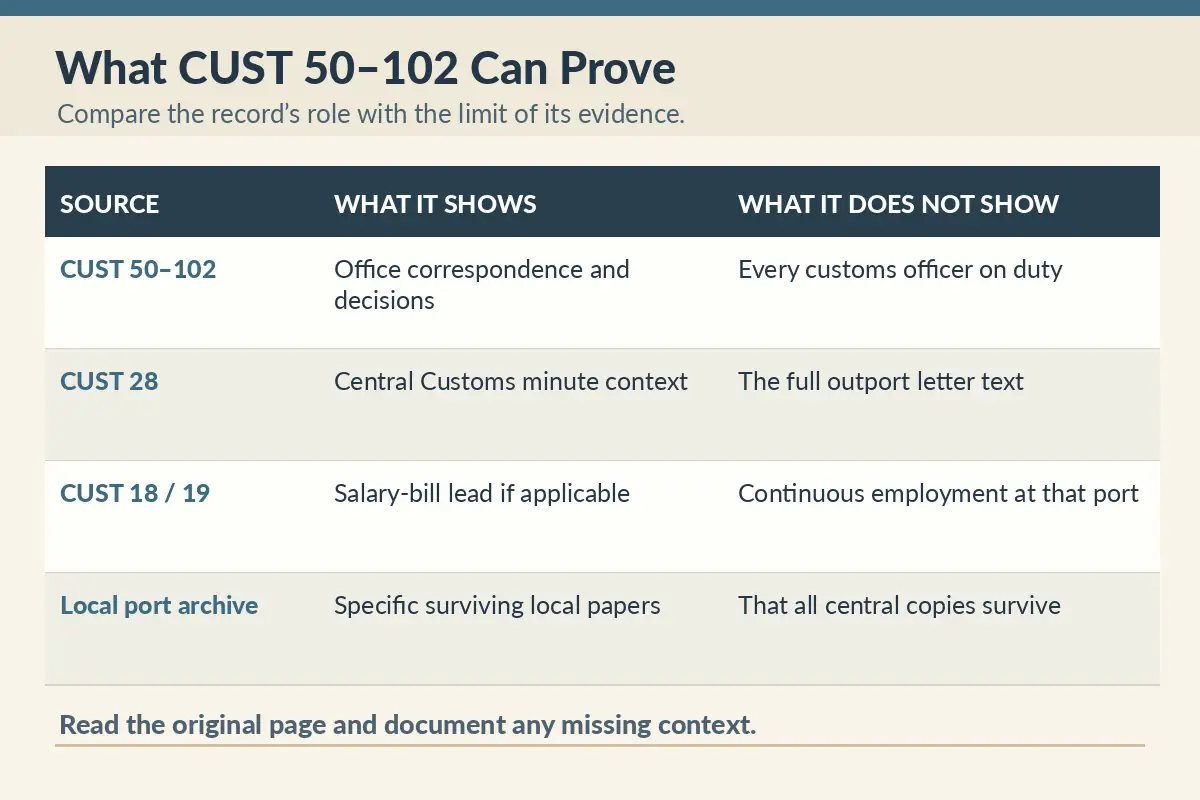
Customs administration was organized around ports and smaller customs stations or creeks, and record arrangement can follow that geography more closely than a person’s surname. Research material for officers is discussed in The National Archives’ customs-officer guide, while specialist genealogical guidance maps historical outport letter books across the CUST 50–102 range. This is a search range, not a promise that every class contains a complete alphabetic list of workers or that a letter names each person engaged at the station.
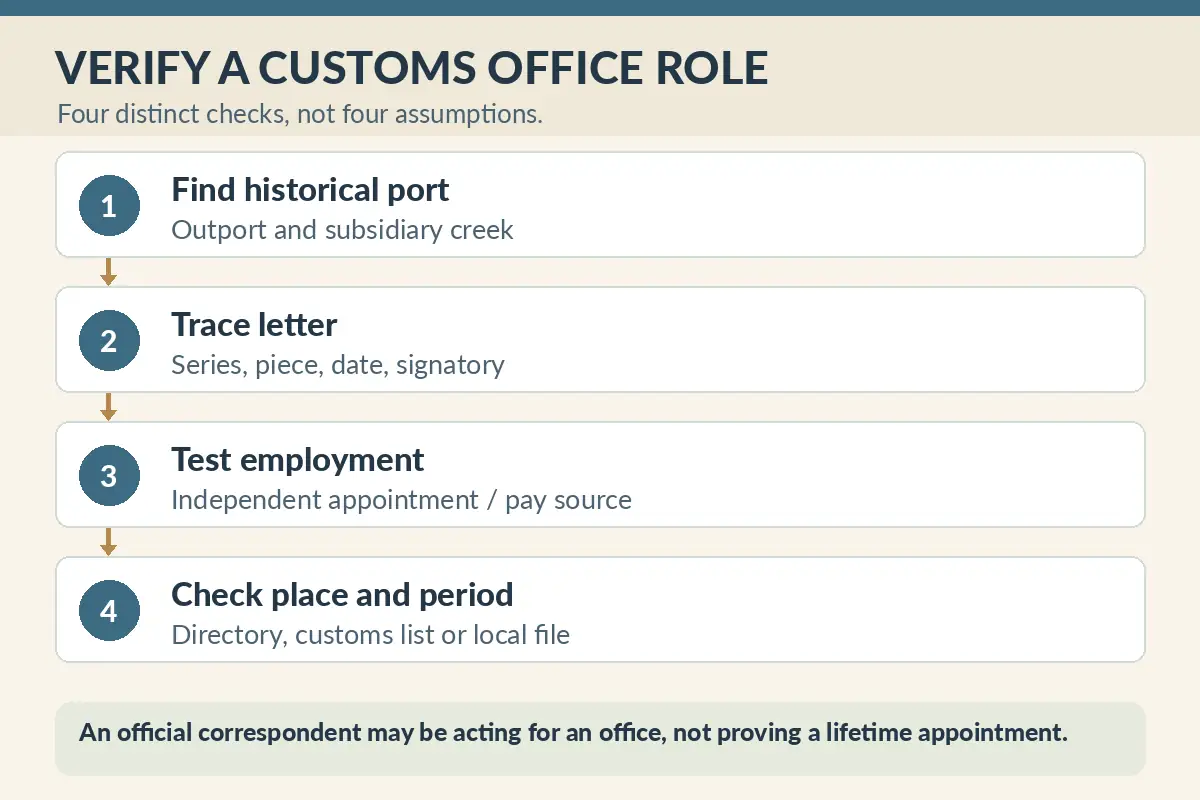
Start with a port confirmed in a dated family record, not a modern seaside town alone. Identify the customs port that held jurisdiction at the relevant time and any subordinate creek or landing place. Put alternative historical place names in the research log. Distinguish where a ship landed, where a letter was written, where an officer was posted and where a family lived. These can be four different places in the same investigation.

Use Correspondence as Evidence of Office Activity
An outport letter might report a local problem, request instructions, convey a decision or summarize a transaction. The sender may sign as an individual or on behalf of a board or office. The document can substantiate an administrative communication on a stated date, but not automatically the signatory’s rank throughout an entire career or the accuracy of every reported event. Treat an enclosed report, minute and final reply as separate evidence units when they appear together.
When you locate a likely item in Discovery, transcribe its reference, date range, departmental or port heading and document type. Do not presume every volume has been digitized, and do not replace inspection of the original with a catalogue subject heading. An undigitized record may require visiting Kew, requesting a copy or seeking a more detailed finding aid. Note whether you viewed a full file, a single page or only the catalogue description.
Distinguish a Correspondent From a Paid Customs Officer
To prove an ancestor worked for Customs, check the actual role: a letter signed by a merchant, magistrate or applicant is not a payroll record. Even a letter signed by a Customs official may not show his formal appointment date, long-term station or retirement. Cross-check central minutes, salary records, appointment warrants or contemporary civil-service lists when available for the period. Related codes such as CUST 18, CUST 19 and CUST 28 can provide avenues, but the useful record depends on the specific question and years.
A port-first search is especially important for repeated names. If James Taylor signs a letter from a port in 1807 while a later staff list shows James Taylor elsewhere in 1820, the intervening career is not automatically proven. Record each independently dated appearance and look for rank, pay, transfers and other identifying details. The evidence should demonstrate continuity rather than assume it from a familiar name.
Check Regional Holdings and Port-Jurisdiction Changes
Not every relevant Customs record stayed with central government. The National Archives’ accession summaries document local archival material, including Customs and Excise papers for ports such as those held in regional collections. The repository holding a local letter book or ship-registration paper may differ from the custodian of centrally filed communications. Before concluding a series is silent, search regional archive catalogues by the historical port, creek, customs house and office name.
Be careful with jurisdictions across the centuries: port limits, administrative centers and record-keeping offices changed. A modern map can help find a place but does not establish which office collected duties in a selected year. Use contemporary directories and gazetteers to tie a historical place to its administration. If the local archive catalogue supplies only a collection-level description, contact the archive or consult its detailed listing before reporting that an individual is absent.
Reconstruct a Measured Timeline of Office and Person
Create two parallel timelines. The first records official events: instructions issued, vessels reported, disputes handled and decisions recorded in letters. The second documents a named person’s employment with independent appointment, salary or retirement evidence. Link the two timelines only where the same person, place and date are adequately supported. A signature can support presence in an official context, but even that reading may need verification if the signature is a copied clerk’s annotation rather than an autograph.
Imagine a family tradition that a forebear managed a coastal customs station. A letter refers to the station and is signed by someone with the correct surname; a local directory independently names that man as an officer. That combination offers a more credible identification than the letter alone. Yet a claim that he directed all shipping through the port would still need a record stating his duties. Preserve the distinction between an institutional record and a personal service history.
More Place and Jurisdiction Guides
How We Research This Archival Record and Its Limits
We check the series against the original government or archive custodian descriptions, then compare the purpose and date coverage with the exact claim a reader wants to make. Sources consulted on 2026-11-08: Primary repository guidance 1; Official guide 2; Official guide 3. A series-level catalogue is a map of the collection, not evidence that a particular named person appears in a document. Catalogue availability and online access can change; always verify the individual piece and its current access conditions before traveling or paying for a copy.
Our editorial method separates four evidence levels: the collection description, the specific original document, an independently created corroborating source and a written conclusion with stated uncertainty. Any hypothetical person or example in this article is illustrative, not a transcription of an identified historic individual. For clarity about commercial relationships, read our affiliate disclosure. We do not infer an affiliate arrangement or recommend paid access unless its practical benefit is established for the exact record sought.
No. It is a range used to locate historical outport correspondence, organized around offices and places rather than an all-person index.
Customs letters were organized administratively; a dated port or creek can identify the relevant files when personal names are absent from catalogue descriptions.
No. Test the role against appointment, pay or other independently dated officer records.
No. Regional repositories preserve additional Customs and Excise records; confirm the holding archive for the specific collection.
Identify its historical customs port and creek jurisdiction, then search contemporary directories and archive catalogues under both forms.