
CO 54 holds original Colonial Office correspondence relating to Ceylon, now Sri Lanka. Its archival scope is administrative: governors’ despatches, enclosures and correspondence about people, property, work and public institutions can surface, but there is no guarantee of a complete file for any particular individual. To follow an application or complaint, establish the place and date, use historical correspondence registers where appropriate, examine the incoming report and compare any reply or instruction in the separate outgoing record. The National Archives’ colonial records guide explains why a catalogue keyword search alone may miss earlier letters.
Use Ceylon’s Historical Jurisdiction, Not a Modern Shortcut
Search under Ceylon as the name used in the British records, while retaining Sri Lanka in your own modern geographical description. CO 54 spans a lengthy colonial administrative period; the catalogue describes original correspondence from 1798 to 1949. The documents reflect changes in governmental departments and local arrangements over those years. A person mentioned in 1805 does not necessarily appear in the same type of correspondence as a person mentioned in 1930.
Start by writing both historical and modern place names, the relevant district if known, and the legal or administrative issue. A petition about a school, a land grant or an employment dispute may have traveled through different offices. Colonial files preserve the views and priorities of those offices; do not treat their vocabulary about communities and workers as a neutral or complete description of the people they governed.
Choose a Register Search or a File-Title Search
Before the twentieth-century filing changes, many Colonial Office correspondence volumes were not catalogued by every letter or correspondent. The National Archives advises using registers of correspondence to trace earlier documents. Search first by colony, approximate year and subject, then note the registry number, sender and date if supplied. A one-line catalogue label such as ‘original correspondence’ is not evidence that an individual is absent from the volume.
For correspondence from 1926 onward, descriptive file titles make keyword searches more useful, though they still cannot capture every name in every enclosure. Try variants of district and subject terms, and keep searching the registry where the files seem incomplete. If an entry is marked as a destroyed or missing document, preserve that fact as a gap in survival, not as proof that the original petition never existed.

Distinguish Incoming Letters From Outgoing Instructions
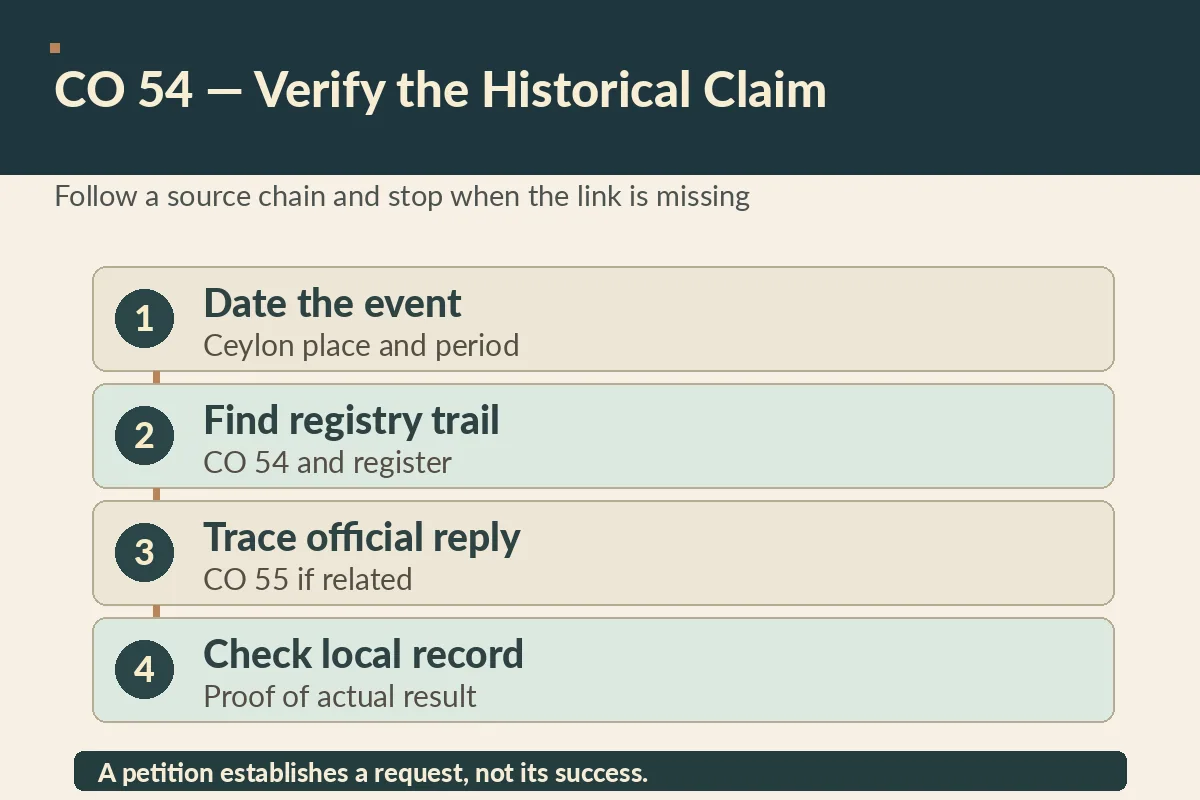
A governor’s despatch in CO 54 may include a petition and minutes from colonial officials. The same question might lead to an instruction or a refusal in outgoing correspondence, for which the separate Ceylon entry-book series CO 55 offers a useful next route. Do not draw an automatic arrow from one CO 54 item to a specific CO 55 volume: the documents must be connected by reference, recipient, date or unambiguous subject.
Make an evidence table with three columns: what the petitioner asked; what the administration recorded; and what a later, independent source proves. A plea for compensation is not receipt of funds. A proposal to move laborers is not a passenger list. An official’s account of a boundary is not a surveyed title deed. Whenever different participants use the same term differently, transcribe their words before providing a modern interpretation.
Read the Enclosures Without Assuming They Are Neutral
Some despatches include copied letters, depositions, lists, maps or translations. The enclosure date may precede the covering despatch substantially, and the copy may have been prepared for a particular administrative purpose. Note whether the original was signed by the petitioner or whether the name appears only in a clerk’s summary. A translation adds a further layer between the speaker and the surviving words.
If the name is common, combine location, occupation, household connections and date; do not merge two residents simply because a Colonial Office clerk spelled their names alike. Conversely, variant transliterations or anglicized forms may conceal an actual match. Build a same-person test using at least two independent characteristics. The power imbalance of the colonial setting should be acknowledged where it affects whose testimony was collected or preserved.

Move From General Reports to Local Consequences
CO 57 sessional papers and CO 59 miscellaneous material, including statistical returns, can give context for legislation, schools and administration in Ceylon. These series can show the structure or totals surrounding a policy, but a government total does not certify that a particular child attended school or a named worker received wages. Keep aggregate figures apart from any case-level evidence in CO 54.
For a family or property question, the most decisive next document may be held in a Sri Lankan archive, a local registry, a religious institution or a contemporary newspaper. Check the precise institution and its jurisdiction before claiming a preserved British file is the whole record. Where two accounts conflict, disclose whether one is a petition, an official reply, a later compiled report or a genuinely independent registration.
Test a Reply Against the Requested Remedy
The receiving office may acknowledge a petition without accepting its truth, may request investigation or may communicate only a partial remedy. Record the verb used in the reply: ‘consider,’ ‘refer,’ ‘recommend,’ ‘authorize’ and ‘pay’ do not mean the same thing. If the outcome was delegated to a district officer, an outgoing instruction alone leaves an important gap between government intention and local execution.
Create a four-date log: date of the underlying event, date of the petition, date of the Colonial Office minute and date of verified implementation, if any. This prevents a long administrative delay from disappearing into a single paragraph of family history. Do not infer that a petition was rejected merely because the next recorded item is missing: surviving correspondence is a selected and incomplete evidence trail.
Cite the Colonial Record at Its True Level
Use the full CO 54 catalogue reference and page or folio, plus the enclosing despatch number when present. If you rely on a Colonial Office register rather than the letter itself, state that the register is the evidence you actually saw. A register entry normally establishes that correspondence was handled; it cannot reliably reproduce all statements in a missing enclosure.
For biographies, preserve historical racial and administrative terminology only in direct contextual quotation and explain why it was used. Avoid presenting a colonial description as the identity a person would have chosen for themselves. The finished finding should state the specific decision proved, the independent corroboration found or missing, and the repositories that remain to be searched.
More Place and Jurisdiction Guides
How We Research and Cite These Records
Our method starts with the official National Archives guide to colonies and dependencies and the CO 54 catalogue series description. We compare relevant registers and correspondence before accepting an individual’s identity or a petition’s reported result. We distinguish Ceylon-era administrative geography from modern Sri Lankan place names and record whether evidence comes from a petitioner, official copy or independent local source. A British office’s archive cannot substitute automatically for the historical records retained in Sri Lanka. For commercial transparency see our affiliate disclosure.
Ceylon original correspondence preserved among Colonial Office records, including governors’ despatches and associated papers.
No. Earlier material often requires correspondence registers and browsing by year and subject.
No. Follow any minute and outgoing instruction, then look for implementation evidence.
CO 55 is a relevant series of outgoing Ceylon correspondence.
No. Local registers and archives may hold decisive person-level or property-level evidence.