
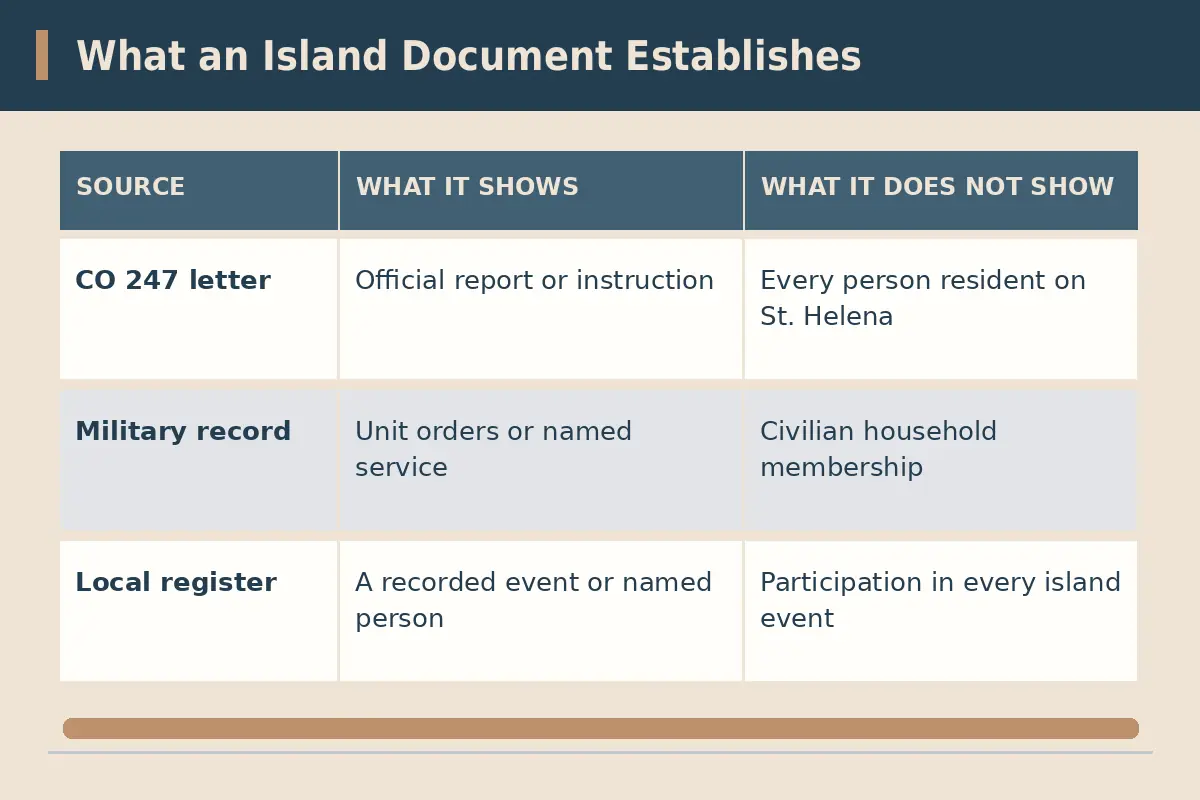
CO 247 includes St. Helena correspondence from the period of Napoleon’s imprisonment; an official letter is not a register of island residents. This guide gives a precise source route, identifies what the archive can and cannot show, and names the independent documents needed before a personal or geographic conclusion becomes defensible.
Locate CO 247 Within the Island’s Historical Government
The National Archives points Napoleonic-era researchers to CO 247 for correspondence from St. Helena during Napoleon’s imprisonment. That description identifies a useful administrative source, not a roster of every island resident. The French emperor was confined on the island in the years following his defeat; official correspondence about island administration and custody should be read in the context of the body or official that created each letter. A record’s origin and purpose matter more than whether the island name appears in a modern family story.
Start with the precise question: an order to an official, a request for supplies, a report from an island office, or the whereabouts of a specific resident. A document about the captivity may establish that officials discussed a measure while providing no evidence that the measure was carried out exactly as proposed. Create a dated search card with historical island place names, office, approximate year and source type. If you need a person, require more than the letterhead or the presence of an official seal.

Distinguish an Order, Report and Later Narrative
Government correspondence includes different communicative acts: an incoming report can state what an official observed; an instruction can express what authorities wanted; an acknowledgement can confirm receipt; and a later summary can look back on an incident. Those do not have the same evidential weight for what happened. Read salutations, file endorsements, receipt dates and enclosures carefully. A letter dated in London and received on St. Helena later may refer to an earlier event, so a single date in a catalogue heading may not identify the date of the underlying action.
Use a four-column letter log: writer and location, issue or request, stated action, and external confirmation needed. Avoid assuming a correspondence file preserves the complete exchange. Replies may be missing, sent through a different office or included as extracts. If a letter states that provisions were requested, look for a later receipt or account before saying they arrived. If it discusses security restrictions, do not infer every individual on the island was subject to those restrictions. A colonial report is evidence of a report, not universal local experience.
Historic place names associated with St. Helena can be reused in travel writing long after the imprisonment years. Record whether a map or narrative is contemporary with the letter or retrospective. Use site names such as Longwood only when they are actually supported by the source examined.
Keep Colonial, Naval and Military Sources Separate
St. Helena during Napoleon’s captivity involved civilian administration, imperial concerns and military or naval responsibilities. Different departments created different classes of evidence. The National Archives’ overview of Napoleonic records reminds researchers that War Office, Admiralty, Foreign Office and other government departments kept materials by administrative provenance. A CO 247 item may refer to a soldier or vessel without itself being that person’s service file or the ship’s log. The correct follow-up depends on the claim embedded in the letter.
For a named officer, look for relevant army or naval appointment, muster or pay records with matching date and unit. For a visitor or vessel, seek independent movement, passenger or port documentation appropriate to the period. For an island laborer or merchant, consider civil, church, property or local government material where it survives. Avoid automatically replacing all these searches with military records because Napoleon’s captivity provides the most famous historical frame. A person’s proximity to a celebrated event is not proof of participation.
Test a Named Resident Rather Than an Island Legend
Imagine an inherited claim that “Eliza Carter served at Longwood while Napoleon was on the island.” This is a hypothetical family example, not a discovered person. CO 247 might help establish the administration of an estate or office connected to the island; it does not prove that this invented individual lived or worked there. To test a real claim, first verify the person’s name, age, occupation and dates independently. Then identify which official, estate, employer or parish records could connect that person to a specific place.
Use a resident-evidence grid with columns for source, direct name, role, location, date and remaining alternative identities. A name in an official letter may identify a writer, recipient, petitioner, witness or someone mentioned in passing. Such roles do not establish kinship or household membership. Check island records and wider family evidence for relocation, same-name individuals and changes in spelling. Avoid upgrading a single mention into continuous island residence or a personal relationship with Napoleon, however appealing that story may be.

Preserve the Context and Cite the Individual Correspondence
Search CO 247 in Discovery using island-specific historic terms, the named administrator or office, and a date range grounded in the question. An item’s catalogue reference and broad description help locate a file; they cannot guarantee that a particular name, order or incident appears in its pages. Record the full piece reference, document date, writer, recipient, folio or page and any enclosure details. Distinguish a later copy or published transcription from an original signed letter and record whether wording is complete.
When concluding, state only the level the evidence reaches. A letter may prove that an office requested a particular action on a date; a separate receipt may show it occurred; a resident’s entry in an independent record may establish that individual’s presence. Do not collapse all three into one sentence claiming an imagined household history. If the evidence is incomplete, state what remains uncertain and identify which local or departmental records would answer it. That approach turns famous historical correspondence into careful, useful family research.
Do not treat the date a letter was sent as a person’s date of residence. Official correspondence can pass between officials who never visited the island. A signature or salutation is not a passenger record, and an administrative title alone is not evidence of a continuous posting.
More Place and Jurisdiction Guides
How We Research This Archive Series
This guide starts with the official description in The National Archives’ research guidance, not a claim that we have inspected a particular person’s private file or a specific original piece. The archival statements here concern the series or research method. A hypothetical example is labelled as such; it is not a newly discovered historical event. We use the Discovery search guidance to distinguish keyword matches from archive holdings and document contents, because catalogue descriptions do not transcribe every word of an original.
For every real candidate, record its historical place or person’s name, the creator, document type, date, full CO 247 piece or item reference, access restrictions, and the exact claim being tested. The official citation guide explains how to document those references so another researcher can retrace them. An unread document remains a catalogue lead, never proof of imagined details. If a record is missing, preserve the searched terms and dates and examine survival and alternate custodians before interpreting the gap.
Before sharing a conclusion, audit the difference between original source wording and your interpretation. Require independent evidence for any further claim about an individual, property owner, legal effect, or completed action. Respect archival access limits and living people’s privacy. This website also provides an affiliate disclosure; no paid partnership or commercial access is implied by these archival references.
The National Archives identifies St. Helena correspondence from the period of Napoleon’s imprisonment within CO 247.
No. It is government correspondence, and a person needs direct independent residence evidence.
Not by itself. Seek a dated reply, receipt, execution report or another independent source.
Yes. Correspondence may be sent to or from the island by officials working in different places.
Use island church, civil, property or employment evidence, as available, to connect a named person to a dated place.