
The Plymouth merchant musters in CUST 66/227 cover 1776–1780; they may identify a vessel and master without naming the full crew. This guide gives a precise source route, identifies what the archive can and cannot show, and names the independent documents needed before a personal or geographic conclusion becomes defensible.
Identify the Plymouth Exception Before Searching BT 98
A family story about a sailor on a Plymouth merchant vessel in the late 1770s leads to an unusually precise archival route. The National Archives directs researchers to CUST 66/227 for muster rolls of ships registered at Plymouth from 1776 through 1780. Most early British merchant musters are searched in BT 98, but this known customs reference is a useful exception. Start by establishing that Plymouth was the port of registry at the relevant date, not merely one port where a ship arrived. A vessel called at Plymouth without necessarily being registered there.
Write a one-line search target that includes ship name as historically spelled, year, port, and the question being asked. For example, a fictional note saying “Thomas Dale sailed from Plymouth in 1778” contains neither a proven ship nor proof of registration. First locate contemporary port or shipping evidence; then check whether an actual muster entry exists in the appropriate piece. Do not assume the surname alone can retrieve a full crew roll. Record each spelling used and preserve contradictory ports rather than changing the story silently to fit a result.

Read the 1747 Muster System on Its Own Terms
Muster books developed under a system created in 1747 to support disabled merchant seamen, funded through deductions from wages. According to The National Archives, the common early format documented the owner, master, overall crew number and brief voyage information. Some surviving musters also give full crew names and individual contributions, but such entries occur irregularly. This is why an unlabelled total such as “twelve men” cannot be turned into twelve imagined people. The absence of a name may reflect the form, not a sailor’s absence from the voyage.
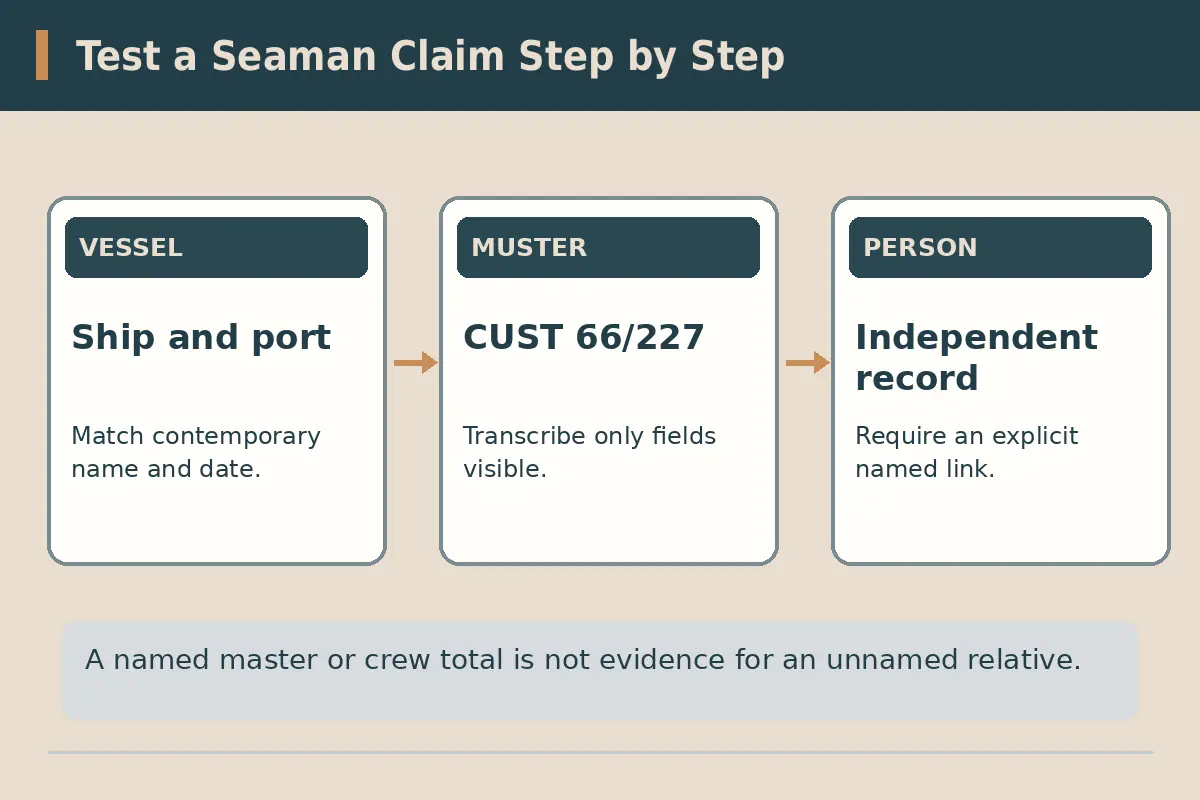
Transcribe the column labels before interpreting the figures. Separate the owner who financed or held an interest in the vessel from the master who commanded it and any other sailors individually recorded. Record the page, any folio numbering, spelling of the ship and any voyage detail literally. If names appear, look for an explicit relationship between each entry and that specific vessel. If only totals appear, label the item a vessel-level record and use it to reconstruct traffic, not to assert a person’s service.
A historical ship name can recur across different vessels, and spelling may vary between port records. Keep a separate identity card for each candidate with registry, tonnage when recorded, master, date and source reference. If two vessels share a name, do not merge their voyages merely because their entries occur in the same decade.

Choose an Alternative When Plymouth Is Wrong
The official main series for merchant muster books is BT 98, with early records broadly spanning 1747–1834. Its catalogue can be explored by historic port and date. The same research guide identifies another special survival for Scarborough, 1747–1765, in CUST 91/111 and CUST 91/112. These references are alternatives conditioned by registration port and date; they are not a chain through which every seaman must pass. A Plymouth ship in 1773, for instance, should not automatically be forced into the 1776–1780 exception.
If a search fails, investigate whether the ship changed registry, had an alternative name, or falls outside the surviving range. Make a coverage ledger with the port actually checked, the archival series, years covered, search term, and what was inspected. Separate “no catalogue result” from “no vessel in the original” and both from “no named sailor on the form.” Search nearby dates when the question justifies it, but never stretch a five-year known record interval to cover an entire career.
Build a Vessel-to-Person Evidence Ladder
An early muster that identifies a ship and its master is strong evidence for those words on that page, subject to correct transcription. It is much weaker for the career of a specific ordinary seaman. Begin a three-column comparison: documentary statement, proposed identity, and missing proof. A match on ship name and date may support a voyage context; a known master named in a contemporary notice offers a further cross-check. A crew total remains an aggregate even when family tradition supplies a plausible sailor’s name.
To test one individual, look for a contemporary letter, apprenticeship record, port proceeding, maritime court case, parish document or other original evidence that actually names the person with a ship, place or master. Evaluate spelling, occupation, residence and chronological plausibility together. Never use an indexed family tree as a substitute for the connecting document. A successful result might legitimately be that the ship is identified while the seaman remains unproven. This is a useful research conclusion, not failure.
Cite the Exact Piece and Preserve Negative Results
Cite CUST 66/227 by its full reference, followed by the internal page, folio, ship or dated entry if you have inspected it. A catalogue description alone supports only the existence and broad scope of an archival item. An online description cannot tell you that a particular 1778 vessel is present unless it explicitly says so. Make separate entries for each inspected image or manuscript leaf, and note if the writing is faint or if a name is uncertain. Do not paraphrase an illegible spelling as a verified ancestor.
Close the investigation with a measured statement. If the original muster lists a vessel and master, say precisely that. If it lists the proposed ancestor and independent evidence supports the identity, explain both records. If no named crew was kept, do not claim a negative search disproves their participation. The useful takeaway is the early-Plymouth exception and an honest classification of the form: named person, named master, or crew count only. That classification determines the next search and prevents weak genealogical additions.
The distinction between date of a voyage, date of filing and date of a modern catalogue entry also matters. If one date is inferred rather than written on the roll, label it “approximate” and preserve the basis. A claim about wages or deductions must be tied to the actual columns, not reconstructed from the general history of the seamen’s fund.
More Records and Archives Guides
How We Research This Archive Series
This guide starts with the official description in The National Archives’ research guidance, not a claim that we have inspected a particular person’s private file or a specific original piece. The archival statements here concern the series or research method. A hypothetical example is labelled as such; it is not a newly discovered historical event. We use the Discovery search guidance to distinguish keyword matches from archive holdings and document contents, because catalogue descriptions do not transcribe every word of an original.
For every real candidate, record its historical place or person’s name, the creator, document type, date, full CUST 66/227 piece or item reference, access restrictions, and the exact claim being tested. The official citation guide explains how to document those references so another researcher can retrace them. An unread document remains a catalogue lead, never proof of imagined details. If a record is missing, preserve the searched terms and dates and examine survival and alternate custodians before interpreting the gap.
Before sharing a conclusion, audit the difference between original source wording and your interpretation. Require independent evidence for any further claim about an individual, property owner, legal effect, or completed action. Respect archival access limits and living people’s privacy. This website also provides an affiliate disclosure; no paid partnership or commercial access is implied by these archival references.
The National Archives identifies it as a customs reference holding merchant muster rolls for ships registered at Plymouth, 1776–1780.
No. Many give only owner, master, crew total and brief voyage information; full personal lists appear irregularly.
Start with BT 98 by historical port and date, while checking specific survival exceptions described in the official guide.
No. Registration and a port of call are different claims; corroborate the ship’s historical registry.
No. Require a document naming the person with a reliable ship or voyage connection.