
Royal Artillery muster rolls in WO 10 are a useful way to place a named gunner or noncommissioned officer with an artillery unit during a specified period. Their most reliable answer is narrower than a whole military biography: a recorded appearance in a particular return, sometimes with pay or administrative information. A similarly named man in a later roll is not automatically the same soldier. The correct entry point is a unit and an approximate year, not a surname alone.
The National Archives’ muster-roll research guide lists artillery material in WO 10 alongside WO 69 and WO 54 for 1708–1878. That is a set of research routes, not three interchangeable sets of identical documents. This guide shows how to locate a likely roll, record what it actually says, and find independent evidence for the individual before claiming enlistment, movement, or discharge.
Choose an artillery unit and date before the surname
Begin with the most specific known description: Royal Artillery, Royal Horse Artillery, company, troop, battery, or an earlier administrative designation as actually written in the family source. Record the spelling and the date range. A later battery number may not have been used in the year you are investigating; do not silently apply a twentieth-century label to an eighteenth-century volume. If a discharge paper or parish entry offers a unit, cite that document before opening the muster catalogue.
Search Discovery within WO 10 for the unit and year, and browse adjacent catalogue descriptions rather than stopping at the first similar heading. The National Archives warns that musters are usually arranged by regiment or corps; the personal names may be visible only in the original volume. A failed surname search against catalogue metadata therefore says little about whether a gunner appears in a particular return. The next step may require an original document order or a reading-room visit.

Read muster status and pay separately
For every appearance, capture the volume reference, return date, unit heading, exact name, rank or capacity, and any entry relating to pay or absence. A muster can reflect administration at a particular accounting point. It is not necessarily an eyewitness account of the soldier’s location on every day in the interval covered. Some books contain changes of rank, transfers, or the circumstances in which a name leaves a list, while other volumes are less detailed.
A payment entry supports a financial or accounting claim only to the extent of its wording. It need not show the sum physically received by the soldier or prove that every previous engagement has been recovered. A marginal note needs the context of its column headings; do not translate an unexplained abbreviation as a medical diagnosis or disciplinary verdict. Photograph or transcribe the headings along with the named line, because a lone cropped name is easy to misread.
Test the first and last appearances of a gunner
A first surviving appearance in WO 10 is the first appearance you found, not automatically an enlistment date. Search backward across nearby periods and distinguish a missing volume from a volume in which the person is absent. Likewise, a last entry may reflect transfer, discharge, death, a change of unit, or simply the end of the available series. Record the wording rather than picking the most dramatic explanation.
The National Archives’ guide to soldiers up to 1913 describes WO 69 materials including Royal Artillery description books, original attestation papers, service records, and some family or pension registers. Those records may reveal age, physical description, birth place, or a service chronology absent from the muster. They are not guaranteed for every man. Where they survive, compare the particulars carefully before merging two same-name gunner entries.

Build a unit-by-unit identity ledger
Make a separate row for each entry, including date, series and piece number, company or troop label, rank, name spelling, pay or absence remark, and confidence in the match. Keep the source transcription distinct from your interpretation. If a name appears on a different unit’s books, add an identity question rather than writing “transferred” without supporting text. Repeated names are especially hazardous in large corps whose units moved and changed labels.
Use a second column to assess claims: the named man appeared on a return; the named man was paid for a stated period; the named man served in a particular campaign; the named man later obtained a pension. Each requires different evidence. A unit may be documented in an overseas station while the individual’s personal deployment remains unproved. This distinction protects the family narrative from importing an entire regimental history into a single man’s life.
Compare alternative artillery and operational sources
WO 69 can help differentiate gunners through attestation or description, and WO 54 is another artillery-related series identified by the muster guide. Follow the date and document type rather than searching all these series as though they were consecutive chapters of one file. A later pension register may mention a service period without preserving the original daily returns, while an administrative establishment can show the authorized size of an artillery formation without naming every member.
For broader operational context, the army operations guide separates establishment, inspection, and monthly return series. Use those to understand a unit’s strength or station, then return to person-level evidence for the named gunner. If a unit was ordered to embark, confirm whether the man was still in its ranks at the relevant date. An order for a corps is not the same as proof that one soldier boarded a ship.
More Records and Archives Guides
How We Research Royal Artillery Service Claims
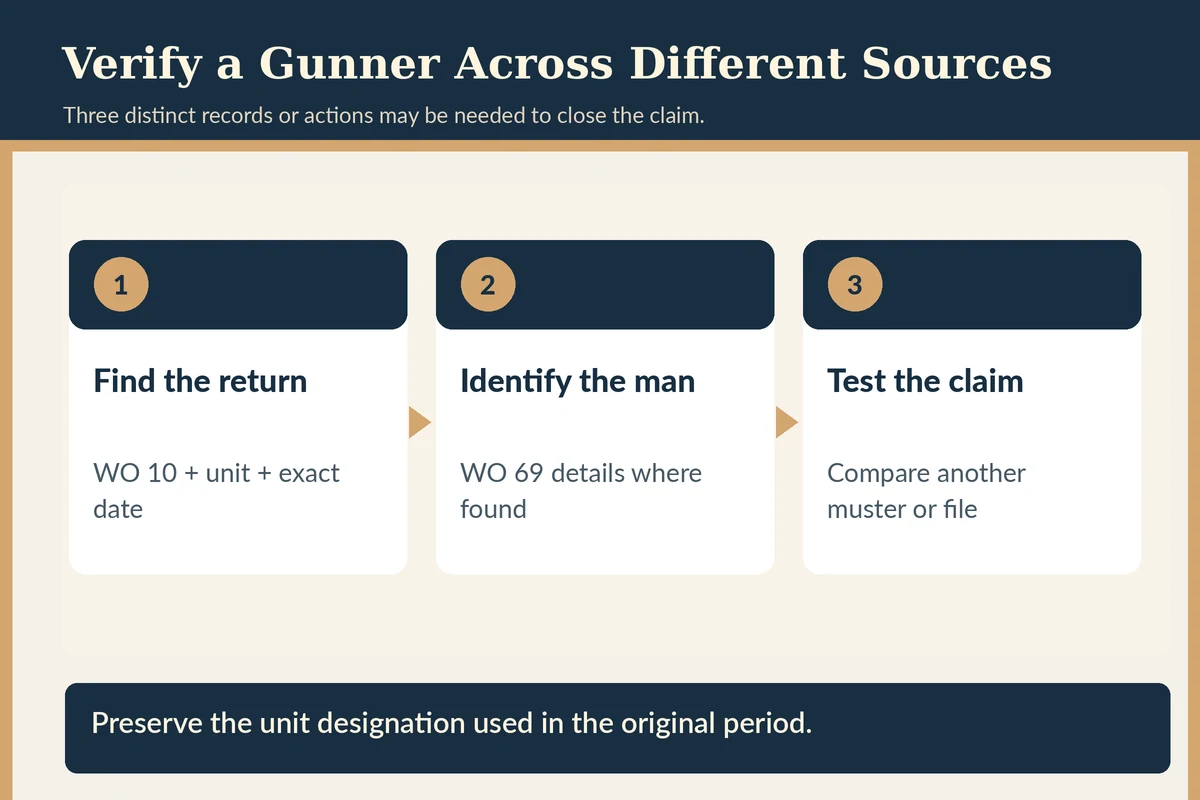
Our working method begins with the earliest independently sourced name-and-unit pairing, locates the correct WO 10 volume, and records the return’s complete administrative context. We test the match with WO 69 or other personal records where available and treat the gaps in a series as documented uncertainty. The National Archives’ guides establish search routes and general record scope; they do not prove that any particular gunner appears in an unexamined document.
Every final citation should state the specific return, reference, date, unit label, and the exact entry or folio when available. We then list the unresolved question: whether the same man appears in another period, whether a transfer was recorded, or whether a family detail matches independently. That makes the research repeatable without transforming payroll evidence into a fully invented military career.
For information about external links and editorial transparency, see the GenHis affiliate disclosure. These archival references are independent research citations, not a claim of affiliation or endorsement.
Usually a unit and an approximate date are more effective, because catalogue descriptions frequently cover volumes rather than fully indexed names.
It proves the person was recorded in that return under the stated circumstances. First appearance does not necessarily equal first day of service.
WO 69 includes various Royal Artillery personnel papers and registers; WO 10 is a muster and pay research route, not an interchangeable biography file.
Not without person-level confirmation for the relevant dates; a unit establishment or station record does not locate every man.
Record the gap, try adjacent dates and related series, and avoid interpreting a missing return as proof of absence or discharge.