
ADM 54 contains supplementary Royal Navy ships’ log books, including masters’ logs from 1808 to 1871. They are operational and navigational records, not a comprehensive set of personal service dossiers. Use a vessel’s name, approximate date, and suspected station or voyage to begin. The National Archives explains that naval logs usually report position, movement, weather, signals, and orders, while personal information on sailors is uncommon. A log can place a ship at an anchorage without proving that a particular man sailed aboard on that day.
Start from a ship and a date, not just a surname
The Royal Navy log-books guide suggests searching Discovery by vessel name and year within the appropriate ADM series. Avoid treating a common ship name as unique: vessels could be renamed, replaced, or serve at different times. Check the ship’s date of commission and other identifiers when possible. Record the exact date range of the surviving log, not a broad chronological label such as “Napoleonic Wars,” which is often too imprecise to identify the correct volume.
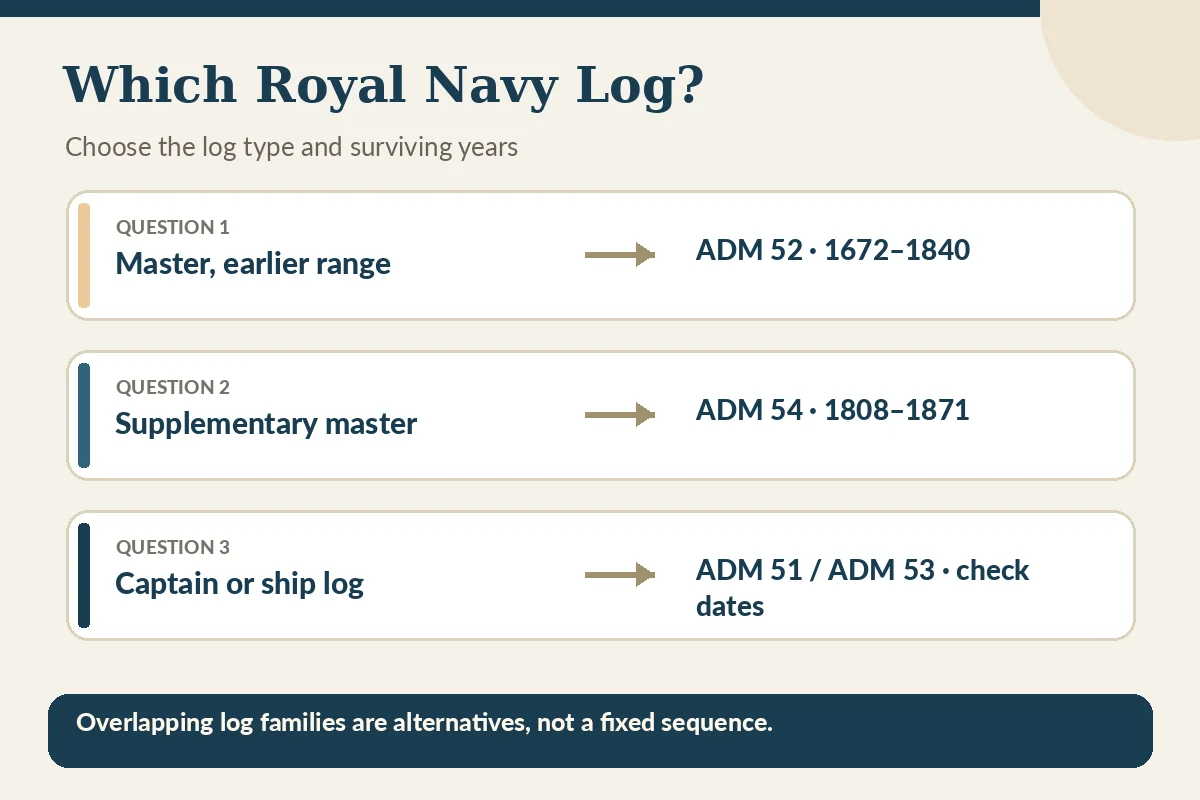
Select the right family of log books
The chronology overlaps. Masters’ logs are in ADM 52 for 1672–1840 and ADM 54 for 1808–1871. Captains’ logs appear in ADM 51 for 1669–1852. ADM 53 contains later ship logs from 1799 onward, increasingly central as older forms were superseded. These are not four consecutive stages of every ship’s paperwork. Which survived depends on the vessel, time period, and officer’s duties. Search more than one series when the research question requires a comparison of accounts.
A master’s navigation entry may be closely related to the material a captain used but the captain’s log could add different information or omit mundane detail. Compare each entry’s author, purpose, and period before drawing conclusions from differences. For a storm or unexpected change of course, a master’s log can provide technical detail absent from a later narrative. For a personal disciplinary case or sailor’s health, other records may be more useful. Selecting the correct log family saves a searcher from mistaking “no entry found” for “no voyage occurred.”
Transcribe a voyage as a dated track
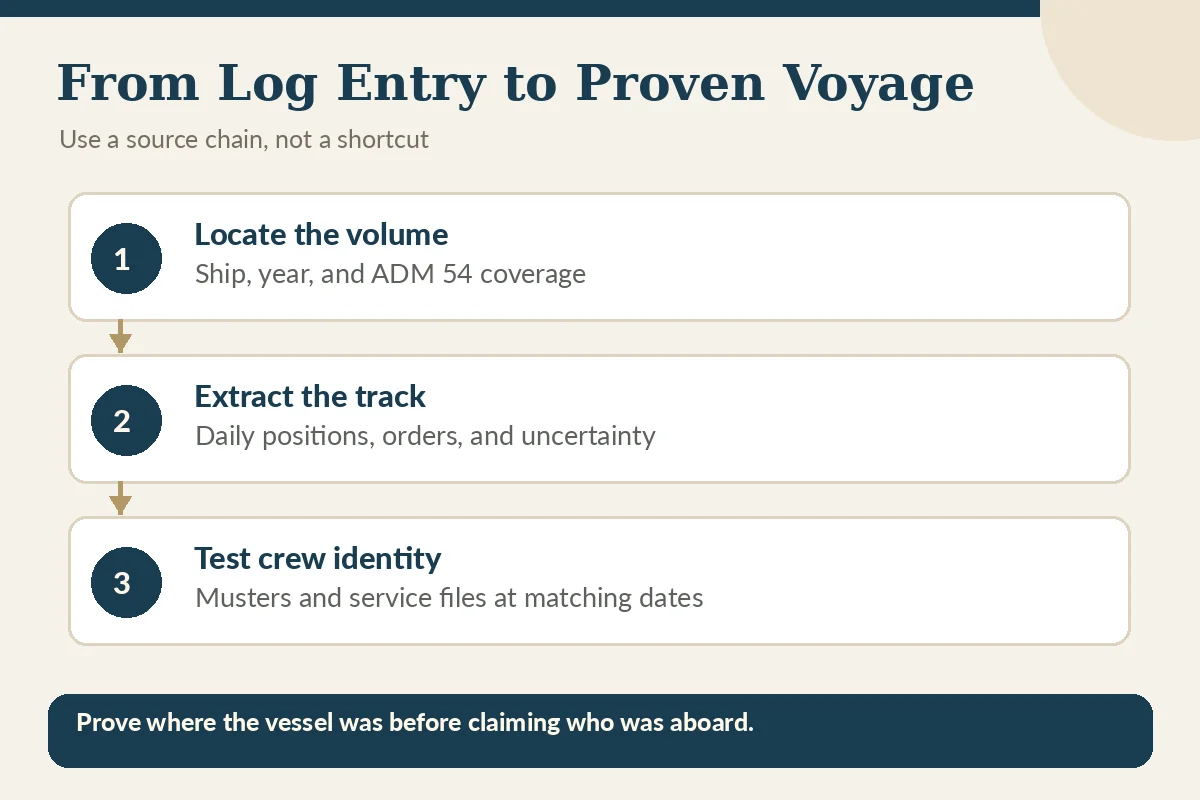
On each relevant page, record ship name, date, location or bearing, wind, course, weather, notable signals, and the exact event language. Logs can contain unfamiliar nautical abbreviations and dates expressed by watch or naval convention; verify their meaning rather than normalizing them silently. Note whether a location is a sighted landmark, a reported port, or a calculated position. A position calculated at sea may carry uncertainty that a modern digital map does not visibly show.
Keep a voyage table with one row per observation and separate fields for verbatim coordinates or bearings, interpreted location, and confidence. A route drawn through log positions is a reconstruction, not an original chart. If the log records sailing orders but no later arrival, do not finish the journey from an itinerary that was only planned. If another ship was in company, make clear which vessel’s log actually reports each movement. The value of ADM 54 lies in precisely dated operational evidence, not in a polished map with unsupported stops.

Check gaps and lost log books
Not every expected log survives. The National Archives’ guide to ships wrecked or sunk explains that logbooks could be lost with a vessel and that logs of accompanying ships may offer substitute evidence. A missing ADM 54 volume can also result from changes in record keeping, survival, or cataloguing. Keep a search note listing the name, date span, and series checked before concluding that a journey is undocumented.
When reconstructing a wreck, separate the ship’s final recorded position from a later reported place of loss. Another vessel’s report can describe its own observations but may include secondhand information about the missing ship. An inquiry or court-martial file can add testimony, yet it had a different purpose and might focus on responsibility rather than exact geography. The appropriate final narrative should mark the source of each observation and avoid displaying an inferred wreck site as an established coordinate.
Prove a sailor’s presence with person-level records
A family tradition may connect an ancestor with a ship and a known action. The log can help determine what that ship did, but the ancestor’s service needs evidence in muster books, pay books, service registers, or comparable person-level documents appropriate to the period. Distinguish a ship’s complement from the people actually recorded aboard in the particular month. A ship was sometimes under a new captain, with transfers or temporary attachments that complicate a seemingly continuous service story.
Create two columns: ship event and individual evidence. For example, “ADM 54 reports the ship anchored off a named port on a certain date” is an event claim. “A named sailor was present” needs a record identifying that person and linking them to the same ship and date. If service evidence exists only for an earlier year, say so rather than extending it forward. A surname in a modern history of the battle cannot repair a gap in official manning records. Resist treating shared names or a ship’s place as proof of family identity.
A useful worked example starts with a log noting that a vessel was anchored off a coast on a specific date. Researchers can enter that position in a voyage table and compare the next day’s log for movement. If a family story places a sailor in a battle nearby, the vessel’s position remains only one part of the claim. A muster or pay record identifying the man on that ship at that time is the other necessary part. A report of the fleet’s action alone does not fill that gap.
More Records and Archives Guides
How We Research Historic Navy Voyages
We search by ship and year, verify the proper log type and its date coverage, and extract a dated series of observations directly from the manuscript where available. We compare ADM 54 against related logs only as appropriate, labeling the author of each passage and distinguishing orders from observed movement. If a volume is missing, we use independent ship reports with explicit attribution rather than inventing connecting entries.
For genealogy, our conclusion always has two parts: what happened to the vessel and what evidence, if any, places the named sailor aboard. We disclose uncertainty in positions, abbreviations, and absent volumes. For further details on our links and editorial relationships, consult the GenHis affiliate disclosure.
No. They primarily record navigation and operational events; use suitable muster or service records for names.
The National Archives identifies supplementary masters’ logs from 1808 to 1871 in this series.
Both contain masters’ logs, but their date ranges overlap; check the ship and year in each series.
A dated arrival entry can support that ship movement, whereas an earlier sailing order alone cannot.
Check logs of accompanying ships and relevant inquiry documents, marking secondhand reports as such.