
ADM 51 records what a Royal Navy captain recorded about a vessel, not a complete list of every sailor aboard. Find the right ship and dated log, then verify a person elsewhere. Use the original archive guide for coverage and consult the GenHis affiliate disclosure before choosing any outside provider.
Start With a Named Ship and a Narrow Date Window
ADM 51 is a series of Royal Navy captains’ logs, principally covering the sailing-navy period from 1669 into the mid-nineteenth century. These are records about particular ships and command periods. A family historian who knows only a naval ancestor’s surname will often be disappointed by a straightforward catalogue search. The productive first question is which vessel was operating in the locality and year suggested by a letter, pay entry, service record, burial reference or family account. Write down the ship name as documented and the date range that source actually supports. Popular vessel names were reused: the name alone is not a unique ship identifier.
Identify the captain and the vessel’s general station when possible. For a ship with more than one period of service, record the command dates separately rather than creating an uninterrupted career from the vessel’s name. A captain’s account may be precise about a day’s weather and position yet silent about an ordinary rating. That silence is characteristic of the source, not evidence that a named sailor was absent. Treat the archive piece and its exact dated folios as the unit you will cite.
Search ADM 51 by Vessel Name and Relevant Years
The National Archives directs researchers to search ADM 51 by ship name and date. Start with the vessel’s most secure name and a short period; test historical spellings and renamed vessels only if an outside source establishes a change. Read the Discovery result at series, piece and item level. An individual catalogue description may not transcribe personal names in the pages. If a digitized image is not available, follow the current access instructions for Kew or a reproduction request; the online description is not the log itself. Record the full archival reference and dates on the cover or opening page before reading individual daily entries.
Check whether a run of days is continuous. Changes of commanding officer, detached service, missing leaves and physical volumes can create breaks. Do not interpolate positions between recorded dates as if they were daily statements. If a ship was at a named port, distinguish arriving, anchoring, provisioning and sailing; these are different events, and an archival transcription should retain the captain’s exact terms before a modern interpretation. Use a contemporary chart if geographic terminology has changed, recording the original spelling alongside its proposed modern equivalent.
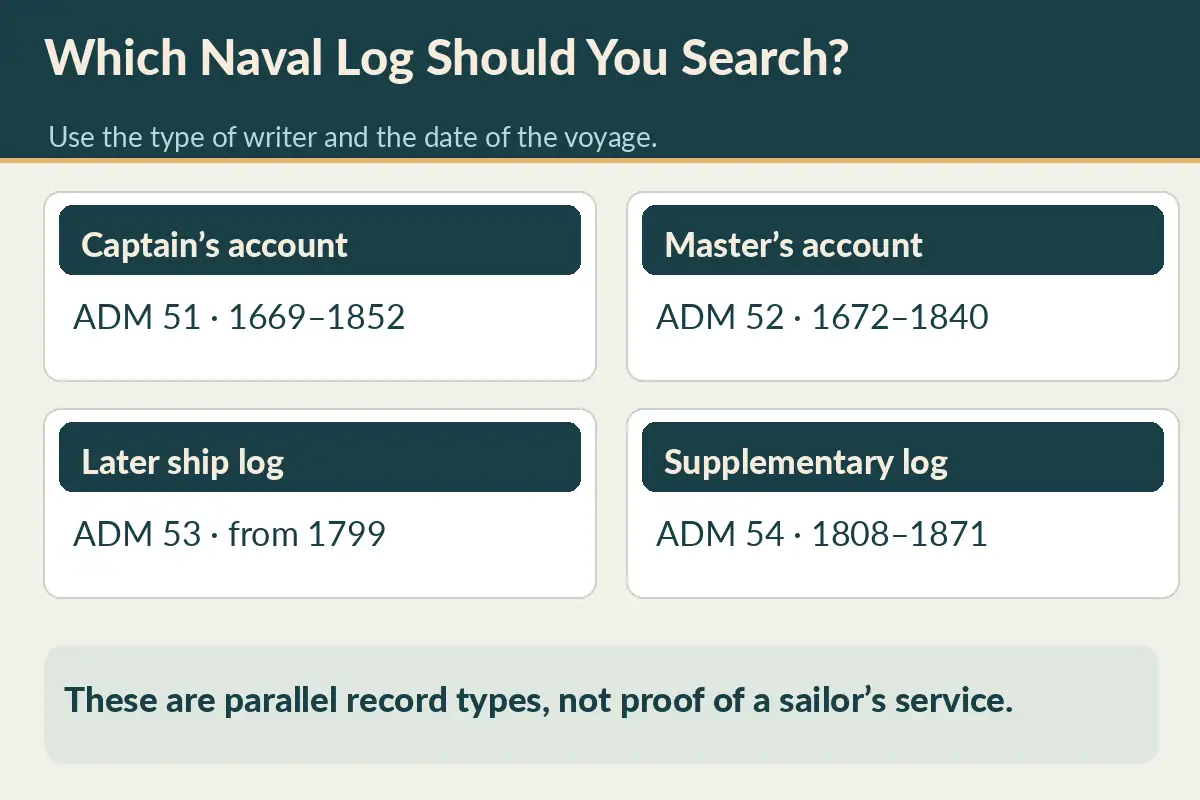
Separate Captains’ and Masters’ Observations
The official log-book guide explains that captains’ logs were compiled from masters’ logs, with a captain adding information he considered important or had to include by regulation. Masters’ logs are generally searched in ADM 52 for 1672–1840. ADM 53 contains ships’ logs that became the principal series in the nineteenth century, and ADM 54 holds supplementary logs for part of the period. These overlapping series should be treated as parallel possible witnesses, not as a mandatory sequence in which one document automatically leads to the next.
For a disputed location or unusual event, compare contemporary accounts for the same vessel and day. Log writers can disagree about a time, spelling, health incident or location; note the difference rather than choosing the neatest wording. A journal written by another ship sailing in company can be useful when the target ship’s logs were lost. It is still independent evidence about what that other observer recorded. Never quote it as if it were a surviving entry from the missing vessel.
Extract a Navigational Event Without Making a Personal Claim
A log can establish that its writer recorded a ship at a specified anchorage, on passage, or involved in a naval operation. This does not by itself establish that every sailor in a muster was present throughout the voyage. Transfer, sickness, desertion, shore duty or a clerical delay can interrupt an individual service timeline. Make two columns: the ship’s documented dated movement and the separate evidence of a person’s assignment. Join those columns only over periods in which the individual’s muster or pay record actually supports the connection.
In the ship column, transcribe the calendar date, entry time if present, place, wind or weather observations when relevant, and the physical location of the text. In the person column, record name variants, rating, muster or service reference and the observed dates. An inference such as “probably aboard during the voyage” requires explanation and should never be silently restated as “sailed to the destination.” When writing public family history, favor modest statements anchored to exact documents over colorful scenes drawn solely from a vessel’s itinerary.
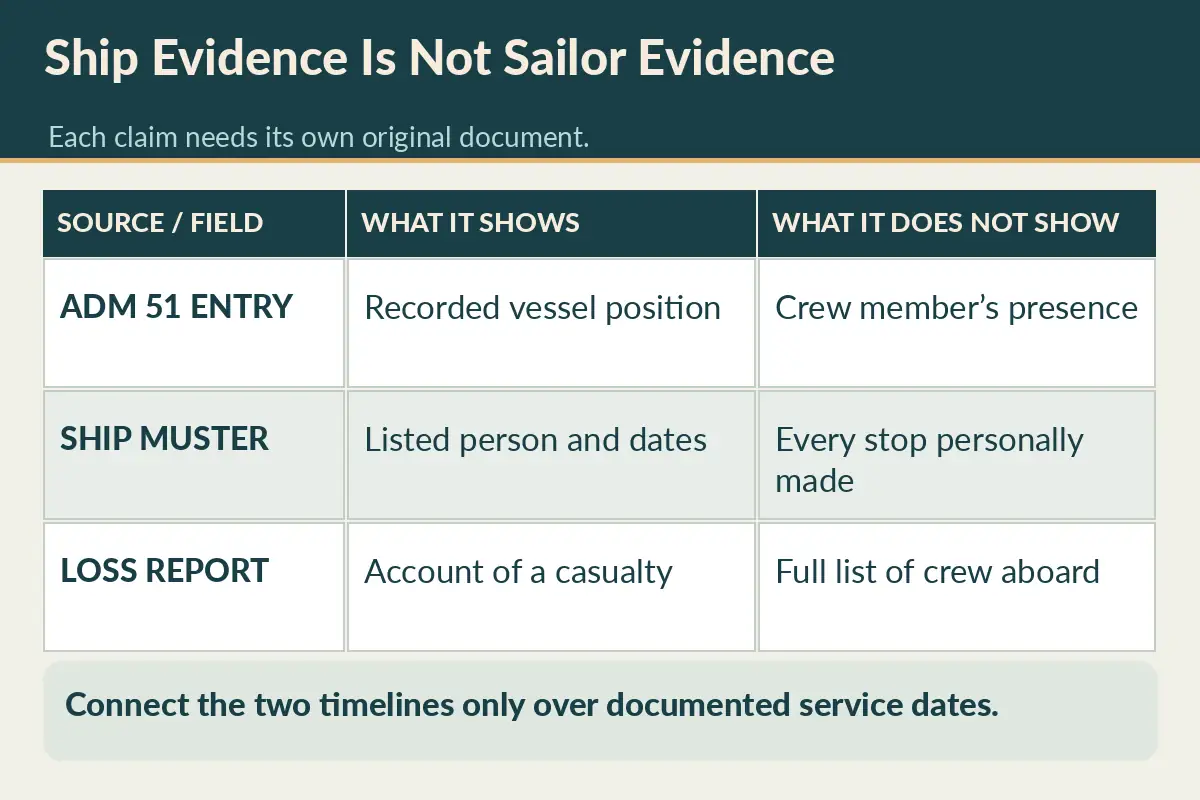
Use Other Records When a Log Is Missing
The National Archives explains that logs might be lost when a ship sank. In that situation search ADM 52, ADM 53 and ADM 54 where the dates fit, and look for logs of ships that sailed in company. A loss inquiry, newspaper notice, ship muster or official correspondence can answer related questions but is not a substitute for the missing daily volume. Another writer might describe the wreck without documenting the service of a particular seaman; a court might address fault rather than the identities of all aboard. Capture the reason a substituted document was selected.
Set a search boundary: full name of the vessel, candidate command, a year-by-year log survival check, and any other ships or series tested. If the target appears in a person-level muster but the captain’s log is absent, preserve the stronger person-level evidence without claiming that the voyage cannot be researched. Conversely, the survival of a complete log series does not prove a family member served there. The missing-link question should remain visible in the research report.
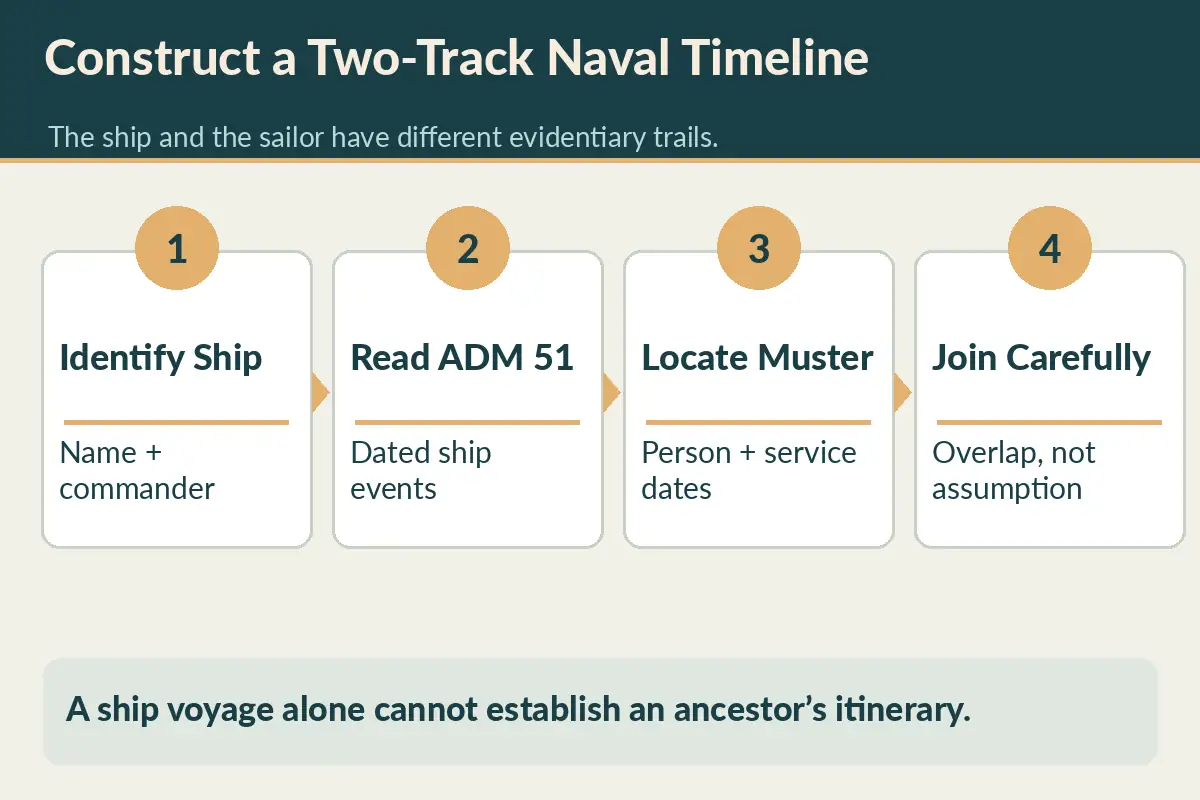
Build an Auditable Two-Track Voyage Timeline
Keep a repeatable worksheet with two dates for every event when appropriate: the date it occurred and the date the record was written or certified. Record the ship, commander, ADM 51 piece, page or folio, phrase transcribed, modern interpretation, and unresolved issues. A second tab can hold sailor-level records. This guards against accidentally attributing a vessel’s public voyage to one ancestor. Check secondary fleet histories for context only after the actual sequence is established from original or clearly identified contemporary sources.
When two vessels share a name, compare their captain, station, dates and other contextual clues before merging timeline entries. Highlight a change of ship as a separate service claim needing its own record. The final useful finding might be narrow: a log recorded a ship off a specified coast on a named day, while a separate muster places a person in that vessel during an overlapping interval. That is stronger and more honest than inventing an eyewitness account.
How We Research Adm 51 Captains Logs
We begin with a vessel/date identity test, search ADM 51 at its original piece level, and compare master and ship logs when appropriate. We transcribe events literally, then build a separate individual-service timeline from muster or pay material. Missing leaves, reused ship names and contradictory entries are reported instead of smoothed away.
More Records and Archives Guides
Official Custodians and Verifiable Record Limits
For original arrangement and date coverage, check the custodian’s primary guide (Identifies captain logs in ADM 51, their derivation from masters’ logs and vessel-and-date search.). For a separately documented access or contextual limit, read the related official source (Identifies ADM 51/52/53/54 alternatives and cautions that logs can be lost when vessels founder.). An index, catalogue description and original image are distinct types of evidence; cite the one actually examined.
The reliable primary search is by ship and date; sailor identification usually requires separate service or muster records.
ADM 51 holds captains’ logs; ADM 52 holds masters’ logs, which were among the sources from which captains compiled entries.
No. Establish the individual’s assignment for the actual period using personal or muster records.
Check logs of accompanying ships and other appropriate Admiralty series; explain what survives and what does not.
The principal later log series is ADM 53, with supplementary material in ADM 54.