
New Orleans coastwise manifests record forced transportation of enslaved people, not voluntary immigration. Choose inward or outward M1895 rolls, read each entry and document limits. Use the original archive guide for coverage and consult the GenHis affiliate disclosure before choosing any outside provider.
Recognize These as Records of Forced Transportation
NARA microfilm publication M1895 comprises 30 rolls of customs manifests submitted at New Orleans for coastwise voyages involving enslaved people from 1807 to 1860. These records were generated within a system of slavery and domestic forced movement. They are not passenger lists of free migration and should never be presented that way. Their evidentiary value is that a named or partially named person may be connected with a particular vessel, date and reported origin or destination. Research should respect descendants and distinguish a person’s own identity from categories imposed by enslavers or customs officials.
Begin with a suspected place, date or ship supported by independent material. A name alone may be insufficient: the forms often give only a first name, and an age may be an estimate. Write down what is known from a later census, a freedom claim, a marriage record or a family account before searching. Do not automatically treat the shipper or enslaver listed on a manifest as a biological relative or an enduring owner; these are legal-administrative roles within the transaction as recorded.
Select Inward or Outward Manifests Before a Roll
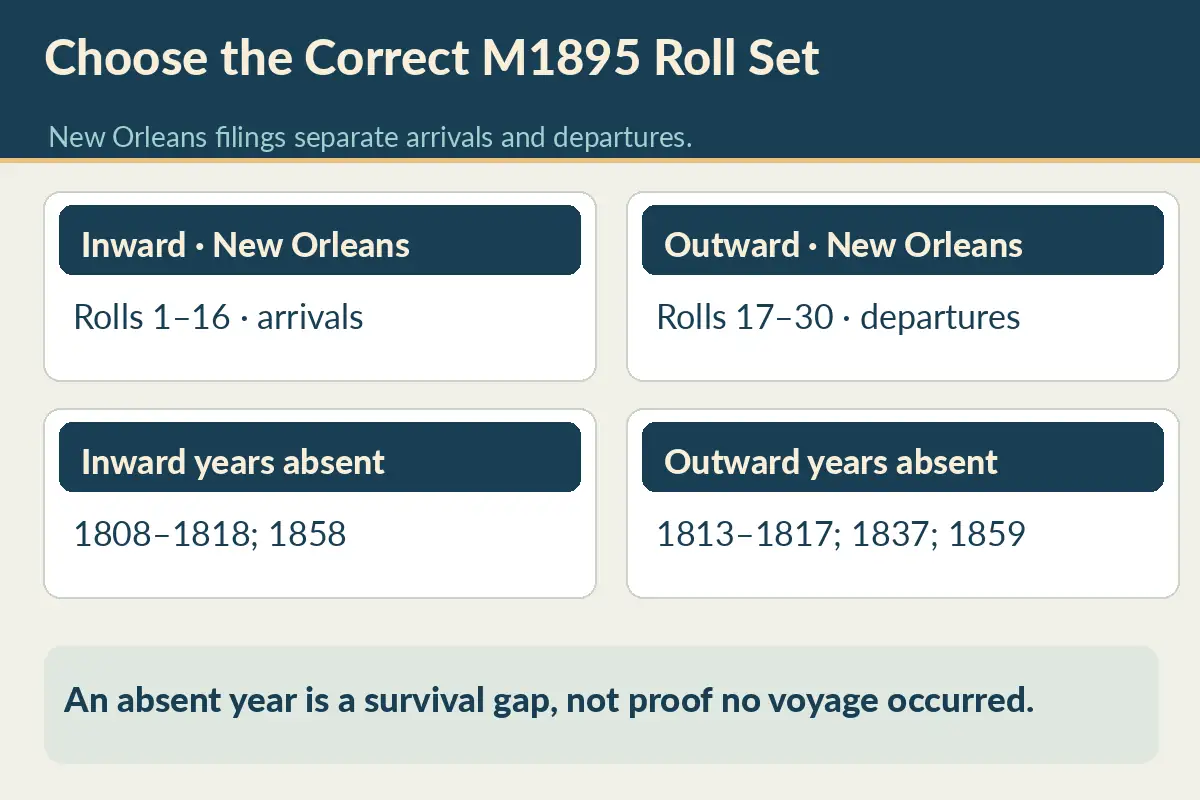
M1895 divides its 30 rolls between inward manifests filed for arrivals at New Orleans and outward manifests filed for departures. The official NARA page supplies a roll-by-roll chronological list: inward rolls 1–16 and outward rolls 17–30. A presumed arrival should not be searched in outward records by default. NARA explains that port officials required documentation both before departure and upon arrival, but the two surviving parts are not a complete pair for every voyage. The filing date may correspond to a certification event rather than a separately documented disembarkation.
Use the vessel and known month to choose a roll and then examine adjacent chronological entries, not merely a name index. Record whether the heading says inward or outward, the named port, the ship’s master and the official date. A group of people on one form may include infants, people identified by one name or people separated by an official clerk’s spacing. Never merge them into families based only on their listing order. If an image is difficult to read, transcribe uncertain letters with an explicit uncertainty marker.
Respect the Exact Gaps in Surviving Years
NARA specifically identifies major gaps. No inward manifests survive in M1895 for 1808–1818 or 1858. No outward manifests survive for 1813–1817, 1837 or 1859. Some documents may also have been lost within otherwise represented years. The oldest inward roll includes 1807 and later material beginning in 1819; outward rolls similarly skip intervals. A negative search in one of these periods has a different meaning from a negative search through an intact roll.
Build a coverage gate before interpreting any absence. Record the direction, proposed date, corresponding roll, whether the year survived and the actual pages inspected. For 1821–1827 inward material NARA notes miscellaneous sections after the ordinary chronological sequence, so a researcher should not stop at the first expected date. The physical arrangement may be imperfect and the guide recommends scanning all of a relevant year when a vessel is not found where expected. Missing a year cannot prove that no forced movement happened.
Read Every Field Without Repeating Historical Categories as Facts
The surviving forms can identify a ship and master, port of departure and arrival, certification date, name, reported age, sex, stature, and the person recorded as shipper or enslaver. Officials used racial color labels as part of the historic form. Transcribe such terms only when necessary to interpret the source and attribute them to the record; they are not reliable biological identity labels. Height, reported age and name variants can help distinguish individuals, but each is subject to error and coercion. Historical names may change across later sources.
Create a person-by-person ledger instead of only a vessel table. Include literal name, reported age, the reference for the person’s line, direction of travel, date, place, named shipper, and a separate confidence field. Note whether a surname is actually written or supplied by a modern index. Compare with an independent bill of sale, probate inventory, manumission record or post-emancipation record only if it concerns an identifiable person. Do not infer kinship from an enslaver’s surname or from two people transported together.

Distinguish Customs Statements From Actual Life Events
An outward manifest is evidence of what was certified as destined for transport, and an inward record is evidence of what was filed upon arrival. Neither is, without more, a complete account of the person’s experience between ports or afterwards. A destination is not evidence of lifetime settlement. A shipper is not necessarily the final purchaser, and a line in a list is not proof of a later household or a family connection. Contemporary law structured the information collected, so these are administrative documents with severe omissions as well as valuable names.
If the same vessel appears in both directions or on adjacent trips, compare the dates and people without assuming the lists belong to one voyage. The description of each person, the master and port route may help link entries; differences must remain recorded. NARA’s examples include both full names and first names only, illustrating why one-to-one identity matching is not always possible. A responsible family narrative can preserve that uncertainty and still honor a documented journey.
Extend the Search Beyond New Orleans Without Overclaiming
New Orleans is one place where RG 36 records survived. NARA identifies coastwise manifest collections for additional ports, including Savannah and Mobile, and some regional finding aids are searchable by recorded name or enslaver. These are separate customs collections with different coverage, not automatic duplicates of M1895. Search the port relevant to the known route and record whether that repository holds incoming, outgoing or both types of manifest. A record of departure elsewhere might help test a New Orleans arrival, but only exact dates and matching people support the link.
State the access route, reproduction, roll and page in every citation; credit the archive and distinguish any transcribed database index from the actual manifest. Sensitive information should be included only when it advances the research question, and language should center the people whose lives were constrained by the records. The strongest outcome is often a careful, limited finding—an identifiable person was recorded as transported on a specified vessel under a particular customs document—plus a documented plan for further records.

How We Research M1895 Slave Manifests
We separate inward and outward M1895 rolls, apply NARA’s explicit missing-year gates, and inspect each original form for vessel and person fields. We retain historical official classifications only as attributed source text and test name, age, route and identity against independent records without assigning kinship from a shipper’s name.
More Records and Archives Guides
Official Custodians and Verifiable Record Limits
For original arrangement and date coverage, check the custodian’s primary guide (Documents 30 M1895 rolls, inward/outward date spans, missing years, recorded fields and New Orleans custody.). For a separately documented access or contextual limit, read the related official source (Explains RG 36 coastwise slave manifests, customs filing practices and other surviving port holdings.). An index, catalogue description and original image are distinct types of evidence; cite the one actually examined.
No. It documents customs filings for enslaved people transported in the coastwise trade.
NARA identifies 30: inward rolls 1–16 and outward rolls 17–30.
No inward manifests for 1858 survive in M1895; check direction and other records rather than treating absence as proof.
No. Some forms use only given names, making identity matching difficult.
No. It records historical customs declarations, not necessarily a final purchaser or subsequent residence.