
Start With the Institution Instead of the Surname
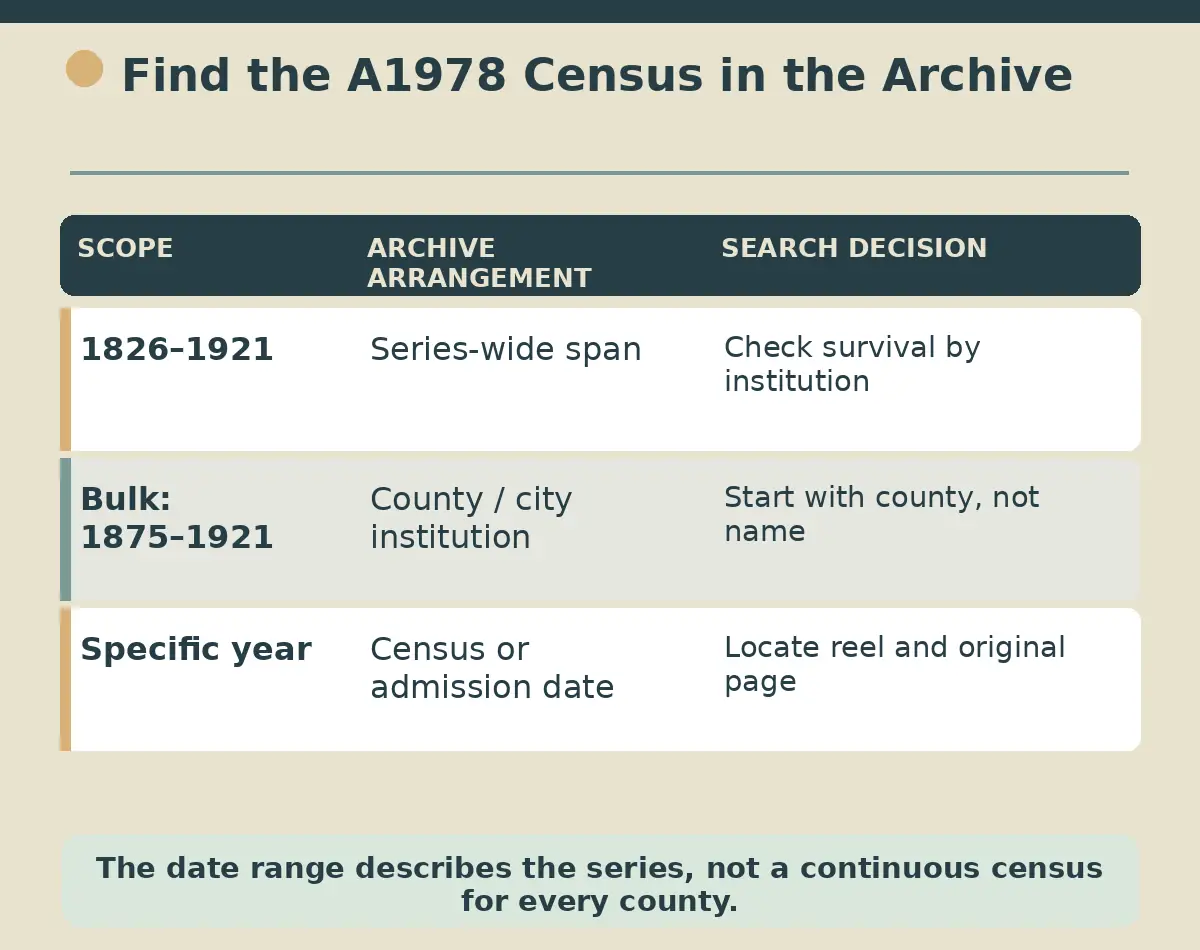
To locate a person in New York’s historic almshouse or poorhouse census, begin with the county or city institution and an approximate year. The New York State Archives identifies its census of inmates as series A1978, covering 1826–1921, with most surviving returns from 1875–1921. It is not one all-inclusive online name directory. A name is useful only after you have defined which institutions and years can actually be searched.
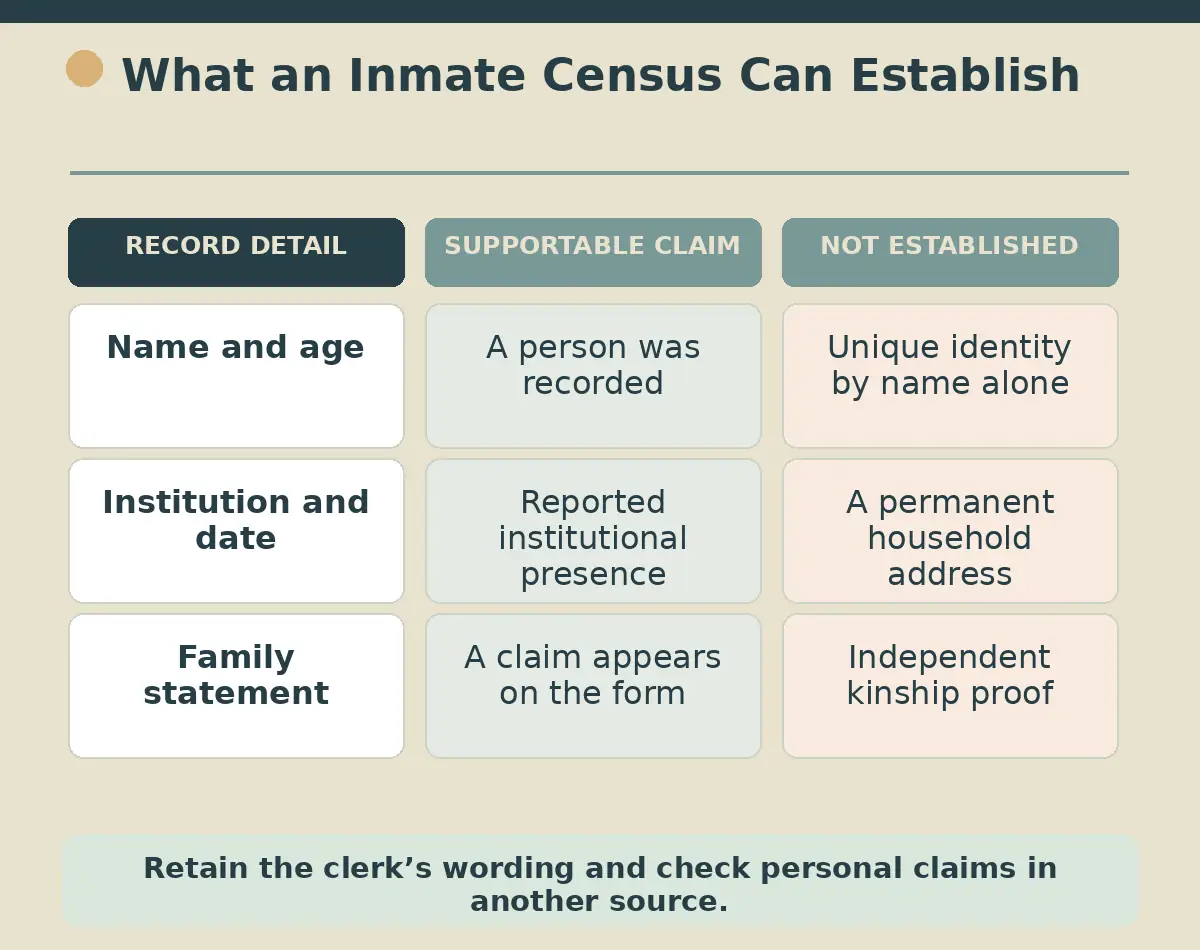
The forms can describe an institutional resident’s personal, family and economic circumstances, but the content depends on the form and institution. An entry establishes that someone was reported in a particular record, not that the person lived there permanently or was unrelated to anyone elsewhere. Start a research note with one question, such as whether a named adult appeared in an identifiable county poorhouse during a documented interval.
Separate the Series Dates From Each Institution’s Survival
The range 1826–1921 is the span of A1978 as a collection, not a guarantee that each New York county or institution has returns for every year. The Archives specifically cautions that some institutions do not appear throughout the entire period. Before testing surname spellings, identify which years and local jurisdictions survived, and note any absence or uncertainty. The bulk of the evidence is late nineteenth and early twentieth century, not a continuous record starting in 1826.
Make a small coverage grid with county or city, institution, candidate admission date, surviving years and film or image route. If a family lived on the border of two counties or moved, include both jurisdictions, but label them as competing possibilities. If the individual lived in New York City, distinguish statewide A1978 from the city’s separate almshouse ledgers, which have their own custodial arrangement and dates.
Read the Finding Aid in the Correct Arrangement Order
According to the Archives, A1978 is organized alphabetically by county or city institution and then chronologically by census or admission date. That order is your key when no surname index exists. Begin with the county, identify an appropriate institution, select the correct time window and only then read successive images or microfilm frames. The order of files is archival: it does not imply that two people next to one another on a page entered on the same day.
Keep every stage of the retrieval path, including repository, A1978, locality, institutional designation, date, film roll and image or page number. If the item appears in a derivative collection on Ancestry, do not cite only the search result. Save its image, exact name spelling and physical identifier, then match the digitized source to the official series. That way another researcher can reconstruct the search without your subscriber account.
Choose Between Digital, Microfilm and Staff-Assisted Searches
The State Archives describes several ways to examine A1978: digital access through Ancestry.com New York for eligible New York residents, self-service microfilm in the reading room, and interlibrary loan of film. The reading room and loan arrangement are not proof that every image is freely visible to all internet users. Consult the repository’s poorhouse census guidance before planning access or requesting assistance.
For a staff-assisted search the Archives asks for a resident name, institution or place and approximate residence dates. A broad request such as “find everyone with this surname in New York” is not a realistic use of an unindexed and place-arranged collection. If staff cannot locate a proposed record, record which county, years and specific holding were checked; do not turn that one unsuccessful request into proof of absence from all almshouses.
Transcribe the Form Without Modernizing Its Labels
When the image is available, write down the person’s exact recorded name, the form’s date, the institution, and every present field relating to age, birthplace, family situation, means of support or admission. Some forms contain personal and economic history, but not every sheet asks the same questions. Preserve uncertainty such as an unclear age or a crossed-out surname. Do not silently insert a father, spouse or diagnosis that does not appear on the page.
Historical institutions used classifications and social language that may be stigmatizing today. Quote those categories only when needed to explain a record, identify them as the institution’s language and do not treat a label as an independent medical or moral conclusion. If a name is duplicated, create two candidate rows and compare their ages, dates and locations with other documents rather than choosing the record that fits a family story best.
Distinguish Admission, Enumeration and Departure Dates
An admission date and a census date can answer different questions. Admission documents the administrative entry reported in the form; the census shows a person represented when that enumeration was compiled. Neither date automatically identifies discharge, death or continued residence. Transcribe each date in its own field and describe the event as stated, especially if the record has later updates or multiple entries for a returning resident.
Check county-level vital records, census schedules, city directories or local relief records for the months on either side of a proposed institutional stay. A later outside address does not invalidate an earlier poorhouse record: the person may have been discharged, transferred or temporarily cared for. If the local archive holds an admission-discharge register, compare it as a distinct source rather than projecting that register’s fields onto A1978.
Build an Identity Test That Allows Two Namesakes
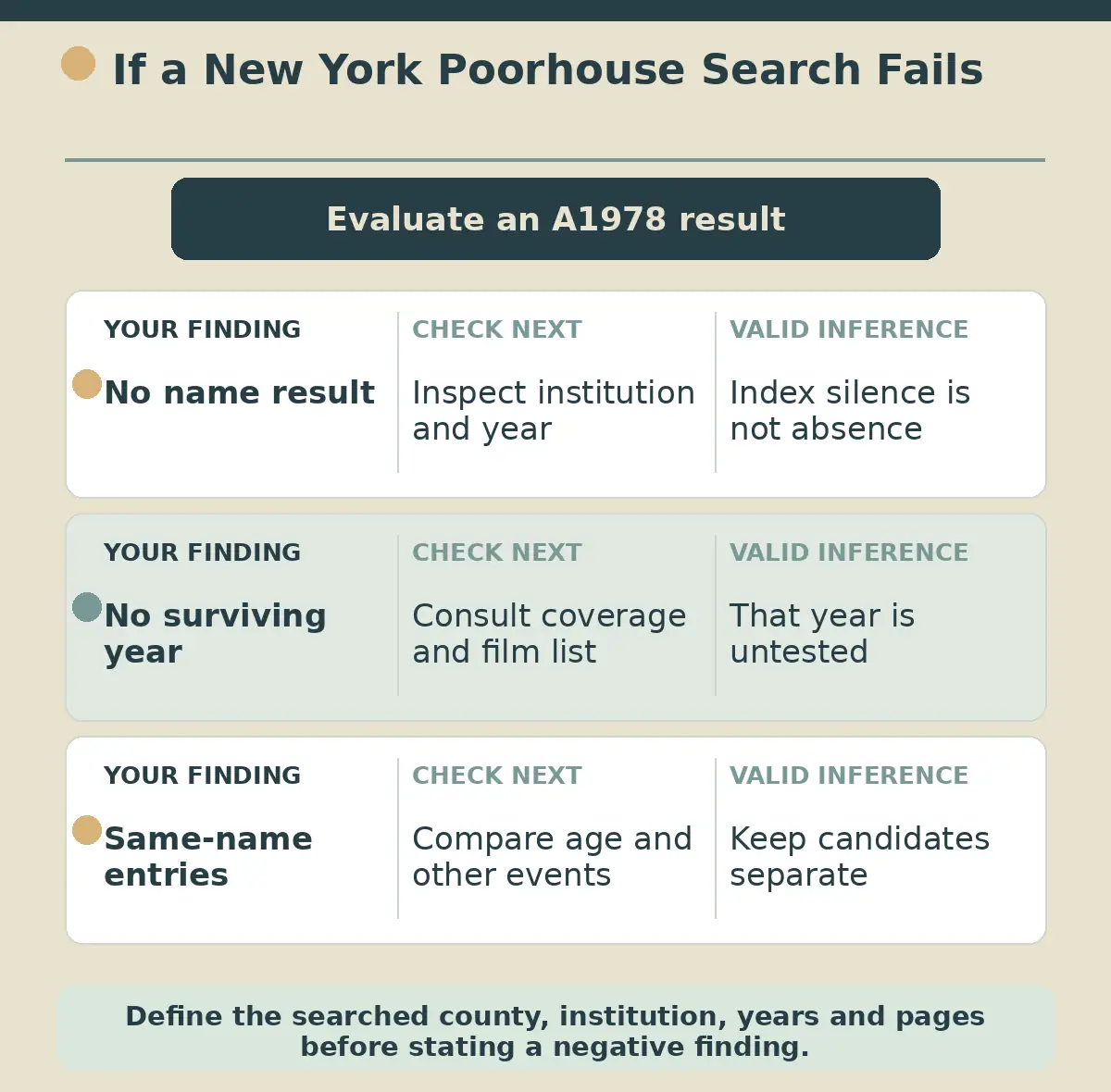
For two people of the same name, collect three independent indicators: consistent age or birthplace, a matching local residence or associated relative, and chronology that does not conflict with another documented event. A matching surname and county alone are inadequate. A person could have been enumerated away from family, and the same year might contain entries for different institutions. Write each comparison next to a precise record citation.
If the image mentions a relative or former home, treat it as a reported claim, possibly from a clerk rather than the resident. Seek a contemporaneous marriage, birth, census or death document to corroborate the connection. Maintain a separate unresolved category when details are inconclusive. Good genealogy preserves two candidates until the evidence can distinguish them; it does not force a match merely because the record is emotionally powerful.
Record Negative Searches With Their Real Boundaries
A failed digital surname search is not a negative A1978 search, because the entire collection is not organized around a universal inmate-name index. Even a careful film review can exclude only the particular institution, date range and surviving reel examined. List variants tried, the county or institution, the date range, the platform or roll and the specific reason the result remained unresolved. Mark uncovered periods explicitly as not searched.
When A1978 cannot answer the question, look for the relevant municipality’s poor-relief overseer reports, city almshouse ledgers, civil death records, or county institutional material. Those alternatives have different creators and different evidentiary purposes. Avoid combining a broad statewide series description and a narrower city institutional ledger into a single imaginary database; two collections may contain the same individual without being interchangeable.
More Records and Archives Guides
How We Research a New York A1978 Candidate
We first verify the archival series scope on the custodian’s page, check whether the required institution and years survive, and then follow the official arrangement through county, institution and date. We preserve the original form’s language, distinguish admission from census and extract only claims actually reported. Every accepted citation identifies A1978 and a retrievable frame or page where available.
Next we compare proposed namesakes against independent civil or household evidence and keep unresolved matches open. We disclose access barriers rather than advertising an unverified free search, and we record missing institutional years before interpreting a no-hit result. The GenHis affiliate disclosure explains the site’s relationship policies; no paid service is necessary to follow the research logic here.
No. The series spans 1826–1921 but individual institutional and year coverage is incomplete.
The New York State Archives says the series is not indexed by inmate name; begin with the institution and date.
The Archives lists Ancestry.com New York access for eligible New York residents and microfilm through interlibrary loan.
No. The NYC Municipal Archives collection has a different custodian and arrangement.
No. Residence, admission, discharge and death must be proved from their specific records.