
There is no comprehensive, publicly searchable set of nineteenth- or early twentieth-century New Zealand household census returns like those familiar from Britain or Canada. Archives New Zealand says most official historic census records were destroyed, although some exceptional local and Māori census-type material survives. To find a family at a particular date, use an electoral roll, street directory, school register, local archival list or a relevant vital record instead. Each substitute answers a different question and may omit children, women or people ineligible to vote.
Do Not Mistake Census Totals for Named Households
Statistics New Zealand preserves historical information on the questions asked and population counts, but tabulated results are not a searchable list of all named residents. A person’s presence in a district aggregate cannot be proved by an age or occupation total. Historical census forms also changed over time, so a statement that a question appeared in 1906 does not show that a genealogical image survives for one ancestor. Begin with a precise date, place and person rather than searching for a fictional nationwide name index.
Understand Why the Usual Census Search Fails
Archives New Zealand explicitly notes that it does not hold official historic household census records as a normal family-history collection because most were destroyed. Unlike countries that kept enumeration books, New Zealand cannot offer a continuous series of searchable household pages for each decade. Avoid websites that silently confuse modern anonymous statistical tables with named historical forms. Record the loss as a source-coverage fact. It is not evidence that the particular household did not exist or was absent from New Zealand.
Use Electoral Rolls as an Eligible-Voter Snapshot
Electoral rolls can locate a person in a particular constituency and year, but the historical right to vote varied. A roll does not enumerate every member of a dwelling, and a person missing from it may have been a child, ineligible, unregistered or temporarily elsewhere. Archives New Zealand directs researchers to the National Library for a fuller historic roll collection. Compare electorate, address or occupation only where the specific edition records them. Never infer the entire household from a single voter entry.

Check Street Directories for Occupants and Business Names
Auckland Libraries recommends street and telephone directories as local census substitutes. Directories may identify householders, tradespeople or property users while omitting lodgers, dependents and other residents. Confirm the edition’s publication date and geographic coverage before mapping a listed person to a specific calendar year. Some directories organize by street, others by surname or locality. A directory entry is useful evidence of a listing, but not conclusive proof that the same individual lived at the address throughout the year.
Use School Records Without Assuming Parentage
School admission, attendance and leaving registers can trace a child near a particular date. Search under the actual school district and time period, noting that school archives have different survival and access arrangements. A guardian or address may be recorded, but the named adult is not necessarily a biological parent. Compare dates and spellings to civil records before adding relationships. Such records are particularly important when electoral rolls omit children, but a single surviving school register does not cover every child who lived in a settlement. Our guide “New Zealand School Admission Registers” covers how to find pupils through education boards.
| Record type | Useful for | Cannot establish |
|---|---|---|
| Electoral roll | Eligible voter and place | Full household |
| Street directory | Listed person or business | All residents |
| School register | Enrolled pupil | Biological parentage |
| Local census list | People in a specific source | National coverage |
Recognize Special Local and Māori Census-Type Lists
Archives New Zealand notes surviving census-type lists in certain areas, including some historical Māori research materials. These are not interchangeable with a complete nationwide census and often reflect particular government activities and historical classifications. Research the creator, purpose, locality and coverage before interpreting a person’s inclusion. Treat colonial labels respectfully, do not present an official category as modern identity, and avoid publishing sensitive details about living descendants or communities without context. Where whakapapa is involved, documentary records do not replace community knowledge or authority.
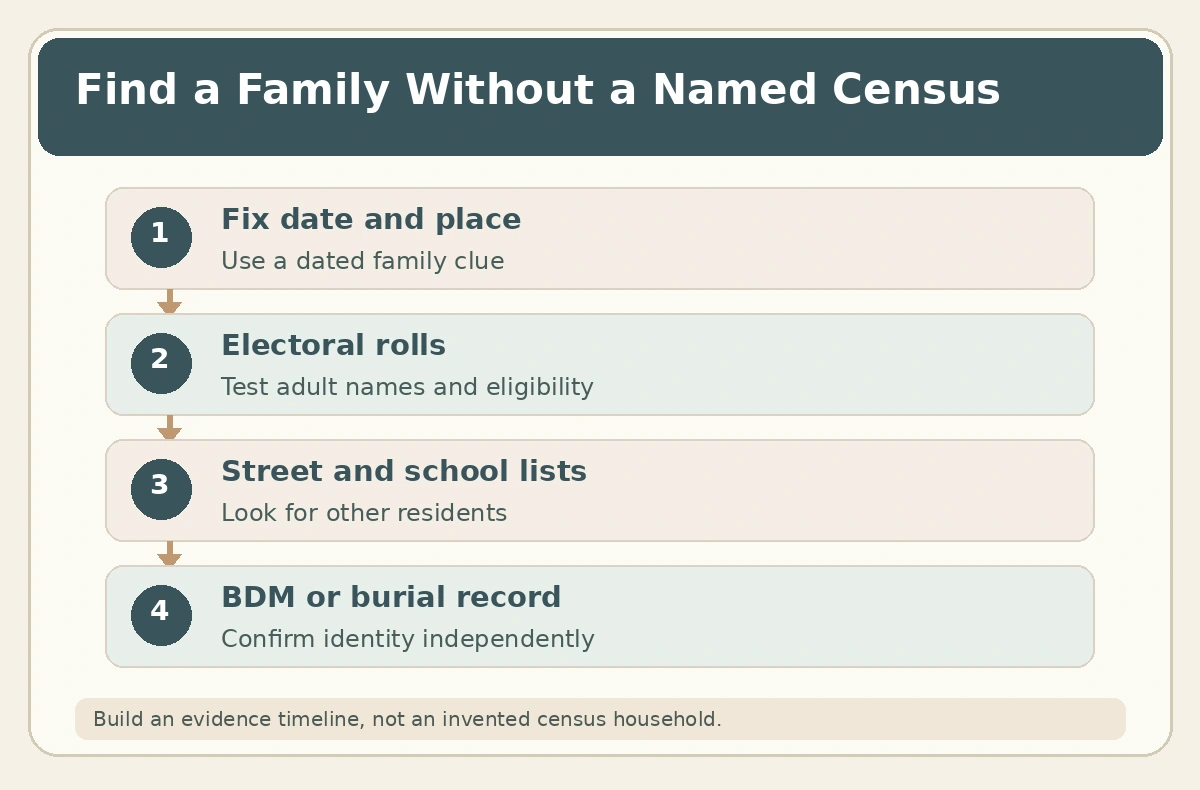
Use BDM and Burial Records to Anchor a Timeline
Historical births, deaths and marriages can establish an event’s registered date and place, while cemetery registers and newspaper notices may add dated addresses. Select records appropriate to a person’s age and the locality in the target year. A registration is not a census: a child’s birth in a district does not prove that an entire family remained there ten years later. Pair an independently documented vital event with an electoral roll or local directory when possible, and leave residence periods as ranges rather than invented exact move dates.
Create a Census-Substitute Coverage Grid
List target year, district, potential source, who was eligible to appear, holdings, result and evidence limits. A voter roll has an eligibility restriction; a directory has listing practices; a school roll has age and institutional scope. Two separate sources covering similar years can sometimes support an address continuity hypothesis without providing a complete household. If sources conflict, keep the entries separate until you can test name, occupation and locality. A well-designed negative-search log explains why a missing name cannot exclude a person.
Illustrative New Zealand Residence Reconstruction
Imagine a named adult in an 1893 electoral roll and the same surname in an 1895 street directory, with a child appearing in a nearby school register. Before calling them one household, check whether the locality boundaries match, whether the adult could legally appear on that roll, and whether the school record specifies a guardian or address. A similarly named person might have moved between the two dates. Record each item as a separate claim with source and year. This is not a reconstruction of any real family and does not imply that all people at an address can be inferred from a directory. The example demonstrates how a set of partial records can support, but not replace, a missing historical census.
Cite the Edition, Custodian and Search Date
A reliable citation says which electoral roll, directory or institution register you actually searched and names its custodian, year, page and locality. For exceptional census-type lists, include the specific archive collection rather than calling it “the New Zealand census.” Do not cite Stats NZ question tables as evidence of a named ancestor. If the original page was not seen, say whether your information came from a searchable index or a later transcript. The honest result may be an overlapping series of partial residence clues rather than one complete household form.

More Records and Archives Guides
How We Research New Zealand Census Substitutes
We checked the Archives New Zealand description of destroyed census returns and exceptional census-type holdings against Auckland Libraries’ substitute-source recommendations and Stats NZ historical census-question tables. The article differentiates statistical aggregates, named local lists and independent substitute records, with careful treatment of historical Māori classifications and the limits of voter eligibility.
Official custodial documentation reviewed: Archives New Zealand explains loss of official census records and presence of limited census-type lists. Auckland Libraries guide to census substitutes, local directories and electoral rolls. Archives New Zealand points to historic electoral roll collections and vital records. The links are research sources, not paid endorsements. Our affiliate disclosure explains the site-wide policy.
No. Most official historical household returns were destroyed, so no continuous searchable family-level series exists.
They give population context but do not prove that a particular person was counted in a district.
A dated electoral roll or street directory can provide a locality clue, subject to voter eligibility and directory coverage.
They may place a child at a school on certain dates, but survival and access vary and they do not enumerate an entire household.
Yes, some specific local and Māori historical lists exist, but their creator, locality and purpose must be checked individually.