
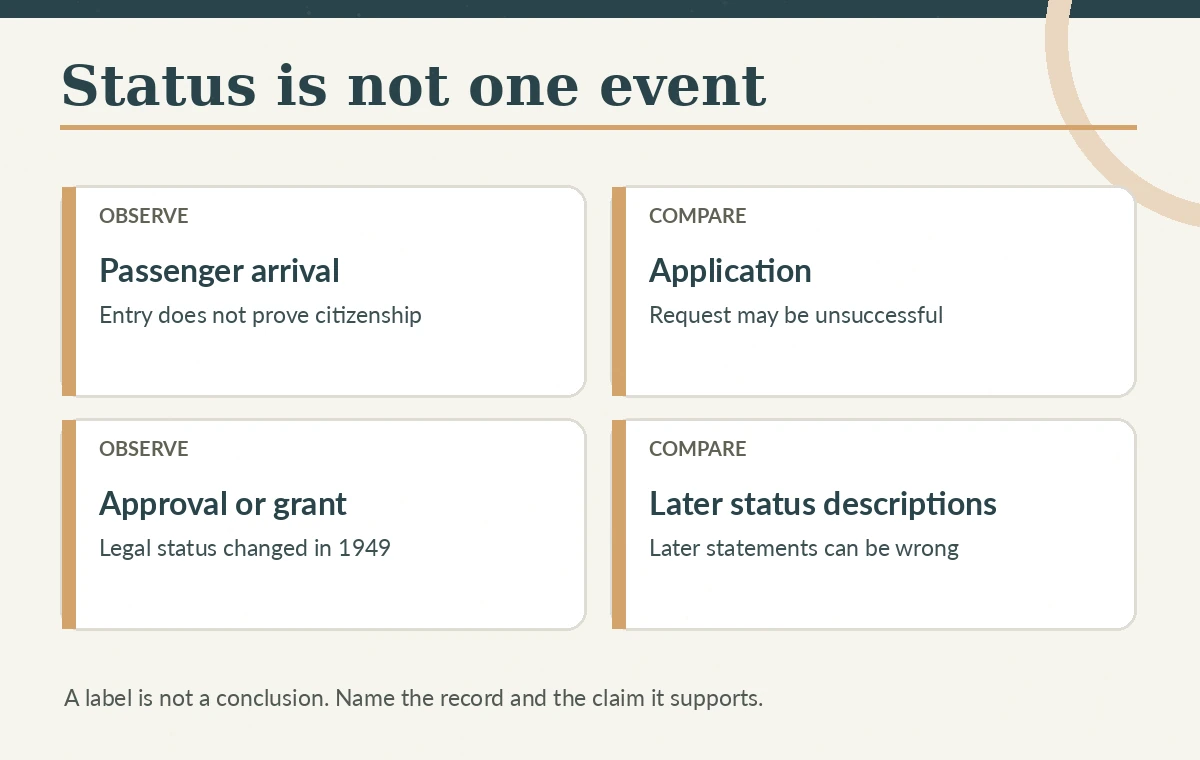
Before 1 January 1949, naturalisation in New Zealand generally conferred British subject status, not the later legal category of New Zealand citizenship. Archives New Zealand holds records beginning in the early 1840s, including a digitized register of people naturalised before 1949. Search the period and name variant, identify whether you have an index, register entry or full application, and check the record’s access decision. Do not treat a passenger list, a residence period, a naturalisation application and a completed grant of status as interchangeable events. The archive also holds alien-registration material subject to different privacy rules.
Put the change in legal status on a timeline
Archives New Zealand explains that for much of the colonial and early twentieth-century period, people were treated as British subjects or as aliens under the terminology of the law then in force. Naturalisation before 1949 generally granted British status; from 1949 it gave New Zealand citizenship. Do not rewrite a historical register using today’s categories without explanation. The guide also notes the distinct legal history of Māori status and the Treaty of Waitangi. A register of naturalised people is therefore not a list of everyone born abroad or everyone living in New Zealand at that time. Our guide “New Zealand Register of Aliens, 1917” adds more detail on this.
Start with the early register and period
The archive identifies a register covering naturalisations in 1840–1866, when there was relatively little formal requirement, and a digitized Register of Persons Naturalised before 1949, cited in its guide as ACGO 8376 IA52 14/26. Begin with these exact archival directions, not a commercial index that may show only a subset. Record the searched name and the years, then inspect the description and any linked image to see which act or grant is being recorded. If a person’s appearance is absent, reconsider surname spelling and eligibility rather than assuming no status was ever held.

Separate an application from a completed naturalisation
An application or correspondence file can document an intention and background, while a register entry or formal certificate may record an administrative outcome. Files do not all have the same surviving components. When making a genealogical claim, identify the document maker, purpose and date before stating that a person became naturalised. A later record calling someone British could derive from birth, legal rules or an inaccurate declaration rather than proving an individual naturalisation proceeding. Record what the source actually says and follow up with the granting evidence if available.
Search altered spellings without erasing the original
Archives New Zealand specifically warns that names could change or be copied incorrectly and that registers are not always strictly alphabetical. Search phonetic alternatives, reordered given names and plausible translations, but preserve the historical spelling as recorded. If a later family member used a different surname, look for a dated document linking the two forms. A spelling variation alone is not proof of a particular ethnic origin or an identity change. Use residences, occupations, birthplaces and family associations as corroboration where those details survive.
Understand what alien files add and restrict
The archive distinguishes naturalisation records from aliens files, including wartime and later administrative holdings. These were created for different legal reasons and may include sensitive information or biased labels, especially around the world wars. A person appearing in an alien register is not automatically someone who sought or received naturalisation. Avoid labeling a person with historical wartime classifications as if they were objective judgments of loyalty. Note the creation date and agency for every file, and observe current access restrictions before seeking the contents.
Apply the access rules before requesting a file
Archives New Zealand says alien files may remain restricted for 100 years from birth or until the subject has died. Some naturalisation files are restricted until 100 years after birth or 40 years after death, whichever comes sooner; the precise access decision should be checked on the item. Certain files more than a century old may still be restricted. When access is closed, ask the archive about the lawful permission process with the responsible agency rather than trying indirect disclosure. Do not assume the date of an application automatically makes every supporting document public.
Reconcile naturalisation and immigration dates
Arrival in New Zealand and becoming naturalised are different events separated by a variable interval. A naturalisation record may point toward a birthplace, former nationality or residence, but it does not guarantee an arrival passenger list exists. Compare the earliest proven local appearance, arrival claims from later documents and the dated naturalisation evidence. If a document names a ship, seek the independent manifest and verify person-level details. Do not turn an exact grant date into an estimated immigration date merely because no voyage record has yet been found.
Avoid relying on nationality alone to identify a family
A person’s reported nationality can reflect changing borders, official categories and informant choices. Two same-name candidates might share a European birthplace but be distinct people in different New Zealand settlements. Build an identity grid showing exact recorded name, chronological residence, occupation, spouse or known kin where lawful, and the source locator. Mark uncertain details explicitly. The archival guide notes separate collections for Chinese New Zealanders, including poll-tax records; do not collapse those distinct historical systems into a generic European naturalisation process.

Use a fictional conflicting-status example
Imagine a fictional merchant called Johann Fischer appearing on a shipping list, later in a local directory as John Fisher, and in a register under Fischer. A matching trade and town make the hypothesis plausible, but they do not alone demonstrate that the documents belong to one person. Search intervening electoral, marriage or business records and compare any precise identifying details. Conversely, another John Fisher in the same town could be a distinct person. Label the scenario explicitly as a demonstration, not a real individual or a sourced historical case.
Write the finding with full archival context
Your citation should identify Archives New Zealand, record group or series such as ACGO 8376 IA52 14/26 where relevant, item or page, person, exact recorded date and the online catalogue or image consulted. A summary should distinguish an index match, a register entry, an application and a grant, and mention any access restrictions. State the legal term used at the time, without assuming modern citizenship or national identity. Finish with one targeted next search, ideally an independent residence or civil event near the grant date. Respect living people and the cultural context of whakapapa.
| Document | Can indicate | Cannot alone establish |
|---|---|---|
| Arrival list | A voyage candidate | Naturalisation or citizenship |
| Application | A request for status | Final approval |
| Register or grant | A recorded legal outcome | Identity of all namesakes |
| Alien file | Historical classification | Modern identity or loyalty |
How We Research
We checked the issuing archives’ public research guides and series descriptions, identified what each search route does and does not establish, and separated index data from original documents. All named example people in this guide are explicitly fictional. The coverage, access and jurisdiction cautions come from the custodians’ descriptions, not assumed completeness. Consult current item access conditions before ordering or sharing sensitive material.
More Records and Archives Guides
Archives New Zealand guides to naturalisation and citizenship records
Archives New Zealand’s citizenship guide, historic naturalisation route and record restrictions (www.archives.govt.nz).
Also, Archives New Zealand citizenship-and-migration research hub (www.archives.govt.nz).
Editorial note: This independent historical research guide provides no legal advice or paid referral recommendation. No commercial partnership is claimed. Follow applicable privacy and archive access rules. See our affiliate disclosure.
Archives New Zealand states it generally gave British citizenship or subject status; New Zealand citizenship began in 1949.
Use Archives New Zealand’s citizenship guide and digitized Register of Persons Naturalised before 1949.
No. Some records require reading-room access or permission because of privacy restrictions.
Archives New Zealand identifies an early naturalisation register for a period with relatively little formal naturalisation requirement.
No. Alien registration and a grant of naturalisation were separate administrative processes.