
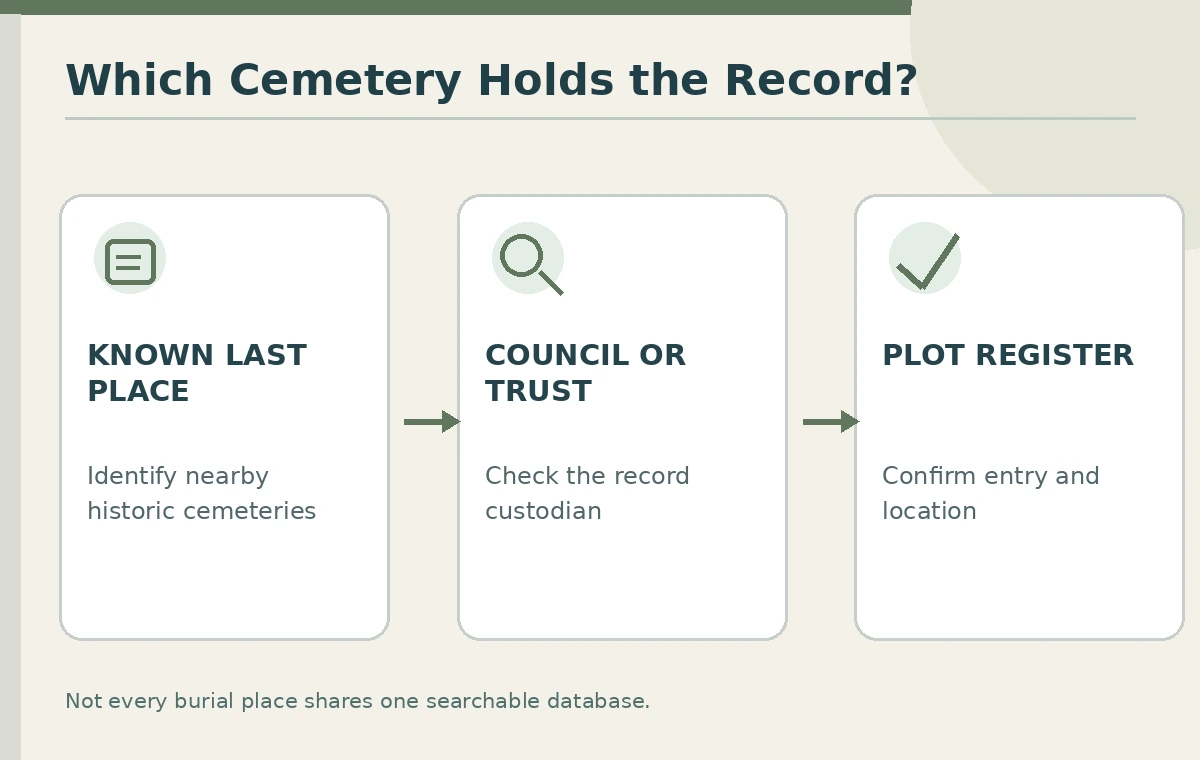
There is no single government cemetery database that proves every burial in New Zealand. Start with the council, trust or other authority that manages the cemetery where a person may have been buried. Search its burial or cremation register, then inspect any plot reference or map. Keep four facts apart: a reported death, an actual interment or cremation, a cemetery plot and a memorial inscription. Each may be supported by a different document, and a missing online entry may reflect historical gaps or a cemetery maintained outside the council’s database.
Choose the cemetery authority before searching names
Begin with the person’s last documented New Zealand locality, likely date of death and the cemetery named in a notice or family paper. Determine whether the site is administered by a city or district council, a cemetery trust, a church or another manager. A modern council boundary does not prove the older administrator held the records. The Auckland Council search offers name, year-of-death range and region options, while other districts have different coverage and fields. A search across all Auckland regions is not a nationwide search. Write the name of the database and the specific cemeteries it claims to include in your log.
Use both a text search and a mapped plot search when offered
Gisborne District Council provides text and map search options for named cemeteries, including Taruheru, Makaraka and several smaller sites. A name search may locate a burial entry; a map can help identify the position of the listed plot. Neither result proves there is an upright, readable headstone today. Record cemetery name, section or block, plot number, burial date and any linked interment or cremation reference. Where an interactive map exists, use the plot identifier printed by the provider rather than estimating coordinates from a screenshot. A map pin and an entry should be checked for consistency before the family tree is updated.
Distinguish a burial, a cremation and a memorial
A burial register reports an interment; a cremation register reports a different service or disposition; a monument can commemorate someone whose remains are elsewhere. A cemetery plot may contain multiple interments, and the lot owner may not be buried there. When an online database displays a headstone transcription, mark it as memorial wording rather than the official date of registration of death. A blank grave image does not erase a burial-register entry. For cremated remains, ask whether ashes were interred, scattered, retained or commemorated: the online record may establish only the cremation. Never use a shared grave or family memorial as sole proof of biological kinship.
Account for incomplete historic council records
Gisborne District Council openly cautions that some historical records may be incomplete or inaccurate and says its earliest Makaraka data go back to 1877. That does not make 1877 a national starting year; each cemetery has its own history. Older paper registers can be damaged, partly digitized, transcribed unevenly or kept by a predecessor council. If a database result is missing, test variant names and dates, read the provider’s scope and contact the relevant authority about non-digitized burial or cremation records. Note whether the absence is due to an unsearched cemetery, an unavailable date range, a missing name index or a demonstrably negative manual search. For a related choice, see our guide “Taruheru Cemetery Records”.

| Record | Best-supported claim | Common mistake |
|---|---|---|
| Council burial register | Recorded interment | Treating it as exact death registration |
| Cremation register | Cremation took place | Assuming remains are in a cemetery plot |
| Plot map | Mapped grave or lot | Assuming a headstone or kinship |
| Inscription index | Text on a memorial | Assuming buried person or verified age |
Cross-check the cemetery identity with an independent death source
A plot listing for James Smith is a candidate, not a proof that he is the same James Smith in your family tree. Compare death notices, ages, last addresses, funeral directors, spouses and children named elsewhere. Search the official New Zealand historical BDM index, within its access rules, for a compatible death registration and record the registration detail separately. An obituary can suggest a cemetery or funeral home, but may contain a planned rather than completed ceremony. Preserve discrepancies: a notice dated Monday and a burial dated Thursday do not conflict if they describe distinct events. A death registration and interment are not required to occur in the same district. For the next step, our guide “Auckland Libraries Family History” explains how to use Kura, local newspapers, and Archives.
Use National Library cemetery indexes for the gaps
The National Library of New Zealand reports holding NZ Society of Genealogists cemetery microfiche indexes, cemetery location information, headstone transcriptions and funeral-home collections. These can help when a council has no searchable historical return. The Library also explains that an indexed collection digitized elsewhere can sometimes be browsed by cemetery rather than by person. Record whether a hit is from a monument transcription, an original cemetery administration register or a funeral director record. Each has a different informant and function. Ask what original source lies behind a secondary name database before treating the search result as a primary burial record.

Create a plot-to-person evidence chain
For each candidate create four cells: person identity, cemetery administration entry, mapped burial location and independent death evidence. Copy the official burial date and location exactly; never convert a grave’s plot number into an invented GPS location. If a council record names a funeral director, that is a lead for a separate source rather than proof of every personal detail. Cite the managing authority, search title, entry identifier, cemetery, plot reference and date viewed. State which claim is supported: burial verified, plot located, marker transcribed, or only a name candidate. This evidence chain makes the result useful even when there is no photograph of a headstone. A similar decision comes up in our guide “Western Australia Cemetery Records”, which explains how to find original funeral applications.
How We Research New Zealand Burial Evidence
Our research for this guide compared the dated and jurisdiction-specific statements on www.aucklandcouncil.govt.nz, www.gdc.govt.nz. We treated source descriptions, access conditions and missing-return notes as separate claims, cross-checked terminology against the original collection guide, and wrote visual steps only for information those sources support. All examples describe hypothetical comparison methods, not identified historical people. Recheck the linked institution before ordering a record or interpreting a changed access rule.
More Records and Archives Guides
Record Sources, Access Boundaries, and Disclosure
Primary source guides used here: Auckland Council official burial and cremation database search options.; Gisborne District Council burial database, maps, cemetery scope and historic error caution.; National Library of New Zealand cemetery microfiche, NZSG collections and funeral-home records.. These links are informational references, not paid placements. This article makes no claim of a paid archival partnership; see our affiliate disclosure. If an archive limits access, never circumvent the rule or publish identifying details about a living person.
No. Council, trust, church, library and genealogy-society collections cover different cemeteries and dates.
Not necessarily. The burial location and death location can differ and need separate sources.
Yes. A cremation record may exist without a corresponding interment or memorial plot.
Use the managing council or cemetery administrator’s official record and map when available, then check that both identify the same entry.
Check cemetery coverage, spelling, dates and other authorities; ask about undigitized registers before concluding there was no burial.