
The 1861 New Brunswick census can name people within families and give occupation, birthplace, religion, education and counts of births, deaths or marriages in the preceding year. It is not a complete surviving province-wide set. Library and Archives Canada dates the New Brunswick enumeration to August 15, 1861 and publishes a district-by-parish list that explicitly labels missing returns. Start with the historical county and parish, check whether that return survives, and use the corresponding microfilm reference before treating a name-search failure as meaningful.
Fix the 1861 parish before running a name search
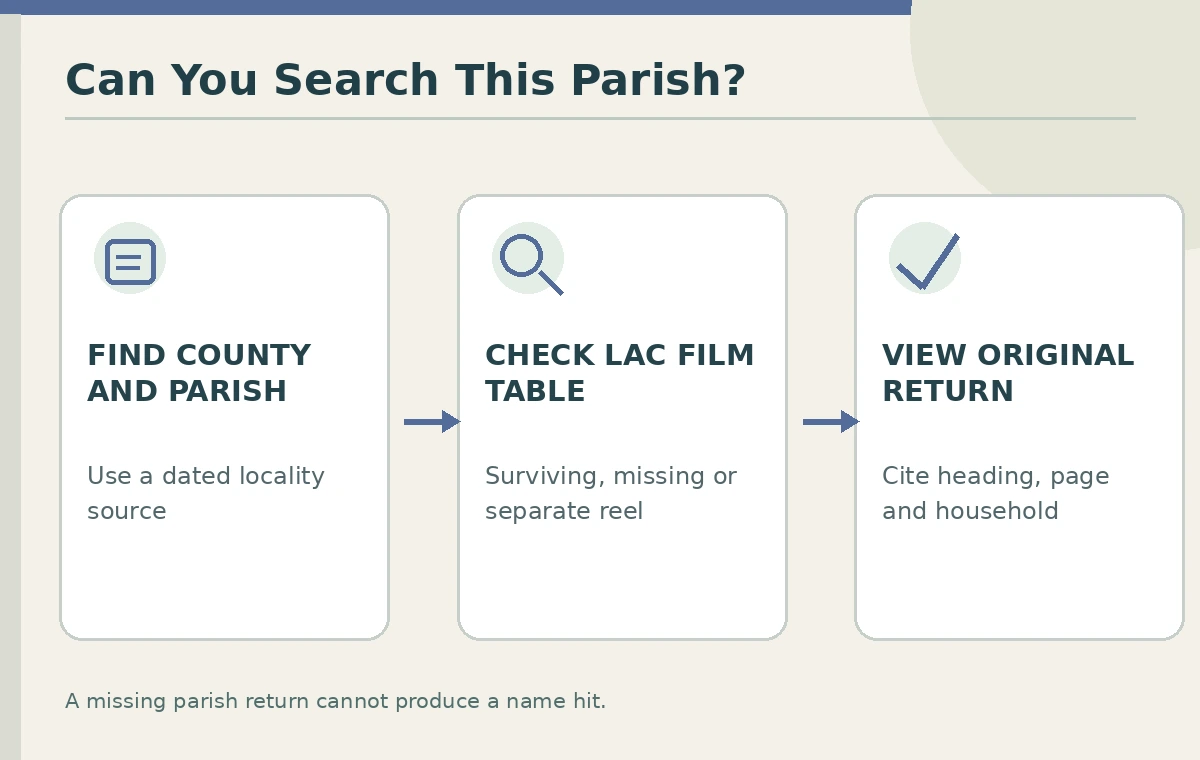
New Brunswick’s nineteenth-century parishes are administrative localities, not necessarily the religious congregations that held baptisms. Identify the likely county and civil parish from a dated land, marriage, tax, obituary or later census record. Write both the historical jurisdiction and modern locality if they differ. Check the LAC 1861 district and subdistrict table for the parish name and film identifier before searching a surname. When a settlement bordered two parishes, investigate both rather than assuming modern map boundaries. A blank index in an unfilmed or missing parish tells you little about the family’s actual whereabouts.
Use the official survival table to avoid impossible searches
The LAC parish inventory marks several areas Missing, including Coverdale in Albert County and Lepreau and Pennfield in Charlotte County. It also notes gaps for multiple Saint John wards; some other parishes point to provincial microfilm not included in the LAC name database. This distinction matters: lost manuscripts cannot be recovered by trying a second commercial index, while a reel available outside the current database may require a different custodian or browsing route. Copy the county, parish, status and reel number into a coverage ledger. Mark each location as surviving online, held on another film, marked missing, or not yet checked—never label all four situations simply no record.
Understand what the sixteen population columns describe
In its 1861 guide, LAC lists 16 New Brunswick population fields. They include number, inhabitants’ names, sex, relationship to family head, age, race and birthplace, rank or occupation, religion, children at school, health-related historical categories, and columns for births, deaths and marriages in the previous year. These are the recorded classifications of a nineteenth-century enumerator; offensive or inaccurate historical labels must not be adopted as a modern judgment about a person. Read the original headings and page context before interpreting a numeral. A reported birth in the previous year does not identify a specific newborn unless additional fields or records connect it.
Separate annual event tallies from civil certificates
New Brunswick’s extra columns for births, deaths and marriages in the preceding year are especially tempting as genealogical shortcuts. A household mark can suggest an event worth searching for, but it does not automatically provide the name, precise date, parents or legal status of the event. Treat the mark as reported household information, not the same thing as a baptismal entry or marriage register. Identify the likely denomination and settlement before locating contemporary church records. Where a household had two adults of similar ages, the relationship field can guide a hypothesis, but it is not independent proof of biological parentage. Support each extracted event claim with a second source rather than writing a fully specified birth or death from a count.

| Parish or location | LAC survival detail | Proper next move |
|---|---|---|
| Coverdale, Albert County | Listed Missing | Use independent locality records |
| Alma, Albert County | Microfilm C-999 | Browse and cite original page |
| St. Martins, Saint John | Provincial reel M-557; not in LAC database | Check alternative film custody |
| Lepreau, Charlotte County | Listed Missing | Do not infer family absence |
Read adjacent pages, family numbers and film context
A name index may omit neighboring occupants and confuse variant surnames, especially where writing is poor. Browse before and after the alleged household and transcribe the parish heading, page numbers, the relationship column and every person grouped under the head. If a film covers multiple parishes, verify the point at which the district changes instead of attaching an entry to the wrong place. Record as written the enumerator’s birthplace and occupation labels; do not silently normalize them to modern counties or professions. Use matching ages and nearby households to distinguish two same-name individuals. The 1861 family grouping reports co-enumeration, which supports a household hypothesis but does not by itself prove kinship.
Build a fallback for a missing civil parish
If LAC explicitly lists a parish as missing, switch from index retries to contemporary substitute sources: assessment rolls, land grants or deeds, church registers, newspapers, and surviving neighboring parish records where residence could overlap. A later 1871 federal census may show some of the same people, but it does not retroactively prove where they lived ten years earlier. Record the archival loss in your research log and explain how it limits a conclusion. A person could be absent from a surviving page because of travel, enumerator error, migration or a spelling issue; where the entire local schedule is missing, absence has no individual evidentiary weight at all.

Leave a citation trail anchored to the page and microfilm
A strong citation names the 1861 Census of New Brunswick, county, parish or subdistrict, page, household and the reel identifier shown by LAC. Also cite the holding institution and the date the image was consulted. Put any separate church or land source on a different line of your evidence matrix. If multiple claims rest on one page, say exactly which line or heading establishes each. An indexed name, a reconstructed residence from a map and a directly transcribed occupation should not all be reported with the same level of certainty. The final product should be a documented identity comparison and a next-record decision, not a family tree built solely from surname coincidences.
How We Research New Brunswick Census Survival
Our research for this guide compared the dated and jurisdiction-specific statements on www.canada.ca, www.canada.ca. We treated source descriptions, access conditions and missing-return notes as separate claims, cross-checked terminology against the original collection guide, and wrote visual steps only for information those sources support. All examples describe hypothetical comparison methods, not identified historical people. Recheck the linked institution before ordering a record or interpreting a changed access rule.
More Records and Archives Guides
Record Sources, Access Boundaries, and Disclosure
Primary source guides used here: LAC province enumeration date, 1861 New Brunswick schedules and fields.; LAC exact parish, subdistrict, missing returns and microfilm routing.; LAC treatment of incomplete pre-Confederation censuses and census methodology.. These links are informational references, not paid placements. This article makes no claim of a paid archival partnership; see our affiliate disclosure. If an archive limits access, never circumvent the rule or publish identifying details about a living person.
Library and Archives Canada gives August 15, 1861 as the provincial enumeration date.
The 1861 New Brunswick population schedule includes names of inhabitants and relationship fields, not just head-of-household counts.
LAC marks those specific parish returns missing; repeating a database name search cannot restore a lost schedule.
Not necessarily. The previous-year fields are census reports and require separate records to identify and date events precisely.
Include province, county, parish, page or household, microfilm or image reference, archive, and the original entry consulted.