
The 1861 England and Wales census records where people were enumerated on the night of April 7, 1861. Search a known household or locality, then inspect the original enumerator-book image in The National Archives series RG 9. An online result is a lead, not the whole record: a household must be checked against its page, neighborhood and independent evidence before names are attached to a family tree. The 1861 schedule can report each person’s age, marital status, occupation, relationship to the head and stated birthplace, but these facts were reported, copied and sometimes misunderstood.
Locate the April 1861 census in RG 9 rather than a later census series
The National Archives assigns the 1861 census to RG 9. This matters when a family appears on several similarly formatted nineteenth-century returns: HO 107 is not an 1861 reference, and RG 10 belongs to 1871. Record the census year, county, registration district, subdistrict and enumeration district before citing a person. A database may display the place of enumeration as a modern administrative unit; the book heading preserves the historic district. If you know an address from a marriage or trade directory, begin in that locality rather than treating every search hit across England as equally plausible. To go further, our guide “1881 England and Wales Census” shows how to verify RG 11 families and occupations.
An enumerator’s book is generally the surviving route to the return, since individual household schedules were gathered and transcribed. Where handwriting is cramped or two households continue across a page turn, the adjacent images matter as much as the single indexed row. Pay attention to the slash or dwelling divisions used by the enumerator. Institutions, boarders and visiting relatives can appear outside the family unit you expected. The census shows presence at a specific enumeration moment, not permanent residence or legal ownership of the premises. Our guide “1851 England and Wales Census” covers how to find HO 107 households and birthplaces.
Search names and addresses, then browse the neighboring RG 9 folios
Begin with a dated independent clue, perhaps a child’s baptism, a marriage certificate or a known trade. Search the person’s surname with a modest age range and the nearest plausible parish. If the index is silent, expand to spelling variants, a first name and the residence, then to household associates. Transcribers can mistake a capital letter, confuse a numeral with another digit, or silently modernize a locality. Never let a database estimate of birth year override the actual age recorded on the page.
Open the image and transcribe each household member, address and occupation. Capture the RG 9 piece number plus folio and page, not only the provider’s record ID. If a household begins before the visible image, browse backward; if it continues, browse forward. District descriptions can identify routes through villages and streets when an index cannot locate the expected family. Keep negative searches in a log: an unsuccessful surname query is not proof the person was absent, especially if the district can still be inspected.

Interpret birthplace and relationship entries as reports to test
The reported birthplace often narrows a search from a whole county to a parish or town, although spelling and geography can be approximate. Transcribe the place exactly before normalizing a modern name in a separate field. A birthplace of “Somerset” is not sufficient evidence for one particular village baptism. An age written as 24 places the birth only approximately; birthdays relative to census night and reporting mistakes complicate a precise year. An occupation can reinforce a candidate identity, but a common trade rarely distinguishes two men with the same name.
A relationship such as son, visitor, servant or lodger is expressed relative to the household head. It can be accurate without establishing biological descent, and stepfamily or foster arrangements may not be disclosed. Record the marital condition as stated without supplying an absent spouse. Historical classifications used in a disability column should be quoted only when relevant, with respectful contextual interpretation. Compare suspected family links with the civil registration, parish baptism or marriage evidence created for the relevant event.
| Evidence step | What to record | What it cannot establish |
|---|---|---|
| START LOCAL | Find a dated town or street clue | A name alone establishes identity |
| AGE RANGE | Allow birthdays and reporting errors | The index replaces a source image |
| DECISION | Do not merge without a link | An uncertain link is proven |
Test the household against the 1851 and 1871 observations
Construct a two-way comparison: the 1851 household may reveal a childhood home and the 1871 household may show a new address or different occupation. Carry forward the exact surnames and birthplaces as transcribed, marking a possible marriage or a name change as a hypothesis. If two equally named households occur nearby, use spouses, occupations, neighbors and children’s independent baptism entries to distinguish them. Census consistency is valuable, but information may have been repeated from the same family informant rather than independently verified. If that is your next decision, our guide “1871 England and Wales Census” explains how to verify households, birthplaces, and RG 10 references.
A useful worksheet has four columns: 1861 statement, candidate independent source, agreement or conflict, and next action. For example, an RG 9 “birthplace” entry can prompt a search for a baptism in an identified parish; it does not itself prove that baptism occurred. Compare address evidence in contemporaneous directories, keeping directory publication dates separate from census night. Preserve discrepancies instead of quietly changing an entry to make a family tree look seamless.

Resolve a fictional same-name case with a piece-and-page audit
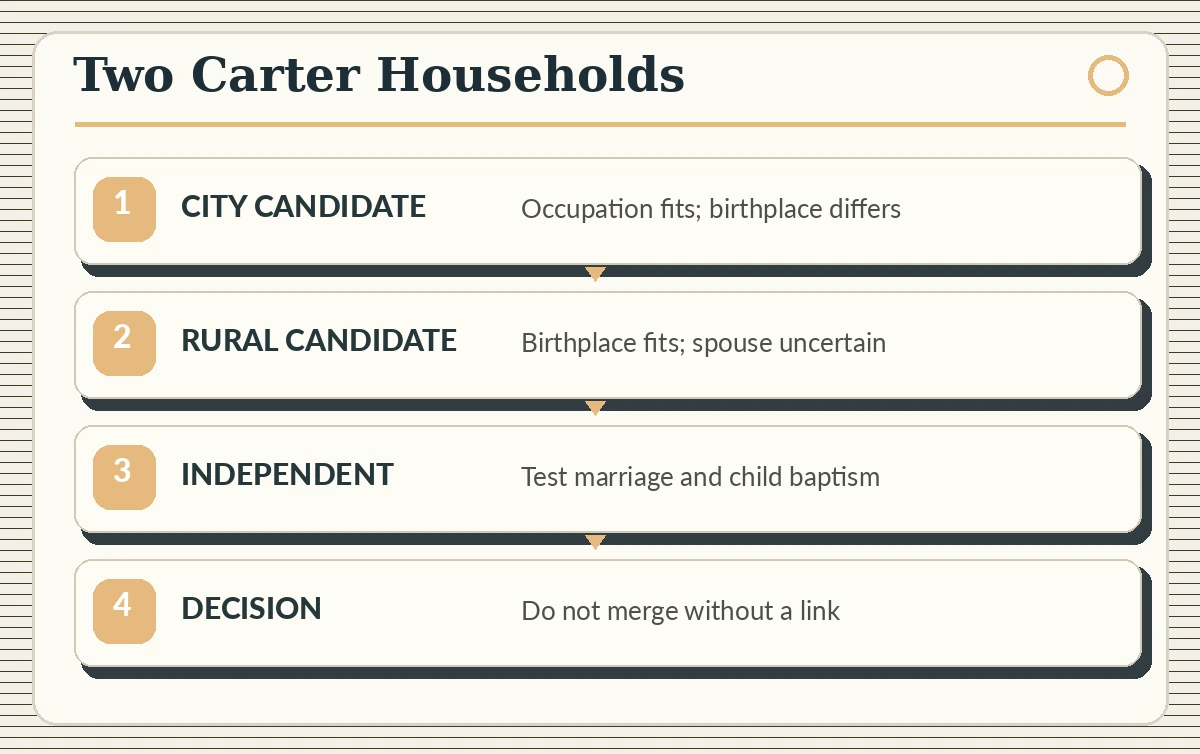
Suppose a fictional Elizabeth Carter, about 35, is associated by a marriage record with a Lancashire town. An index offers an Elizabeth Carter of the right age in Manchester and another in a rural district. Before selecting one, copy both RG 9 piece, folio and page references and read the full households. The Manchester candidate may have an expected occupation but an unexpected birthplace, while the rural candidate has the right birthplace but no familiar associates. Neither isolated match proves identity. Our guide “1851 England and Wales Census” covers how to read HO 107 birthplaces and households.
Obtain the original marriage record and a known child’s baptism, then compare spouse, witnesses, exact places and the 1871 continuation of each candidate household. Note which evidence was created independently and whether alternative explanations remain. If nothing resolves the conflict, keep two separate candidate profiles and a planned search for a further parish or residence record. Your result should be a traceable decision, not merely a name chosen because the search engine ranked it first. Our guide “Norway 1900 Census” covers a related question.
How We Research 1861 England Census
We checked The National Archives census guide for the exact date, RG 9 series, survival of enumerator books and the full-reference requirement; FamilySearch supplies a collection-level cross-check of fields and image indexing. Elizabeth Carter is a fictional teaching case. Our identity gate requires a full image citation and an independent event record before parentage is inferred.
More Records and Archives Guides
Official archival research sources for 1861 england census
The National Archives: date of 1861 enumeration, RG 9, district arrangement, and source limitations (www.nationalarchives.gov.uk).
FamilySearch: 1861 England and Wales collection description, historical fields and RG 9 example (www.familysearch.org).
Sheffield Archives: census-day dates and historical census access context (www.sheffield.gov.uk).
This guide provides historical research information, not legal, medical or investment advice. Archive coverage, costs and access may change. These links are editorial references, not paid recommendations; see the GenHis affiliate disclosure. Interpret outdated historical classifications in context and protect details about living people.
It records people for census night, April 7, 1861; that does not necessarily mean their permanent address.
RG 9. Record the piece, folio and page whenever possible, as well as the district.
No. Treat the birthplace as a lead to a separately documented birth or baptism.
Use the contemporary address or known locality to browse district descriptions and neighboring RG 9 images.
No. It describes a reported relationship to the head and needs corroboration from event records.