
The 1891 England and Wales census records residents on the night of April 5, 1891. Its surviving enumeration books are held by The National Archives as series RG 12. Unlike the 1881 return, the 1891 form adds a three-way employment classification; in Wales it also asks about language spoken. Those columns can distinguish namesakes, but they are reported snapshots, not employment contracts or proof of a person’s first language. Start with the actual image, its district header, and a precise RG 12 piece–folio–page reference.
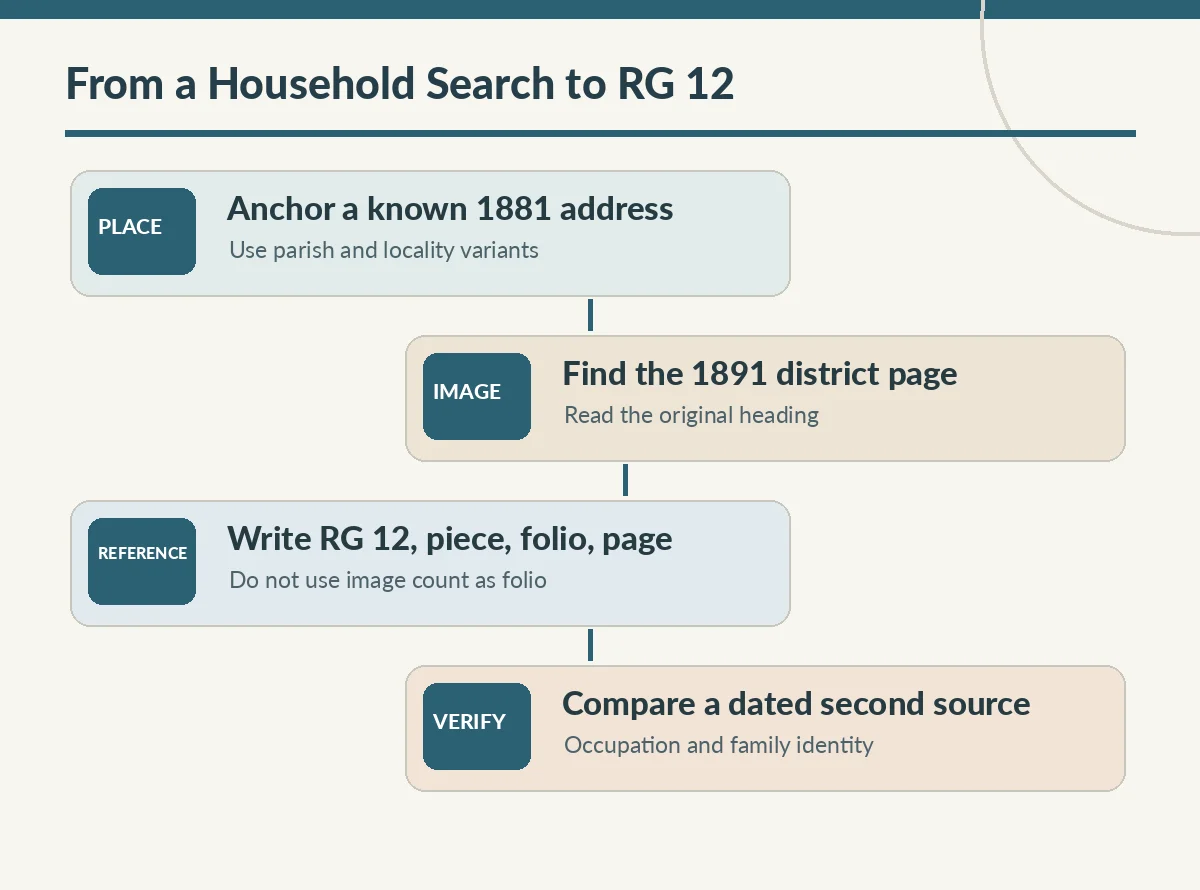
Find the correct 1891 enumeration district and RG 12 page
Start with a securely dated address, church event or 1881 household. Search by the household name and approximate age, but keep the locality flexible when a town has grown or boundaries shifted. The National Archives census research guide lists 1891 as RG 12 and explains that enumerators copied household information into books. Open the scanned return, not just an index card: record county, civil parish, registration district, street, house, page and enumerator’s district where shown.
Read the first page of the enumeration book for its district boundaries and streets. From 1891 these descriptions use separate boundary and street sections. An address may be missing or abbreviated in a rural hamlet; the schedule number to the left is not automatically a street number. A surname hit across the town could be a different family. If your target is not indexed, browse nearby image pages and search for a documented spouse or employer; describe what you examined rather than writing ‘absent from the census.’
Translate the three 1891 employment columns without inventing a job history
The 1891 schedule separates Employer, Employed, and Neither employer nor employed alongside the occupation. Read the original headings carefully: an X can move into the wrong category when rows are cropped or transcribed. A reported employer was not necessarily the legal owner of the workshop, and a person marked as neither may have worked intermittently or outside the usual classification. Copy the occupation and the X-column as two distinct observations.
For an imagined Thomas Evans, a tailor who appears as ’employed,’ test that description against trade directories, apprenticeship papers or a child’s later marriage entry naming the father’s occupation. Make separate rows for the census wording, a later occupational claim and your interpretation. An annual directory may have been compiled months before its printed year, so it is not a perfect second census. Do not assume an employer marker proves how many people worked for someone or that the business persisted beyond census night.

| 1891 form entry | What it reports | What still needs proof |
|---|---|---|
| Employer | Enumerated work classification | Business title or payroll |
| Employed | Enumerated work classification | Specific employer or contract |
| Neither | Not classed in either work column | Unemployment for an entire year |
Check the Welsh language field only where it actually existed
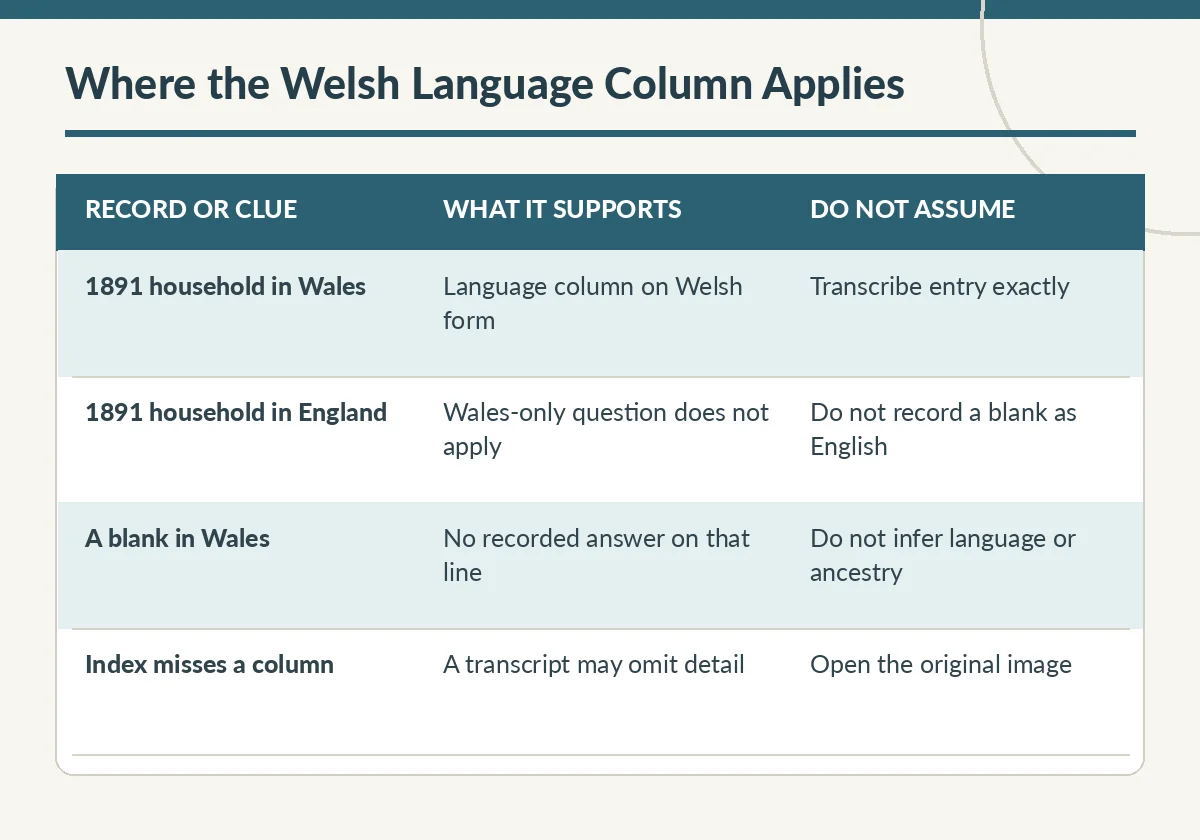
The National Archives identifies language spoken as a Wales-only addition in 1891. Do not apply that field to an English household, and do not confuse a blank entry with an answer of ‘English.’ The printed form and enumerator’s instructions determine whether the field existed for the place at all. On Welsh returns, transcribe exactly what was written rather than silently translating abbreviations or treating language preference as a nationality test.
A household may include speakers with different language answers. Compare the entry with schooling or later family testimony if your specific question concerns language use, but recognize that one respondent or enumerator may have supplied the answer. It does not establish ancestry, ethnic identity, fluency in every setting or the language learned in infancy. If an index omits the language column, seek the original image; the omission belongs to the index, not necessarily to the historical census.
Use rooms occupied and household marks as housing clues
The 1891 and 1901 returns note the number of rooms occupied when the dwelling had fewer than five rooms. A blank in that field may therefore have an entirely different meaning from a recorded 3. Note whether the printed heading applies to a room count and whether the room entry aligns with the family’s schedule. Numbered household schedules distinguish groups at an address; people listed on consecutive rows need not be relatives, and multiple families could occupy one building. Our guide “1881 England and Wales Census” shows how to verify RG 11 families and occupations.
Read the relationship-to-head column literally. Boarders, servants and lodgers may live at the address without kinship. A widow label is a reported marital condition on that night; it does not give a spouse’s death date. When a household extends over two pages, inspect both sides and capture the division mark. Match the housing evidence to rent, deed or municipal records only if the question is specifically about tenancy or ownership; a census occupant is not automatically a property owner. For the next step, our guide “1921 England and Wales Census” explains how to read RG 15 and employment clues.
Cite an 1891 return with piece, folio, and page
An RG 12 number identifies the archival series and the piece, but a piece contains many pages. Copy the folio and printed page from the scan, plus parish, address, and the person or household. Folio numbering is stamped on alternating page faces: one folio may cover both sides of a leaf. An online image counter is not the same as a stamped folio or original printed page. If a mark is illegible, indicate uncertainty rather than manufacturing digits.
Test the citation by trying to locate the same household using just the reference and locality. For difficult handwriting, keep the original word and your proposed expansion side by side; ‘RG 12/…’ from a provider citation should agree with the paper border. Where another provider describes the image differently, keep both retrieval references and identify which image was inspected. A citation’s purpose is to permit a second reader to independently find the same evidence.
Distinguish an 1891 absence from a loss of identification
A missing expected family may reflect travel, seasonal service, name variation, a different address, an institution, or a missed enumeration. Search for individual children in other households before inferring death or migration. Unlike modern household rosters, this is a one-night report. The 1891 series also includes special returns, and the Archives notes that there are no surviving Royal Navy foreign-water ship records for this census; a navy search has its own distinct coverage issue. For the fuller picture, see our guide “1901 England and Wales Census”.
Use an 1881–1891–1901 comparison with only independently observed columns. Highlight changes of birthplace detail, occupation classification and residence; do not make an apparent birth-year discrepancy disappear. A person’s age may be misreported by a household informant. If two Evans households still fit, retain both as unresolved, name the decisive certificate or parish event, and document why a third candidate was ruled out. This is stronger research than selecting the first indexed match. Our guide “1911 England and Wales Census” shows how to read household schedules and RG 78.
More Records and Archives Guides
How We Research the 1891 RG 12 Returns
We reviewed The National Archives’ census guidance for April 5, 1891, the RG 12 series, the 1891 employment and Wales-only language additions, enumerator-district references, and viewing limits. We built the employment and language charts as interpretation aids, not reconstructions of any real family. Thomas Evans is an illustrative example; no individual archival discovery is claimed. Our test is whether every chart caption can be checked against the actual field layout.
A current service may charge for viewing an image even when its name index is searchable without payment; local institutions may have alternate arrangements. This page neither endorses paid access nor assumes an affiliate relationship. See our affiliate disclosure. We prioritize the original document, its full citation and an independent event record before asserting a family relationship.
The National Archives identifies the returns as RG 12; preserve the piece, folio and page for a specific household.
The census night was April 5, 1891, which is a dated report of where people were recorded.
No. The language-spoken addition was for Wales, not the entire England and Wales enumeration.
No. It records the category used by the enumerator. Check deeds, directories or business records independently.
A piece includes many pages; add the folio, page and locality, plus the image provider or repository.